
[Paper Review] Learn to Accumulate Evidence from All Training Samples: Theory and Practice
This paper identifies a fundamental limitation in evidential deep learning: existing models fail to learn from training samples mapped to 'zero-evidence regions' due to non-negative evidence constraints, leading to suboptimal performance. To address this, the authors propose the Regularized Evidential Model (RED), which introduces a novel positive evidence regularization that enables models to learn from all training samples, significantly improving accuracy on challenging benchmarks like Cifar100 while maintaining uncertainty quantification capabilities.
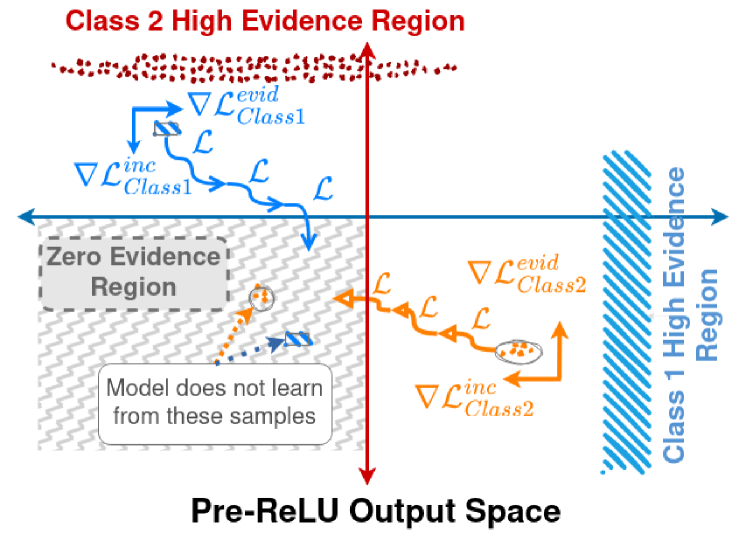
Evidential deep learning, built upon belief theory and subjective logic, offers a principled and computationally efficient way to turn a deterministic neural network uncertainty-aware. The resultant evidential models can quantify fine-grained uncertainty using the learned evidence. To ensure theoretically sound evidential models, the evidence needs to be non-negative, which requires special activation functions for model training and inference. This constraint often leads to inferior predictive performance compared to standard softmax models, making it challenging to extend them to many large-scale datasets. To unveil the real cause of this undesired behavior, we theoretically investigate evidential models and identify a fundamental limitation that explains the inferior performance: existing evidential activation functions create zero evidence regions, which prevent the model to learn from training samples falling into such regions. A deeper analysis of evidential activation functions based on our theoretical underpinning inspires the design of a novel regularizer that effectively alleviates this fundamental limitation. Extensive experiments over many challenging real-world datasets and settings confirm our theoretical findings and demonstrate the effectiveness of our proposed approach.
Motivation & Objective
- To investigate the root cause of poor predictive performance in evidential deep learning models on large-scale datasets.
- To identify the fundamental limitation that prevents evidential models from learning from samples in 'zero-evidence regions'.
- To design a regularization method that enables evidential models to effectively learn from all training samples, including those in zero-evidence regions.
- To empirically validate the theoretical findings across multiple real-world datasets and settings.
Proposed method
- Theoretical analysis reveals that evidential activation functions like ReLU create zero-evidence regions, preventing knowledge acquisition from samples in those regions.
- The authors derive a theoretical superiority of the exponential activation function over ReLU and SoftPlus in avoiding zero-evidence regions.
- A novel positive evidence regularization term is introduced into the training objective to penalize zero or near-zero evidence predictions.
- The regularization encourages the model to distribute evidence more evenly across all training samples, avoiding dead zones in the evidence space.
- The proposed Regularized Evidential Model (RED) integrates this regularization into standard evidential training with minimal architectural changes.
- Experiments compare RED against standard evidential models using different activation functions and loss functions across multiple datasets.
Experimental results
Research questions
- RQ1Why do evidential models underperform compared to standard softmax models on complex datasets like Cifar100?
- RQ2What is the fundamental structural limitation in existing evidential models that hinders learning from all training samples?
- RQ3How does the presence of 'zero-evidence regions' in the evidence space affect model generalization and uncertainty calibration?
- RQ4Can a regularization strategy effectively mitigate the learning deficiency caused by zero-evidence regions?
- RQ5Does the proposed RED model achieve superior predictive performance while preserving uncertainty quantification?
Key findings
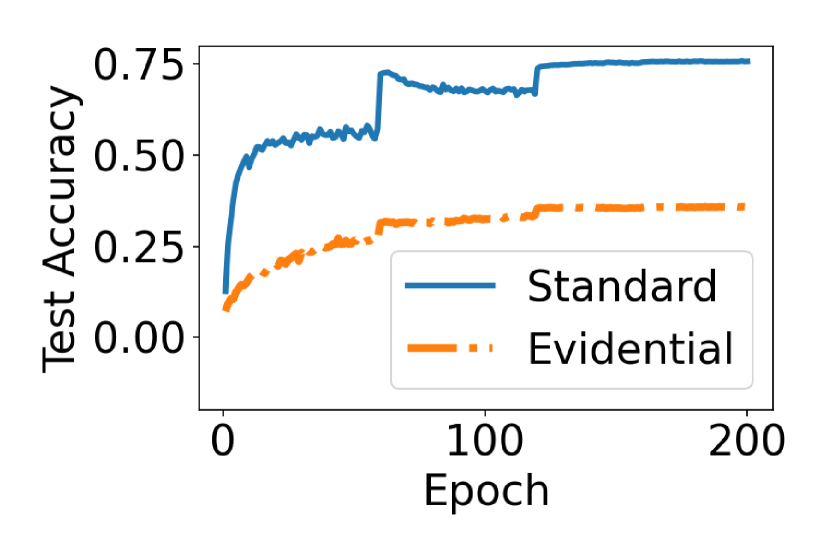
- The proposed RED model achieves 99.12% test accuracy on Cifar100 using the Evidential MSE loss, significantly outperforming the standard evidential model (36% accuracy) and approaching the performance of standard softmax models.
- With the optimal regularization hyperparameter, RED achieves 95.40% accuracy on Cifar10 using the Evidential CE loss, outperforming all baseline activation functions.
- On Cifar100, RED achieves 76.43% accuracy with the Evidential CE loss under optimal regularization, compared to 75.67% for the standard CE model, demonstrating competitive performance.
- The ablation study confirms that the regularization term effectively reduces the proportion of samples mapped to zero-evidence regions, improving model robustness.
- The model shows reduced sensitivity to hyperparameter tuning and maintains stable performance across different architectures and loss functions.
- Theoretical analysis confirms that the exponential activation function is superior in avoiding zero-evidence regions, aligning with empirical results.
Read this paper
Open the full text in the Nubint reader and ask about any passage as you read.
Read this paper on NubintThis review was generated by AI from the original paper. Please check the paper before citing it.