
[Paper Review] Learning by Reconstruction Produces Uninformative Features For Perception
This paper demonstrates that representation learning via reconstruction prioritizes high-variance, low-informative features for perception tasks, explaining why models require long training times and fine-tuning. It proves that masking noise is beneficial for learning perceptually useful features, while additive Gaussian noise is not, and identifies conditions under which noise strategies fail universally.
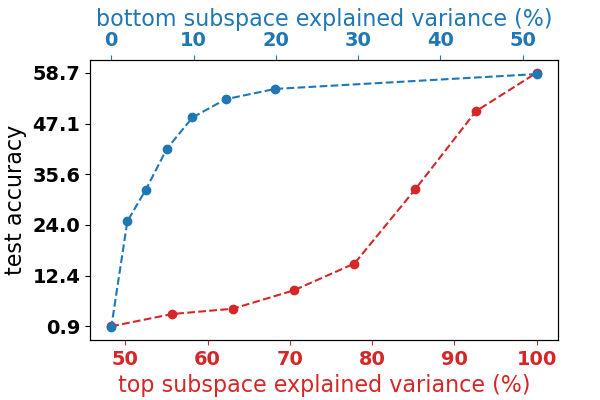
Input space reconstruction is an attractive representation learning paradigm. Despite interpretability of the reconstruction and generation, we identify a misalignment between learning by reconstruction, and learning for perception. We show that the former allocates a model's capacity towards a subspace of the data explaining the observed variance--a subspace with uninformative features for the latter. For example, the supervised TinyImagenet task with images projected onto the top subspace explaining 90\% of the pixel variance can be solved with 45\% test accuracy. Using the bottom subspace instead, accounting for only 20\% of the pixel variance, reaches 55\% test accuracy. The features for perception being learned last explains the need for long training time, e.g., with Masked Autoencoders. Learning by denoising is a popular strategy to alleviate that misalignment. We prove that while some noise strategies such as masking are indeed beneficial, others such as additive Gaussian noise are not. Yet, even in the case of masking, we find that the benefits vary as a function of the mask's shape, ratio, and the considered dataset. While tuning the noise strategy without knowledge of the perception task seems challenging, we provide first clues on how to detect if a noise strategy is never beneficial regardless of the perception task.
Motivation & Objective
- To investigate why reconstruction-based representation learning fails to produce effective features for perception tasks despite strong generative performance.
- To identify the root causes of misalignment between reconstruction capacity and perceptual utility in autoencoders.
- To evaluate the impact of different noise strategies—especially masking versus additive Gaussian noise—on learning perceptually relevant features.
- To provide theoretical and empirical criteria for detecting when a noise strategy is fundamentally ineffective for perception regardless of downstream task.
- To explain the long training times observed in models like Masked Autoencoders by analyzing feature learning order in latent space.
Proposed method
- Projects ImageNet data onto principal component subspaces (top 75% and bottom 25% variance) to evaluate downstream classification accuracy on ResNet9.
- Analyzes training dynamics of deep autoencoders by tracking loss evolution across eigenspaces, showing low-variance features are learned last.
- Derives theoretical conditions under which denoising autoencoders with different noise distributions minimize reconstruction error while maximizing perceptual utility.
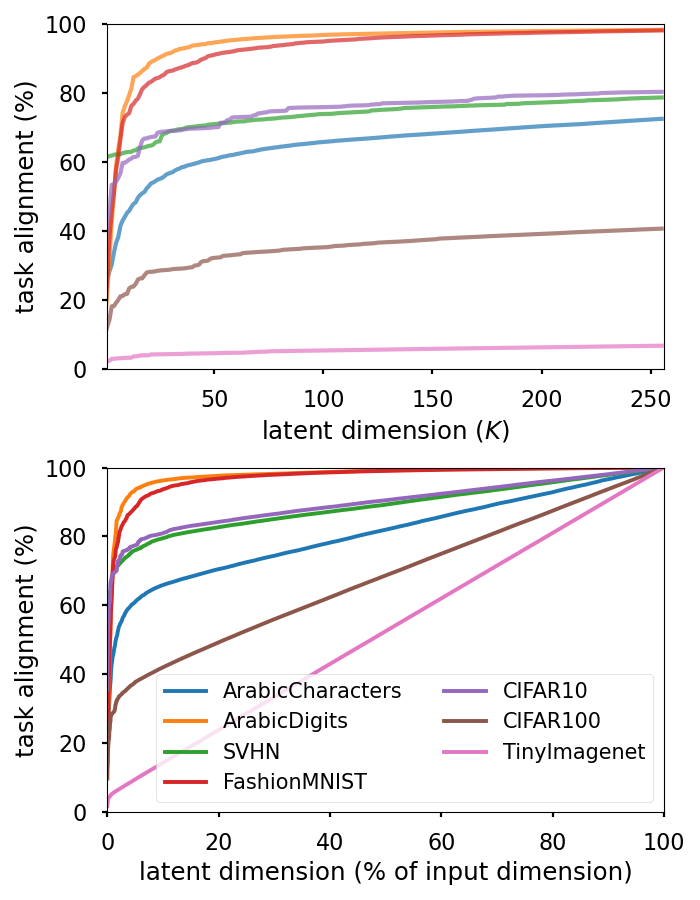
- Uses fast eigendecomposition and SVD-based alignment metrics to efficiently evaluate representation quality across latent dimensions.
- Empirically validates theoretical claims using gradient descent optimization and compares loss convergence across different noise types and hyperparameters.
- Introduces a sweep-based metric to assess alignment between reconstructed and original data across varying latent dimensions and noise types.
Experimental results
Research questions
- RQ1Why do reconstruction-based models like autoencoders fail to produce useful features for perception despite strong reconstruction quality?
- RQ2How does the variance of data subspaces relate to their utility for downstream perception tasks like image classification?
- RQ3Why do models trained with reconstruction require long training times and fine-tuning to achieve good performance on perception tasks?
- RQ4Under what conditions is a noise strategy (e.g., masking vs. Gaussian noise) provably beneficial or ineffective for learning perceptually useful features?
- RQ5Can we detect a priori whether a given noise strategy will never improve representation learning for perception, regardless of the downstream task?
Key findings
- Training a ResNet9 on images projected onto the top 75% of pixel variance (high-variance subspace) achieves only 45% top-1 accuracy on TinyImageNet, indicating poor perceptual utility.
- In contrast, projecting onto the bottom 25% of variance (low-variance subspace) yields 55% test accuracy, demonstrating that uninformative features for reconstruction are actually informative for perception.
- The features most useful for perception are learned last in autoencoders, as the top eigenspace (explaining most variance) is learned first, explaining the need for long training durations.
- Masking noise is provably beneficial for learning perceptually useful features, while additive Gaussian noise is not, due to its inability to disrupt high-variance components effectively.
- The performance gap between models with identical reconstruction error can be extreme—ranging from 50% to nearly 90% top-1 accuracy on ImageNet-10—highlighting the ill-posed nature of reconstruction-based learning.
- A noise strategy is never beneficial for perception if it fails to disrupt the high-variance subspace in a way that encourages learning of low-variance, perceptually relevant features, which can be detected via theoretical analysis of the noise distribution's spectral impact.
Read this paper
Open the full text in the Nubint reader and ask about any passage as you read.
Read this paper on NubintThis review was generated by AI from the original paper. Please check the paper before citing it.