
[Paper Review] Learning by Watching: A Review of Video-based Learning Approaches for Robot Manipulation
This survey reviews video-based learning approaches for robot manipulation, proposing that leveraging large-scale, uncurated online videos enables scalable, generalizable skill acquisition with reduced data bias and curation costs. By combining video representation learning, 3D human/body modeling, and causal reasoning, the approach improves sample efficiency and real-world transfer beyond traditional imitation learning and curated datasets.
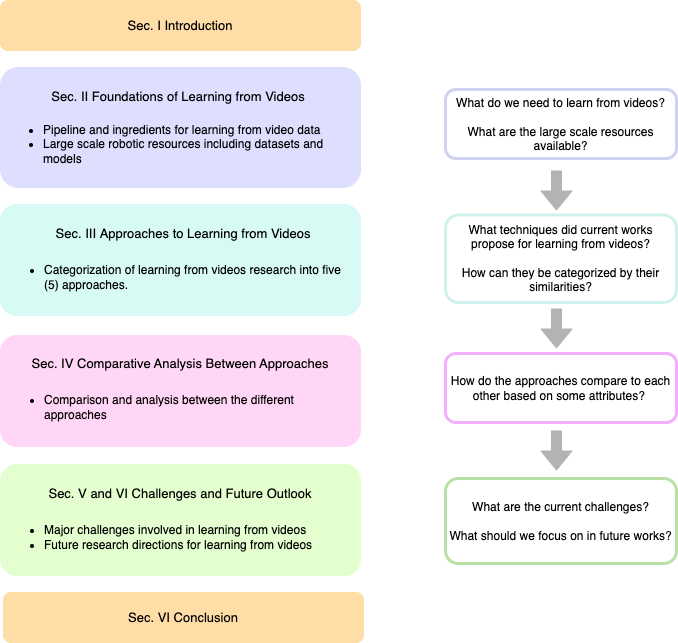
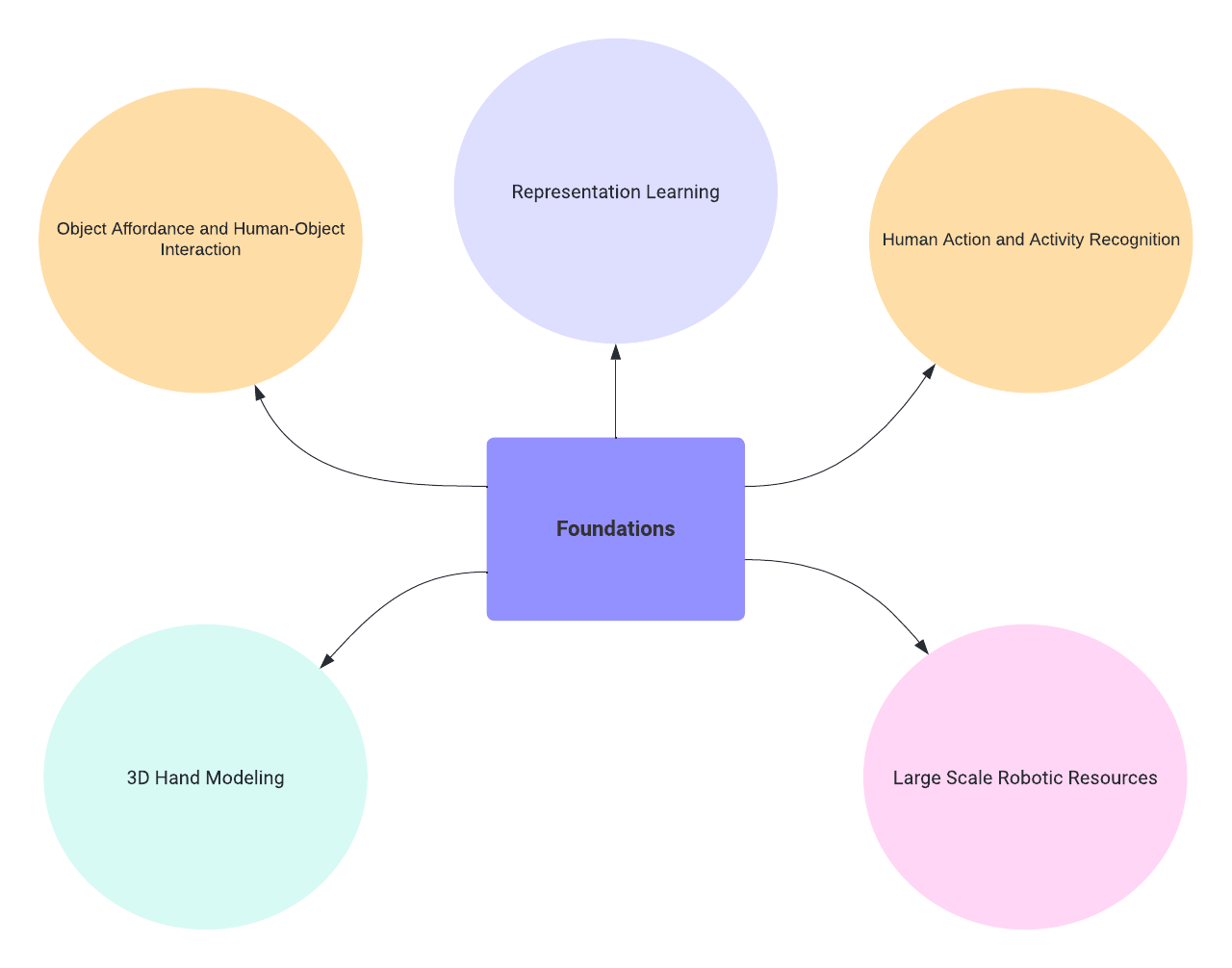
Robot learning of manipulation skills is hindered by the scarcity of diverse, unbiased datasets. While curated datasets can help, challenges remain in generalizability and real-world transfer. Meanwhile, large-scale "in-the-wild" video datasets have driven progress in computer vision through self-supervised techniques. Translating this to robotics, recent works have explored learning manipulation skills by passively watching abundant videos sourced online. Showing promising results, such video-based learning paradigms provide scalable supervision while reducing dataset bias. This survey reviews foundations such as video feature representation learning techniques, object affordance understanding, 3D hand/body modeling, and large-scale robot resources, as well as emerging techniques for acquiring robot manipulation skills from uncontrolled video demonstrations. We discuss how learning only from observing large-scale human videos can enhance generalization and sample efficiency for robotic manipulation. The survey summarizes video-based learning approaches, analyses their benefits over standard datasets, survey metrics, and benchmarks, and discusses open challenges and future directions in this nascent domain at the intersection of computer vision, natural language processing, and robot learning.
Motivation & Objective
- To address the scarcity of diverse, unbiased, and scalable datasets in robot manipulation learning.
- To explore how uncurated, in-the-wild video data from sources like YouTube can serve as a scalable supervision signal for learning manipulation skills.
- To analyze the benefits of video-based learning over traditional curated datasets in terms of generalization, sample efficiency, and reduced bias.
- To identify foundational components—such as video feature learning, object affordance understanding, and 3D hand/body modeling—that enable effective video-based policy learning.
- To highlight open challenges in dynamics modeling, long-horizon understanding, evaluation benchmarks, and sim-to-real transfer in video-based robot learning.
Proposed method
- Utilizes self-supervised video representation learning techniques to extract meaningful spatiotemporal features from uncurated video data.
- Integrates 3D human and hand pose estimation to model human actions and object interactions from video demonstrations.
- Applies multimodal transformers and graph neural networks to learn joint representations of vision, language, and action sequences in video data.
- Incorporates causal reasoning through intuitive physics modeling and object affordance understanding to improve generalization beyond pattern recognition.
- Combines end-to-end and modular learning frameworks using imitation learning and reinforcement learning on video-derived supervision.
- Leverages large-scale robotic datasets like RoboNet and RLBench as foundational resources to evaluate and benchmark video-based learning pipelines.
Experimental results
Research questions
- RQ1How can uncurated, in-the-wild video data be effectively leveraged to train generalizable manipulation policies in robotics?
- RQ2What are the key components—such as video feature learning, 3D human modeling, and causal reasoning—that enable robust video-based policy learning?
- RQ3How does video-based learning compare to traditional imitation learning and curated dataset approaches in terms of sample efficiency, generalization, and bias reduction?
- RQ4What are the major challenges in modeling long-horizon manipulation tasks and dynamics from video observations alone?
- RQ5How can standardized evaluation metrics and benchmarks be developed to fairly compare video-based learning methods across different robotic platforms and environments?
Key findings
- Video-based learning enables scalable supervision from abundant online videos, significantly reducing the cost and bias associated with curated human-annotated datasets.
- Approaches combining video representation learning with 3D human and hand pose modeling show improved generalization to unseen environments and actions.
- Incorporating causal reasoning—such as intuitive physics and object affordance understanding—enhances policy robustness and generalization beyond mere pattern imitation.
- Current methods still struggle with long-horizon manipulation tasks and accurate dynamics modeling from limited video observations, indicating a key open challenge.
- The lack of standardized evaluation benchmarks and metrics hinders fair comparison across methods, with existing evaluations often limited to single domains or platforms.
- Sim-to-real transfer remains a significant challenge, though interactive and active learning can help bridge the domain gap in video-based policy learning.
Read this paper
Open the full text in the Nubint reader and ask about any passage as you read.
Read this paper on NubintThis review was generated by AI from the original paper. Please check the paper before citing it.