
[Paper Review] Learning Conditional Attributes for Compositional Zero-Shot Learning
This paper proposes a Conditional Attribute Network (CANet) for compositional zero-shot learning that learns attribute embeddings conditioned on both the recognized object and input image, addressing attribute diversity across different objects. By introducing an attribute hyper learner and base learner, CANet generates flexible, context-aware attribute representations, achieving state-of-the-art performance on CZSL benchmarks including C-GQA.
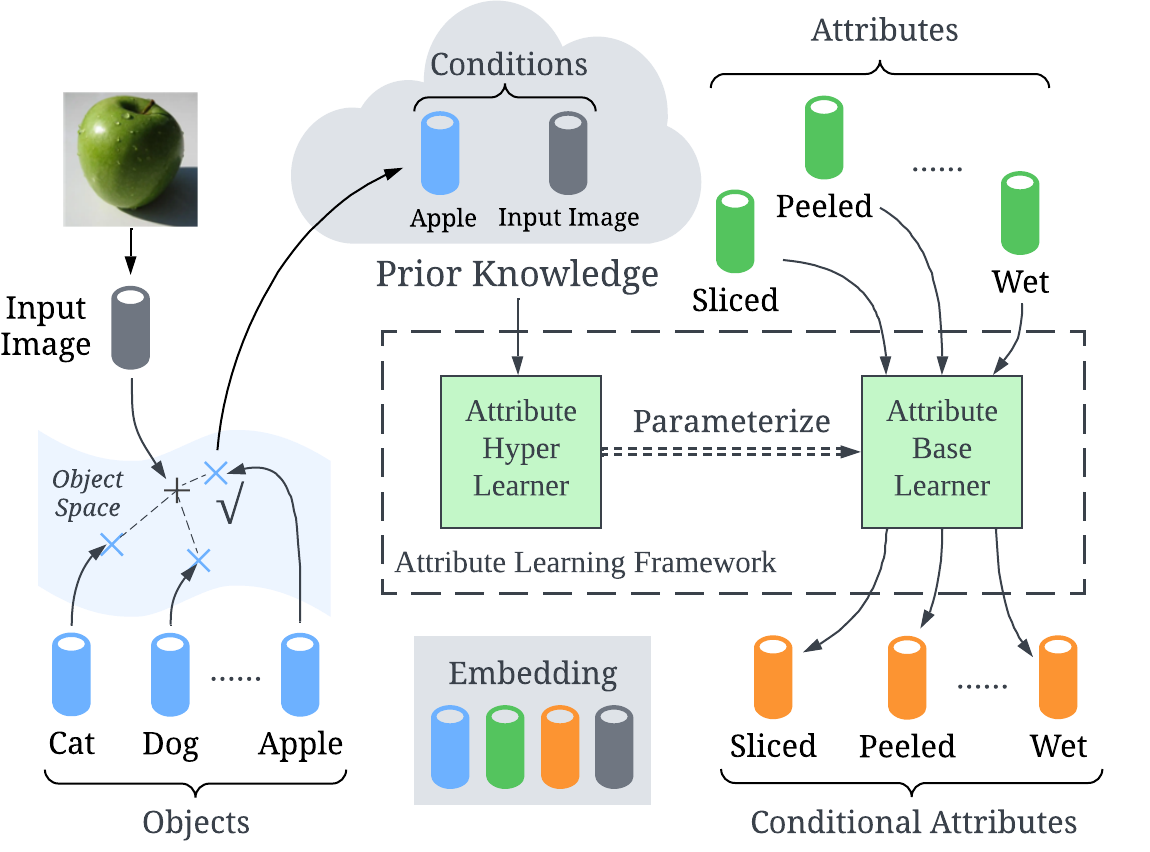
Compositional Zero-Shot Learning (CZSL) aims to train models to recognize novel compositional concepts based on learned concepts such as attribute-object combinations. One of the challenges is to model attributes interacted with different objects, e.g., the attribute ``wet" in ``wet apple" and ``wet cat" is different. As a solution, we provide analysis and argue that attributes are conditioned on the recognized object and input image and explore learning conditional attribute embeddings by a proposed attribute learning framework containing an attribute hyper learner and an attribute base learner. By encoding conditional attributes, our model enables to generate flexible attribute embeddings for generalization from seen to unseen compositions. Experiments on CZSL benchmarks, including the more challenging C-GQA dataset, demonstrate better performances compared with other state-of-the-art approaches and validate the importance of learning conditional attributes. Code is available at https://github.com/wqshmzh/CANet-CZSL
Motivation & Objective
- To address the challenge of attribute diversity in compositional zero-shot learning, where the same attribute (e.g., 'wet') appears differently when combined with different objects (e.g., 'wet apple' vs. 'wet cat').
- To model the contextuality between attributes and objects by conditioning attribute representations on both the recognized object and input image features.
- To improve generalization to unseen attribute-object compositions by learning dynamic, context-dependent attribute embeddings rather than static, object-agnostic representations.
- To validate the effectiveness of conditional attribute learning through extensive experiments and ablation studies on standard CZSL benchmarks, including C-GQA.
Proposed method
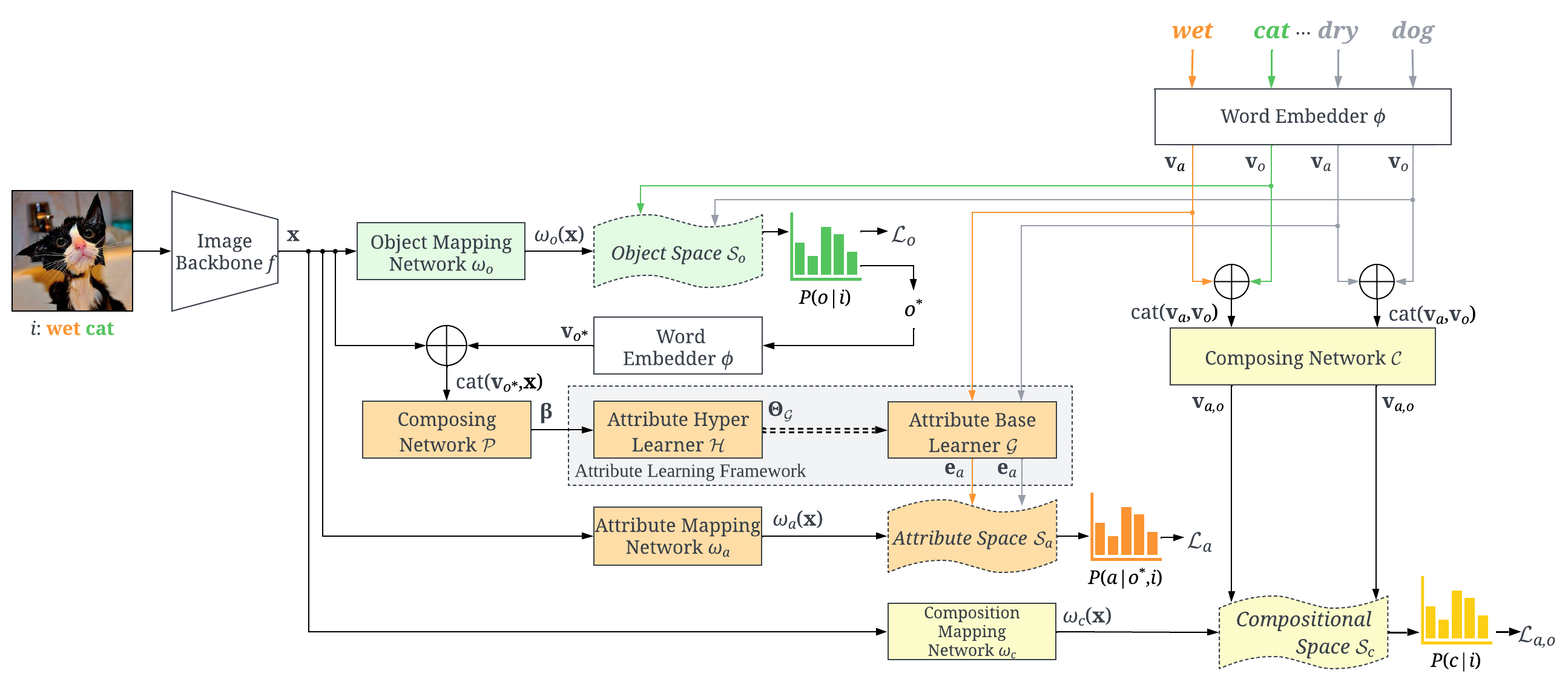
- The method decomposes the joint probability of attribute and object recognition into components conditioned on the input image, object embedding, and visual features, justifying the need for conditional attribute learning.
- An attribute hyper learner is introduced to generate parameters for the attribute base learner based on prior knowledge from the recognized object and input image visual embedding.
- The attribute base learner uses the hypernetwork output to transform fixed attribute word embeddings into conditional attribute embeddings tailored to the current object and image context.
- Conditional attribute embeddings are used to compute classification logits via cosine similarity between the input image embedding and all conditional attribute embeddings.
- The model also composites attribute and object word embeddings and uses cosine similarity with projected image features to predict compositions, enhancing context-aware classification.
- A weighted loss function combines attribute, object, and composition classification heads, with hyperparameter α balancing the contributions of each component.
Experimental results
Research questions
- RQ1Can modeling attributes as conditional on both the recognized object and input image improve generalization in compositional zero-shot learning?
- RQ2How does the conditional attribute learning framework compare to conventional, static attribute embedding methods in terms of zero-shot generalization performance?
- RQ3What is the impact of incorporating image visual features into the attribute hypernetwork on model generalization and robustness?
- RQ4How do different components of the proposed framework (e.g., hypernetwork, base learner, composite embeddings) contribute to performance on seen and unseen compositions?
- RQ5What optimal trade-off between attribute, object, and composition classification is achieved through the weighting factor α in the loss function?
Key findings
- CANet achieves state-of-the-art performance on the C-GQA benchmark, demonstrating superior generalization to unseen attribute-object compositions compared to existing methods.
- Ablation studies show that removing the attribute hyper learner or image visual embedding from the conditioning significantly degrades performance, confirming the importance of context-aware attribute learning.
- The optimal weighting factor α in the loss function is found to be 0.5 on UT-Zappos50K, 0.1 on MIT-States, and 0.3 on C-GQA, indicating that modeling contextuality between attributes and objects is more beneficial than separate classification.
- The model shows improved generalization on unseen compositions when using conditional attribute embeddings, with the highest unseen accuracy achieved when α is set to the optimal value for each dataset.
- The ablation of variants (3)–(6) confirms that the full framework with all components (G, H, P, and x in β) is essential for optimal performance, especially in handling complex, long-tailed attribute distributions.
Read this paper
Open the full text in the Nubint reader and ask about any passage as you read.
Read this paper on NubintThis review was generated by AI from the original paper. Please check the paper before citing it.