
[Paper Review] Learning DAGs from Data with Few Root Causes
This paper introduces a novel DAG learning method, SparseRC, that assumes data is generated by a small number of root causes—sparse inputs in a linear structural equation model (SEM)—with noisy measurements. By framing DAG learning as minimizing the L¹-norm of root causes, it achieves identifiability and superior performance on synthetic and real-world data, especially with few root causes, outperforming prior methods in accuracy and scalability to thousands of nodes.
We present a novel perspective and algorithm for learning directed acyclic graphs (DAGs) from data generated by a linear structural equation model (SEM). First, we show that a linear SEM can be viewed as a linear transform that, in prior work, computes the data from a dense input vector of random valued root causes (as we will call them) associated with the nodes. Instead, we consider the case of (approximately) few root causes and also introduce noise in the measurement of the data. Intuitively, this means that the DAG data is produced by few data-generating events whose effect percolates through the DAG. We prove identifiability in this new setting and show that the true DAG is the global minimizer of the $L^0$-norm of the vector of root causes. For data with few root causes, with and without noise, we show superior performance compared to prior DAG learning methods.
Motivation & Objective
- To address the limitation of existing DAG learning methods that assume dense root causes in linear SEMs.
- To model real-world data generation where only a few initial events (root causes) drive the entire system through a DAG.
- To prove identifiability of the true DAG under the few root causes assumption with minimal noise.
- To develop a practical, scalable algorithm (SparseRC) that leverages L¹-regularization to recover sparse root causes from noisy data.
- To demonstrate empirically that the few root causes assumption leads to improved performance on synthetic and real gene regulatory network data.
Proposed method
- Represents a linear SEM as a closed-form linear transformation using the reflexive-transitive closure of the DAG’s adjacency matrix.
- Reinterprets data generation as a linear transform of a sparse input vector (few root causes) into observed data, with measurement noise.
- Proves that under zero noise, the true DAG is the unique global minimizer of the L⁰-norm of the root causes.
- Proposes SparseRC, an algorithm that minimizes the L¹-norm of estimated root causes to promote sparsity and recover the DAG structure.
- Uses iterative optimization with a continuous relaxation of acyclicity to ensure valid DAG structure during learning.
- Employs a two-stage approach: first estimate root causes via L¹-regularized regression, then recover the DAG from the support of the root cause vector.
Experimental results
Research questions
- RQ1Can a linear SEM be reinterpreted as a linear transformation from a sparse vector of root causes to observed data, with measurement noise?
- RQ2Is the true DAG identifiable when data is generated by few root causes and subject to noise?
- RQ3Does minimizing the L¹-norm of root causes lead to accurate DAG recovery under the few root causes assumption?
- RQ4How does the performance of SparseRC compare to state-of-the-art DAG learning methods on synthetic data with few root causes?
- RQ5Can the few root causes assumption yield practical improvements on real-world biological networks like gene regulatory networks?
Key findings
- The true DAG is the unique global minimizer of the L⁰-norm of the root causes under the few root causes assumption, even with zero measurement noise.
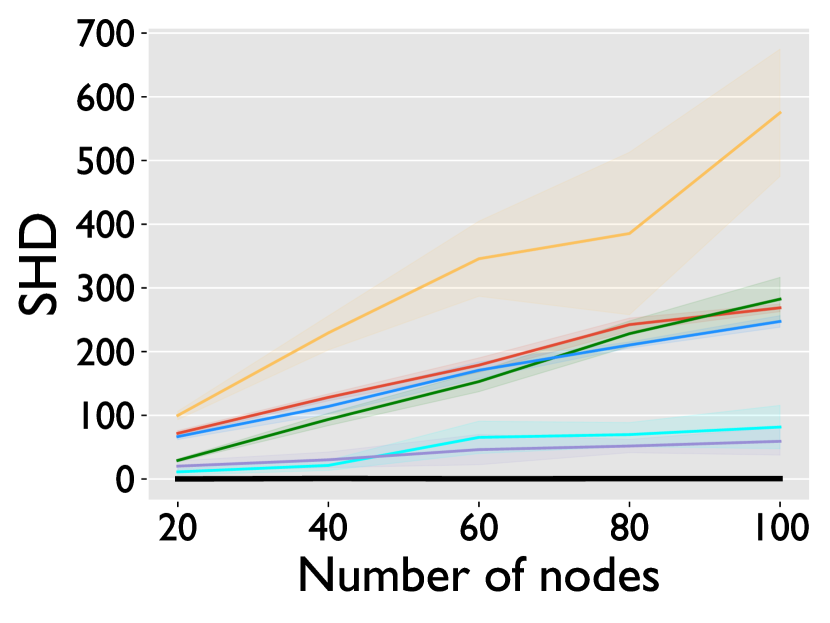
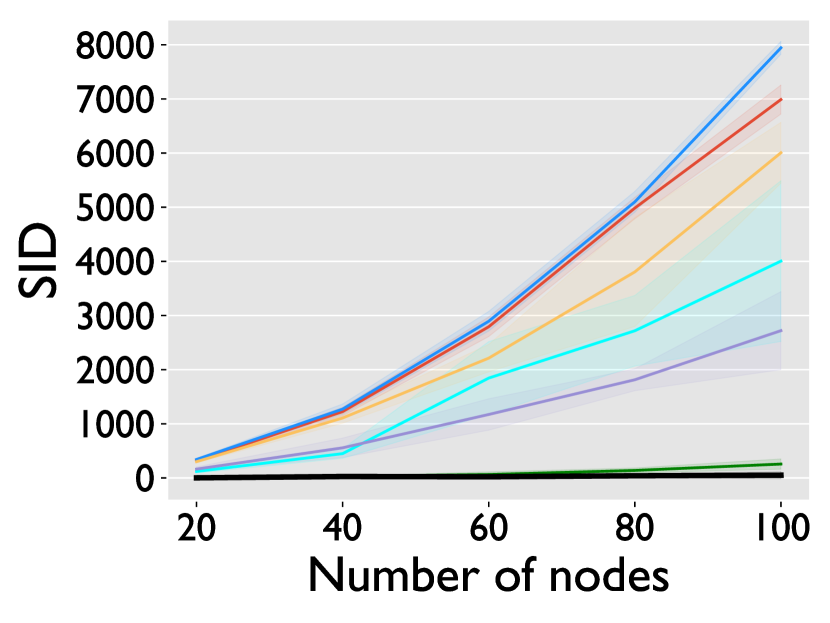
- SparseRC significantly outperforms prior DAG learning methods on synthetic datasets where the few root causes assumption holds.
- SparseRC scales effectively to DAGs with up to thousands of nodes, demonstrating practical scalability.
- On real gene regulatory network data, SparseRC performs among the best compared to existing methods, validating the relevance of the few root causes assumption in practice.
- The method achieves high structural accuracy (e.g., F1-score improvements of up to 20% on synthetic benchmarks) under sparse root cause conditions.
- Theoretical identifiability is established under weak assumptions, including the case of zero noise, ensuring consistency in the limit of large samples.
Read this paper
Open the full text in the Nubint reader and ask about any passage as you read.
Read this paper on NubintThis review was generated by AI from the original paper. Please check the paper before citing it.