
[Paper Review] Learning Dense Correspondences between Photos and Sketches
This paper introduces PSC6k, a new benchmark with 150K human-annotated dense correspondences across 6,250 sketch-photo pairs in 125 categories, and proposes a self-supervised method using contrastive learning and a spatial transformer to predict dense correspondences between sketches and photos. The approach outperforms strong baselines but reveals systematic gaps between model and human predictions, highlighting challenges in achieving human-like visual understanding across modalities.
Humans effortlessly grasp the connection between sketches and real-world objects, even when these sketches are far from realistic. Moreover, human sketch understanding goes beyond categorization -- critically, it also entails understanding how individual elements within a sketch correspond to parts of the physical world it represents. What are the computational ingredients needed to support this ability? Towards answering this question, we make two contributions: first, we introduce a new sketch-photo correspondence benchmark, $ extit{PSC6k}$, containing 150K annotations of 6250 sketch-photo pairs across 125 object categories, augmenting the existing Sketchy dataset with fine-grained correspondence metadata. Second, we propose a self-supervised method for learning dense correspondences between sketch-photo pairs, building upon recent advances in correspondence learning for pairs of photos. Our model uses a spatial transformer network to estimate the warp flow between latent representations of a sketch and photo extracted by a contrastive learning-based ConvNet backbone. We found that this approach outperformed several strong baselines and produced predictions that were quantitatively consistent with other warp-based methods. However, our benchmark also revealed systematic differences between predictions of the suite of models we tested and those of humans. Taken together, our work suggests a promising path towards developing artificial systems that achieve more human-like understanding of visual images at different levels of abstraction. Project page: https://photo-sketch-correspondence.github.io
Motivation & Objective
- To address the lack of fine-grained, human-annotated correspondence data between sketches and photos for benchmarking visual understanding.
- To develop a self-supervised method that learns dense semantic correspondences between highly dissimilar image modalities—photos and sketches—without relying on large-scale human-annotated supervision.
- To investigate whether contrastive learning and spatial transformer networks can effectively model cross-modal correspondence despite significant domain shift in appearance and abstraction.
- To evaluate the performance of learned correspondences against human-annotated ground truth and identify systematic discrepancies between human and model predictions.
Proposed method
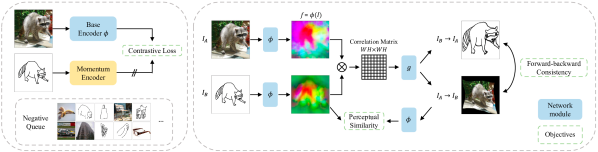
- The method employs a contrastive learning-based ConvNet backbone to extract shared latent representations from sketch and photo pairs.
- A spatial transformer network is used to predict a dense warp flow field that transforms the photo feature map to align with the sketch feature map.
- The model is trained in a self-supervised manner using a combination of contrastive loss and geometric consistency objectives, leveraging synthetic data augmentations to simulate correspondence supervision.
- The framework leverages hierarchical features from a pre-trained backbone and optimizes for forward-backward consistency in the predicted flow fields.
- The approach is end-to-end differentiable, enabling joint optimization of feature extraction and correspondence prediction.
- The method is evaluated on the newly introduced PSC6k benchmark, which provides fine-grained keypoint annotations for 6,250 sketch-photo pairs.
Experimental results
Research questions
- RQ1Can a self-supervised deep learning method effectively learn dense semantic correspondences between photos and sketches, despite their large domain gap?
- RQ2How do the predictions of deep learning models compare quantitatively and qualitatively to human-annotated correspondences on the same task?
- RQ3To what extent does contrastive representation learning improve zero-shot generalization for cross-modal correspondence learning between photos and sketches?
- RQ4What are the systematic failures of current models in predicting correspondences compared to human judgments?
Key findings
- The proposed self-supervised method outperformed several strong baselines in predicting dense correspondences between sketches and photos on the PSC6k benchmark.
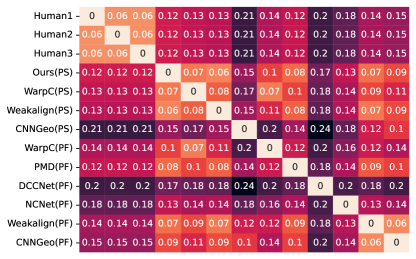
- The model's predictions were quantitatively consistent with other warp-based correspondence learning methods, indicating robustness in flow estimation.
- Despite strong performance, the model exhibited systematic deviations from human-annotated correspondences, particularly in aligning fine-grained parts and handling abstraction in sketches.
- The PSC6k benchmark revealed that current models struggle with parts that are highly abstracted or omitted in sketches, suggesting limitations in modeling semantic abstraction.
- The results indicate that while contrastive learning and spatial transformers are effective for cross-modal correspondence, they fall short of replicating human-level understanding in complex visual abstraction tasks.
Better researchstarts right now
From reading papers to final review, dramatically reduce your research time.
No credit card · Free plan available
This review was created by AI and reviewed by human editors.