
[Paper Review] Learning Dense Visual Correspondences in Simulation to Smooth and Fold Real Fabrics
This paper proposes a simulation-based framework that learns dense visual correspondences for real fabric manipulation using RGB data and deep learning. By leveraging these correspondences, it enables one-shot imitation of 10 diverse smoothing and folding tasks across two robotic platforms—achieving an 80.3% average success rate—without real-world fine-tuning or task-specific retraining.
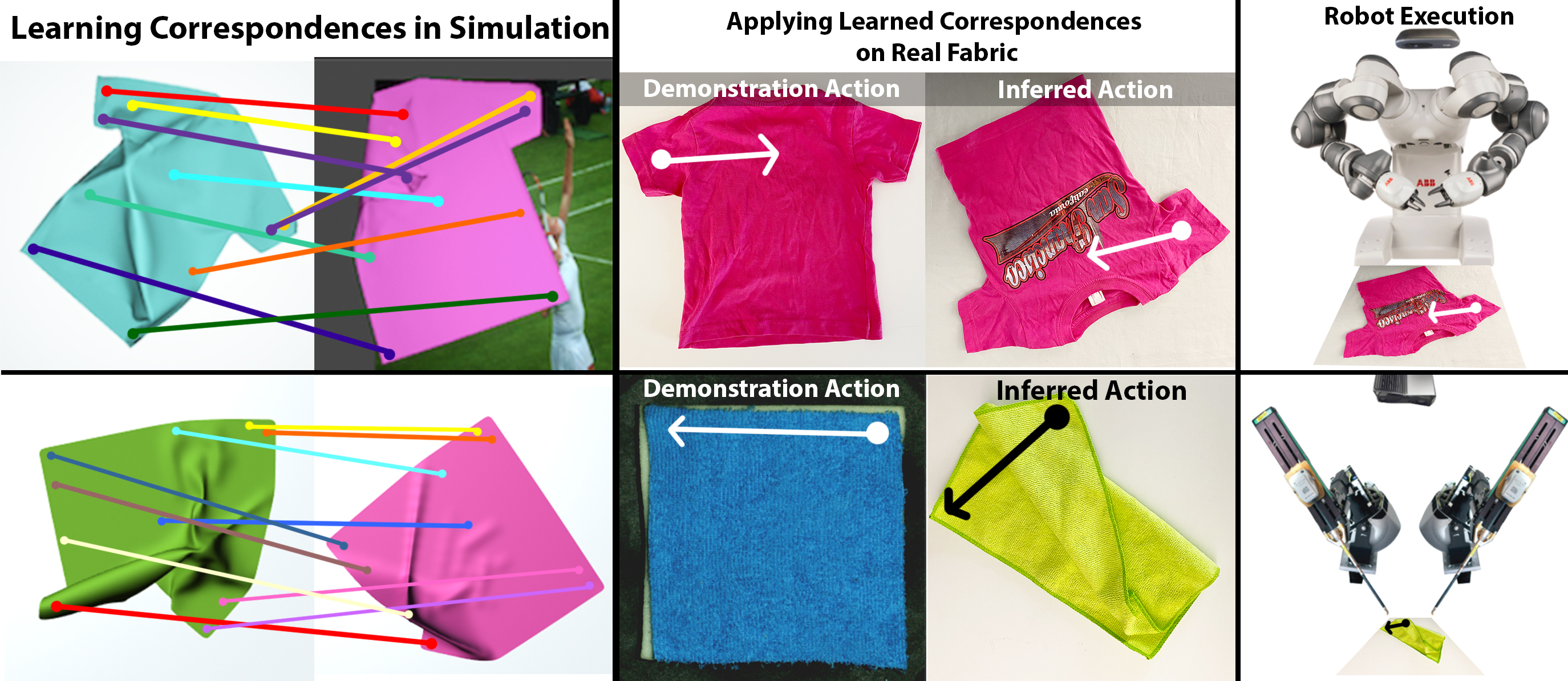
Robotic fabric manipulation is challenging due to the infinite dimensional configuration space, self-occlusion, and complex dynamics of fabrics. There has been significant prior work on learning policies for specific deformable manipulation tasks, but comparatively less focus on algorithms which can efficiently learn many different tasks. In this paper, we learn visual correspondences for deformable fabrics across different configurations in simulation and show that this representation can be used to design policies for a variety of tasks. Given a single demonstration of a new task from an initial fabric configuration, the learned correspondences can be used to compute geometrically equivalent actions in a new fabric configuration. This makes it possible to robustly imitate a broad set of multi-step fabric smoothing and folding tasks on multiple physical robotic systems. The resulting policies achieve 80.3% average task success rate across 10 fabric manipulation tasks on two different robotic systems, the da Vinci surgical robot and the ABB YuMi. Results also suggest robustness to fabrics of various colors, sizes, and shapes. See https://tinyurl.com/fabric-descriptors for supplementary material and videos.
Motivation & Objective
- Address the challenge of generalizing fabric manipulation policies across varying fabric colors, sizes, and initial configurations.
- Enable efficient, task-agnostic policy transfer from simulation to real robots using visual correspondences.
- Decouple perception from control to support cross-robot generalization without retraining.
- Develop a scalable pipeline for generating diverse fabric configurations in simulation to improve descriptor generalization.
- Achieve high success rates in multi-step tasks like smoothing and folding using only a single demonstration per task.
Proposed method
- Train dense object descriptors using synthetic RGB images of fabrics in diverse configurations generated in Blender.
- Leverage domain randomization during simulation data collection to enhance robustness to variations in color, texture, and scale.
- Use learned visual correspondences to compute geometrically equivalent actions between different fabric configurations.
- Map a single human demonstration in a source configuration to equivalent actions in a new configuration using the correspondence field.
- Decouple perception (descriptor network) from control (policy), enabling reuse across different robotic systems.
- Implement a testbed in simulation to validate manipulation policies before physical deployment.
Experimental results
Research questions
- RQ1Can dense visual correspondences learned in simulation generalize across diverse fabric attributes such as color, size, and shape?
- RQ2Can a single demonstration in one fabric configuration be used to generate effective policies for the same task in a different configuration using learned correspondences?
- RQ3To what extent can a single perception module trained in simulation be transferred to different real-world robotic platforms without retraining?
- RQ4How robust are the learned correspondences to variations in camera pose, lighting, and workspace geometry in real-world settings?
- RQ5Can this approach achieve high success rates across a diverse set of multi-step fabric manipulation tasks without task-specific fine-tuning?
Key findings
- The method achieves an average task success rate of 80.3% across 10 different fabric manipulation tasks on both the ABB YuMi and da Vinci Research Kit.
- Smoothing policies increase fabric coverage from an average of 68.4% to 86.4% on the dVRK and from 71.4% to 83.2% on the YuMi.
- The dVRK achieves 100% success on single-action folding tasks (SF, TSTSF), while the YuMi achieves 90% or higher on most single- and two-action tasks.
- The most frequent failure mode is grasp instability, particularly in multi-action tasks, indicating a need for improved grasping strategies.
- The learned descriptors generalize robustly across different robot platforms despite differences in camera pose, lighting, and workspace dimensions.
- The framework enables one-shot imitation of complex tasks like double triangle folding and smoothing followed by folding with consistent performance across unseen fabric variations.

Read this paper
Open the full text in the Nubint reader and ask about any passage as you read.
Read this paper on NubintThis review was generated by AI from the original paper. Please check the paper before citing it.