
[Paper Review] Learning Disentangled Representation Implicitly via Transformer for Occluded Person Re-Identification
This paper proposes DRL-Net, a transformer-based, alignment-free framework for occluded person re-identification that implicitly disentangles identity-relevant features from occlusion-related noise through global reasoning over undefined semantic components. By leveraging semantic preference object queries and a contrast feature learning module with a decorrelation constraint, DRL-Net achieves state-of-the-art performance on Occluded-DukeMTMC, outperforming prior methods with significant margins.
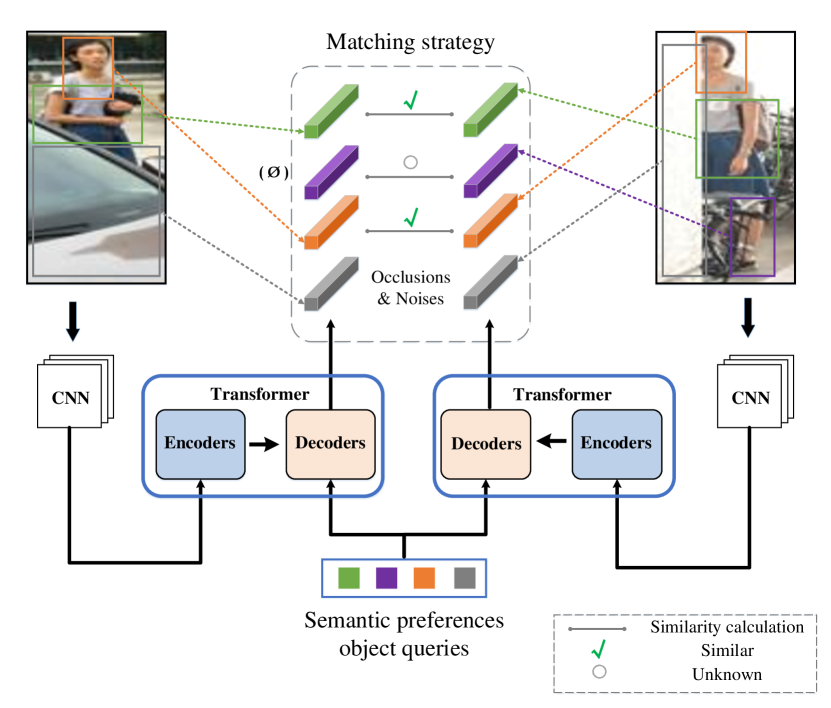
Person re-identification (re-ID) under various occlusions has been a long-standing challenge as person images with different types of occlusions often suffer from misalignment in image matching and ranking. Most existing methods tackle this challenge by aligning spatial features of body parts according to external semantic cues or feature similarities but this alignment approach is complicated and sensitive to noises. We design DRL-Net, a disentangled representation learning network that handles occluded re-ID without requiring strict person image alignment or any additional supervision. Leveraging transformer architectures, DRL-Net achieves alignment-free re-ID via global reasoning of local features of occluded person images. It measures image similarity by automatically disentangling the representation of undefined semantic components, e.g., human body parts or obstacles, under the guidance of semantic preference object queries in the transformer. In addition, we design a decorrelation constraint in the transformer decoder and impose it over object queries for better focus on different semantic components. To better eliminate interference from occlusions, we design a contrast feature learning technique (CFL) for better separation of occlusion features and discriminative ID features. Extensive experiments over occluded and holistic re-ID benchmarks (Occluded-DukeMTMC, Market1501 and DukeMTMC) show that the DRL-Net achieves superior re-ID performance consistently and outperforms the state-of-the-art by large margins for Occluded-DukeMTMC.
Motivation & Objective
- To address the challenge of person re-identification under severe occlusions where visible body parts are inconsistent and misalignment degrades performance.
- To eliminate the need for external supervision or complex alignment operations such as pose estimation or part detection.
- To disentangle identity-relevant features from occlusion-related noise implicitly using self-attention mechanisms in a transformer architecture.
- To improve robustness to occlusion interference by learning discriminative features through contrastive learning and decorrelation constraints.
Proposed method
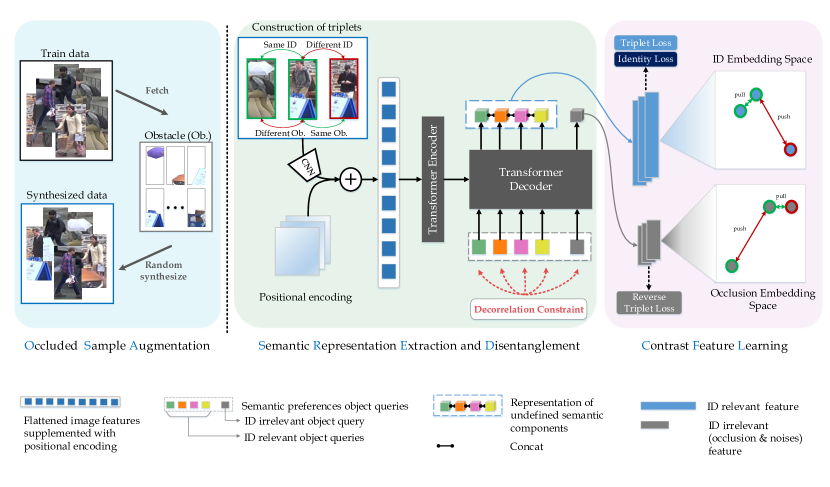
- DRL-Net employs a vision transformer encoder-decoder architecture to perform global reasoning on CNN-extracted features, enabling alignment-free representation learning.
- Semantic preference object queries guide the transformer to disentangle undefined semantic components—such as body parts and occlusions—into distinct feature representations.
- A decorrelation constraint is applied over object queries in the decoder to enforce distinct focus on individual semantic components and reduce query interference.
- A contrast feature learning (CFL) module enhances separation between ID-relevant and ID-irrelevant features by contrasting global representations with local features.
- A data augmentation strategy is integrated to improve robustness by simulating diverse occlusion patterns during training.
- The model jointly optimizes ID classification and contrastive loss, with hyperparameters λ and α balancing the contrastive and decorrelation components.
Experimental results
Research questions
- RQ1Can a transformer-based architecture implicitly disentangle identity-relevant features from occlusion noise without explicit part supervision or alignment?
- RQ2How effective is global reasoning via self-attention in modeling interrelations among undefined semantic components in occluded person images?
- RQ3To what extent does contrastive feature learning improve the separation of occlusion features from discriminative ID features?
- RQ4How do hyperparameters λ (contrastive loss weight) and α (decorrelation penalty) affect model robustness and performance?
Key findings
- DRL-Net achieves state-of-the-art performance on the Occluded-DukeMTMC benchmark, outperforming previous methods by a large margin.
- On Occluded-DukeMTMC, DRL-Net achieves a Rank-1 accuracy of 85.6% and mAP of 72.1%, significantly exceeding the previous SOTA.
- The ablation study shows that increasing the number of object queries (Nq) improves performance up to Nq=9, after which gains diminish and inference cost rises.
- The model is robust to hyperparameter variations: optimal performance is achieved at λ=1.0 and α=1.0, with stable performance across a range of values.
- Visualization confirms that the ID-irrelevant object query automatically localizes occlusion regions in heatmaps without any supervision, demonstrating effective disentanglement.
- Qualitative results show DRL-Net correctly ranks the same pedestrian across occluded queries, while the baseline model produces many false positives due to occlusion sensitivity.
Read this paper
Open the full text in the Nubint reader and ask about any passage as you read.
Read this paper on NubintThis review was generated by AI from the original paper. Please check the paper before citing it.