
[Paper Review] Learning Distinctive Margin toward Active Domain Adaptation
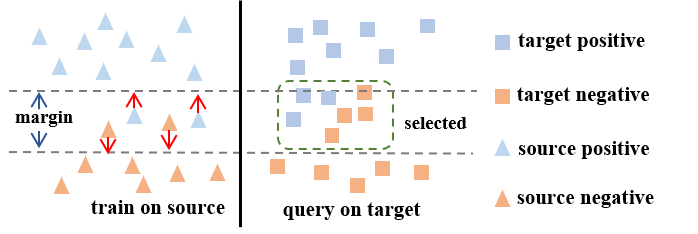
This paper proposes Select-by-Distinctive-Margin (SDM), a simple yet effective active domain adaptation method that uses a maximum margin loss to identify hard examples near decision boundaries in the source domain and selects informative target samples based on their similarity to these hard examples. SDM achieves state-of-the-art performance with only 5% labeled target data, demonstrating high efficiency, stability, and scalability across Office-Home benchmarks.
Despite plenty of efforts focusing on improving the domain adaptation ability (DA) under unsupervised or few-shot semi-supervised settings, recently the solution of active learning started to attract more attention due to its suitability in transferring model in a more practical way with limited annotation resource on target data. Nevertheless, most active learning methods are not inherently designed to handle domain gap between data distribution, on the other hand, some active domain adaptation methods (ADA) usually requires complicated query functions, which is vulnerable to overfitting. In this work, we propose a concise but effective ADA method called Select-by-Distinctive-Margin (SDM), which consists of a maximum margin loss and a margin sampling algorithm for data selection. We provide theoretical analysis to show that SDM works like a Support Vector Machine, storing hard examples around decision boundaries and exploiting them to find informative and transferable data. In addition, we propose two variants of our method, one is designed to adaptively adjust the gradient from margin loss, the other boosts the selectivity of margin sampling by taking the gradient direction into account. We benchmark SDM with standard active learning setting, demonstrating our algorithm achieves competitive results with good data scalability. Code is available at https://github.com/TencentYoutuResearch/ActiveLearning-SDM
Motivation & Objective
- Address the challenge of domain shift in active domain adaptation where labeled target data are limited.
- Overcome the limitations of existing active learning methods that fail to handle domain gaps or rely on complex, overfitting query functions.
- Develop a method that leverages the intrinsic relationship between source and target domains for more effective data selection.
- Ensure model stability and scalability by minimizing sensitivity to hyperparameters and query complexity.
- Provide theoretical justification for the effectiveness of margin-based sampling in identifying informative, transferable samples.
Proposed method
- Propose a maximum margin loss that encourages the model to maximize inter-class separation in the source domain, implicitly identifying hard examples near decision boundaries.
- Use a margin sampling strategy to select target samples whose features are closest to the decision boundary in the source domain, based on their distance to categorical centers.
- Introduce SDM-AG, a variant that dynamically modulates the gradient of the margin loss using an adaptive modulation factor and max-logit regularizer to improve training stability.
- Design SDM-AG-Grad, a second variant that incorporates the first-order gradient of the margin sampling function to enhance selectivity during data sampling.
- Theoretical analysis shows that the margin loss behaves similarly to a Support Vector Machine, focusing on hard examples and enabling transferable decision boundaries.
- The method is computationally efficient, with query complexity of O(NKD + N log N), significantly faster than prior methods like CLUE and TQS.
Experimental results
Research questions
- RQ1Can a simple margin-based loss function effectively identify hard examples in the source domain that are transferable to the target domain?
- RQ2How does the proposed margin sampling strategy compare to uncertainty-based or diversity-based sampling in active domain adaptation?
- RQ3To what extent does the model's performance improve with limited labeled target data using SDM compared to existing active domain adaptation methods?
- RQ4How sensitive is SDM to hyperparameters such as the margin value and loss balance factor?
- RQ5Can the proposed method maintain high efficiency and scalability across different domain shift scenarios?
Key findings
- SDM-AG achieves consistent performance gains across all Office-Home scenarios, with the largest improvement observed in the R→A setting, indicating strong scalability with increasing annotation budget.
- SDM-AG matches or exceeds the performance of unsupervised domain adaptation methods like ATDOC and CDAN using only 5% of the target data, demonstrating high data efficiency.
- The method is robust to hyperparameter changes, with minimal performance variation across different values of margin $m$ and balance factor $ abla$, indicating high stability.
- SDM achieves a 24.6× speedup in query time compared to the nearest competitor (CLUE), with a query time of only 0.067 seconds, highlighting its computational efficiency.
- Theoretical analysis confirms that the margin loss induces SVM-like behavior, focusing on hard examples and enabling effective transfer to the target domain.
- The two variants—SDM-AG and SDM-AG-Grad—improve training stability and sampling selectivity, respectively, without increasing model complexity.
Better researchstarts right now
From reading papers to final review, dramatically reduce your research time.
No credit card · Free plan available
This review was created by AI and reviewed by human editors.