
[Paper Review] Learning Dynamic Alignment via Meta-filter for Few-shot Learning
This paper proposes a dynamic meta-filter mechanism for few-shot learning that adaptively aligns query features by learning position-specific and channel-specific filter weights from local support feature neighborhoods. By integrating Neural ODE for adaptive, continuous alignment and leveraging dynamic neighborhood sampling, the method achieves state-of-the-art performance on miniImageNet and tiered-ImageNet, improving accuracy by up to 1.16% on 5-shot tasks through better feature refinement and reduced redundancy.
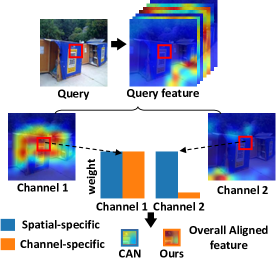
Few-shot learning (FSL), which aims to recognise new classes by adapting the learned knowledge with extremely limited few-shot (support) examples, remains an important open problem in computer vision. Most of the existing methods for feature alignment in few-shot learning only consider image-level or spatial-level alignment while omitting the channel disparity. Our insight is that these methods would lead to poor adaptation with redundant matching, and leveraging channel-wise adjustment is the key to well adapting the learned knowledge to new classes. Therefore, in this paper, we propose to learn a dynamic alignment, which can effectively highlight both query regions and channels according to different local support information. Specifically, this is achieved by first dynamically sampling the neighbourhood of the feature position conditioned on the input few shot, based on which we further predict a both position-dependent and channel-dependent Dynamic Meta-filter. The filter is used to align the query feature with position-specific and channel-specific knowledge. Moreover, we adopt Neural Ordinary Differential Equation (ODE) to enable a more accurate control of the alignment. In such a sense our model is able to better capture fine-grained semantic context of the few-shot example and thus facilitates dynamical knowledge adaptation for few-shot learning. The resulting framework establishes the new state-of-the-arts on major few-shot visual recognition benchmarks, including miniImageNet and tieredImageNet.
Motivation & Objective
- To address the limitations of existing few-shot learning methods that overlook channel-level disparities and suffer from redundant matching and inflexible alignment.
- To improve feature alignment by dynamically modeling both spatial and channel-wise importance using local support context.
- To enable adaptive, task-aware alignment through continuous control via Neural ODE, overcoming fixed-iteration recursive alignment.
- To reduce redundancy by sampling only relevant local neighborhoods of support features instead of using the full support feature.
- To enhance knowledge adaptation for novel classes by focusing on high-quality channels and salient regions in few-shot examples.
Proposed method
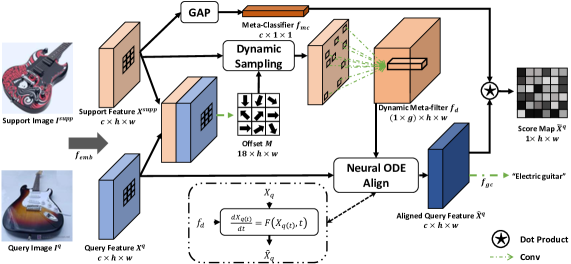
- Dynamically sample a local neighborhood around each query feature position based on input few-shot support images, using a learnable offset to adaptively select relevant context.
- Predict a position-specific and channel-specific Dynamic Meta-filter (DMF) from the sampled neighborhood to guide feature alignment.
- Apply the DMF to perform adaptive, learnable feature alignment between query and support features, emphasizing important spatial regions and channels.
- Use Neural Ordinary Differential Equation (ODE) to model the alignment process as a continuous transformation, enabling flexible and adaptive refinement over time.
- Integrate group convolution in the DMF module to balance expressiveness and computational cost, with group count tuned per few-shot setting (160 for 5-shot, 64 for 1-shot).
- Remove global pooling layers to preserve spatial resolution and improve supervision density, enhancing meta-filter learning.
Experimental results
Research questions
- RQ1Can dynamic, position- and channel-specific filtering improve few-shot feature alignment beyond static or spatial-only methods?
- RQ2How does adaptive, continuous alignment via Neural ODE compare to fixed-iteration recursive alignment in terms of generalization and robustness?
- RQ3Does local neighborhood sampling reduce redundancy in support knowledge while preserving critical semantic context?
- RQ4To what extent does channel-wise attention improve performance when support features contain poorly learned channels?
- RQ5How does the model generalize across varying shot settings (1-shot vs 5-shot) with different information capacity requirements?
Key findings
- The proposed method achieves new state-of-the-art performance on miniImageNet and tiered-ImageNet, with a 1.16% accuracy gain on 5-shot tasks compared to prior methods.
- Removing the global pooling layer improves performance by 0.64% on 1-shot and 1.16% on 5-shot, due to better preservation of spatial detail and denser supervision.
- Using Neural ODE for alignment yields superior performance over fixed-iteration recursive alignment, especially on 5-shot tasks where fixed iterations degrade accuracy by 0.95%.
- The model with ODE-based alignment consistently outperforms all baselines across all tasks, demonstrating the effectiveness of adaptive, continuous refinement.
- The number of groups in the DMF module significantly affects performance, with 160 groups optimal for 5-shot and 64 for 1-shot, confirming the need for adaptive capacity based on shot level.
- Visualizations show that the dynamic meta-filter successfully highlights target objects and suppresses noisy or irrelevant channels, outperforming CAN and non-aligned baselines in feature alignment quality.
Read this paper
Open the full text in the Nubint reader and ask about any passage as you read.
Read this paper on NubintThis review was generated by AI from the original paper. Please check the paper before citing it.