
[Paper Review] Learning from Hypervectors: A Survey on Hypervector Encoding
A focused survey on how hypervectors are generated and encoded in Hyperdimensional Computing, examining data mappings, encoding methods, and hardware considerations to influence accuracy and efficiency.
Hyperdimensional computing (HDC) is an emerging computing paradigm that imitates the brain's structure to offer a powerful and efficient processing and learning model. In HDC, the data are encoded with long vectors, called hypervectors, typically with a length of 1K to 10K. The literature provides several encoding techniques to generate orthogonal or correlated hypervectors, depending on the intended application. The existing surveys in the literature often focus on the overall aspects of HDC systems, including system inputs, primary computations, and final outputs. However, this study takes a more specific approach. It zeroes in on the HDC system input and the generation of hypervectors, directly influencing the hypervector encoding process. This survey brings together various methods for hypervector generation from different studies and explores the limitations, challenges, and potential benefits they entail. Through a comprehensive exploration of this survey, readers will acquire a profound understanding of various encoding types in HDC and gain insights into the intricate process of hypervector generation for diverse applications.
Motivation & Objective
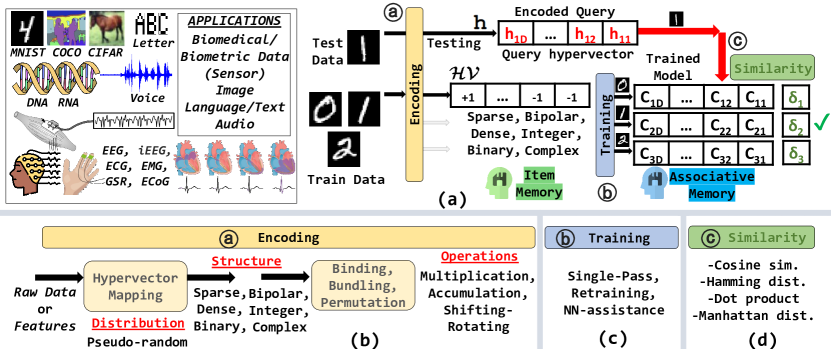
- Clarify how HVs are generated from various data types (numeric, 2D, sequences, etc.) and how this affects model performance.
- Survey existing HV encoding techniques (record-based, N-gram, sparse/dense, LD-based) and their trade-offs.
- Highlight hardware and on-edge learning implications of HV encoding.
- Identify challenges and open research opportunities in HV generation for diverse applications.
Proposed method
- Review and categorize HV mapping and encoding techniques from prior HDC literature.
- Compare orthogonality, density, and sparsity considerations for HVs across data representations.
- Discuss hardware implications and optimization strategies for HV generation (FPGA, CIM, etc.).
- Summarize how different encoding schemes impact accuracy and efficiency in learning tasks.
Experimental results
Research questions
- RQ1What HV generation strategies exist for different data types (numeric, image, sequence), and how do they affect encoding quality?
- RQ2How do encoding choices (orthogonality, density, sparsity, LD/distributions) influence HDC accuracy and hardware efficiency?
- RQ3What are the primary trade-offs between record-based and N-gram based HV generation methods across applications?
- RQ4What are the current hardware considerations and platforms supporting HV encoding at scale, particularly for on-edge learning?
- RQ5What open challenges remain in HV encoding for emerging applications and data modalities?
Key findings
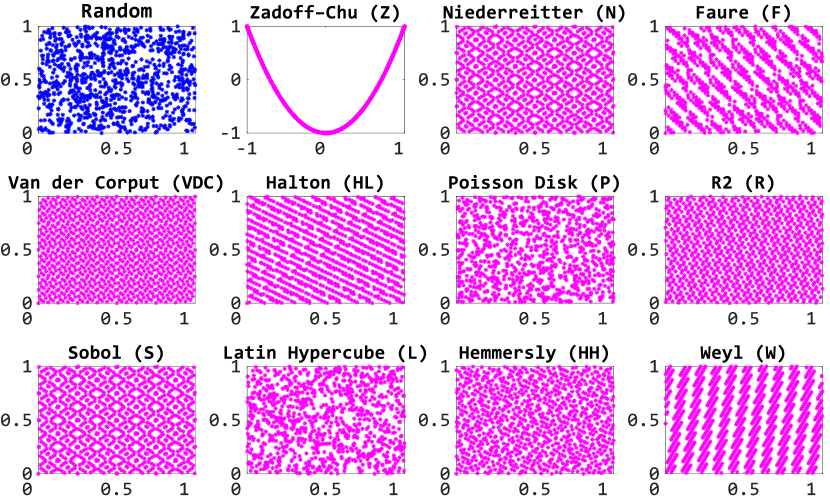
- HV generation quality and vector distribution critically impact HDC accuracy and efficiency.
- Multiple encoding schemes (record-based, N-gram, stochastic, LD-based) offer trade-offs between accuracy, hardware cost, and scalability.
- Sparse versus dense HV representations impact hardware efficiency and can be tailored to data type (numeric vs symbolic).
- Hardware-oriented optimizations (FPGA, CIM, on-chip learning) can yield substantial gains in area and throughput compared to baseline architectures.
- There is a notable research gap in HV encoding for DNA processing and certain data modalities, suggesting opportunities for future work.
Read this paper
Open the full text in the Nubint reader and ask about any passage as you read.
Read this paper on NubintThis review was generated by AI from the original paper. Please check the paper before citing it.