
[Paper Review] Learning from Multiple Independent Advisors in Multi-agent Reinforcement Learning
This paper proposes a two-level Q-learning framework that enables multi-agent reinforcement learning (MARL) agents to simultaneously learn from multiple independent, sub-optimal advisors by evaluating their advice and using it to guide action selection. The method achieves improved sample efficiency and convergence to Nash equilibrium, outperforming baselines in three MARL test-beds while effectively integrating diverse advisor expertise and filtering out poor advice.
Multi-agent reinforcement learning typically suffers from the problem of sample inefficiency, where learning suitable policies involves the use of many data samples. Learning from external demonstrators is a possible solution that mitigates this problem. However, most prior approaches in this area assume the presence of a single demonstrator. Leveraging multiple knowledge sources (i.e., advisors) with expertise in distinct aspects of the environment could substantially speed up learning in complex environments. This paper considers the problem of simultaneously learning from multiple independent advisors in multi-agent reinforcement learning. The approach leverages a two-level Q-learning architecture, and extends this framework from single-agent to multi-agent settings. We provide principled algorithms that incorporate a set of advisors by both evaluating the advisors at each state and subsequently using the advisors to guide action selection. We also provide theoretical convergence and sample complexity guarantees. Experimentally, we validate our approach in three different test-beds and show that our algorithms give better performances than baselines, can effectively integrate the combined expertise of different advisors, and learn to ignore bad advice.
Motivation & Objective
- To address sample inefficiency in multi-agent reinforcement learning (MARL), a major barrier to real-world deployment.
- To overcome the limitation of prior work that relies on a single expert or near-expert demonstrator.
- To enable effective integration of multiple independent, potentially conflicting advisors with diverse expertise in complex MARL environments.
- To provide theoretical guarantees on convergence to Nash equilibrium and finite-time sample complexity.
- To empirically validate the method's ability to learn from combined advisor knowledge while ignoring sub-optimal advice.
Proposed method
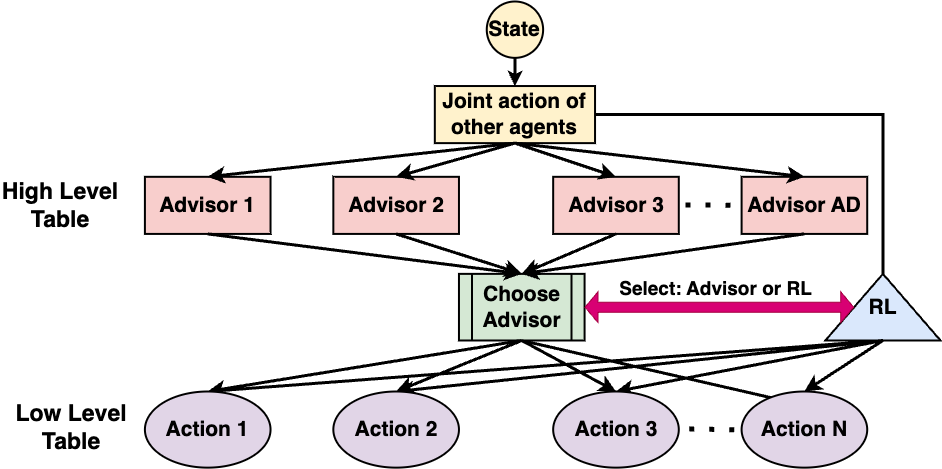
- The method employs a two-level Q-learning architecture: a high-level Q-network evaluates advisor advice, and a low-level Q-network selects actions based on this evaluation.
- Advisors are evaluated at each state using a value estimation mechanism, and their advice is incorporated through a weighted action selection process.
- The framework extends prior single-agent TLQL to multi-agent settings, using independent Q-learning with a policy pruning rate (PPR) to prevent over-reliance on advisors during execution.
- An actor-critic variant is developed for the centralized training and decentralized execution (CTDE) setting, enabling scalable training.
- Theoretical analysis proves convergence to a Nash equilibrium under standard MARL assumptions and provides finite-time sample complexity bounds for two learning rate schedules.
- The approach uses a dual replay buffer system and hard target network updates to stabilize training, with hyperparameters tuned across multiple baselines.
Experimental results
Research questions
- RQ1Can multiple independent, sub-optimal advisors be effectively leveraged in multi-agent reinforcement learning to improve sample efficiency?
- RQ2How can conflicting advice from multiple advisors be resolved to guide robust action selection in multi-agent environments?
- RQ3Does the proposed two-level Q-learning architecture converge to a Nash equilibrium in multi-agent settings?
- RQ4What is the finite-time sample complexity of the proposed MARL algorithm with multiple advisors?
- RQ5Can the method learn to ignore poor-quality advice while effectively integrating high-quality guidance from diverse advisors?
Key findings
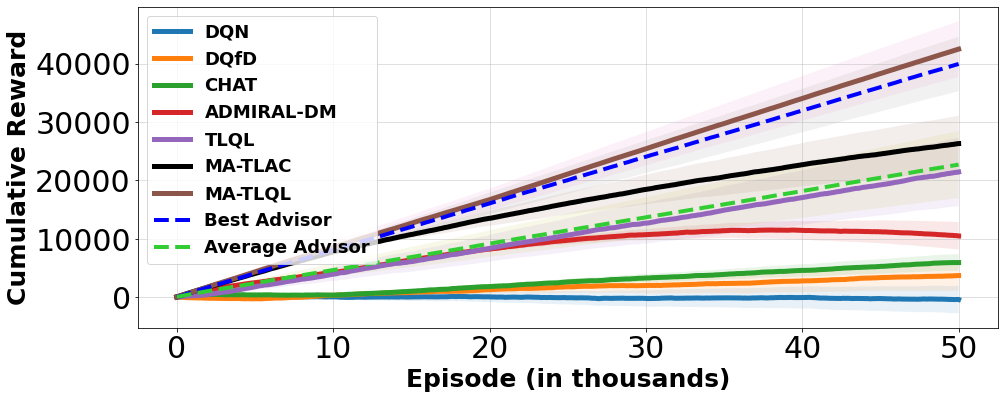
- The proposed method outperforms strong baselines, including DQfD, CHAT, TLQL, and ADMIRAL-DM, across three distinct multi-agent test-beds: Pommerman, Pursuit, and Rovis.
- The method successfully integrates the combined expertise of multiple advisors, achieving higher cumulative rewards than any single-advisor baseline.
- The algorithm learns to suppress poor advice, as evidenced by improved execution performance when advisors are unavailable, indicating effective advisor filtering.
- The use of policy pruning rate (PPR) significantly improves generalization, with execution performance increasing by up to 40% compared to non-PPR variants.
- Theoretical analysis confirms convergence to a Nash equilibrium and provides finite-time sample complexity bounds, validating the algorithm's stability.
- Training on a single A100 GPU took approximately 12–15 hours per experiment, demonstrating feasibility on standard hardware.
Read this paper
Open the full text in the Nubint reader and ask about any passage as you read.
Read this paper on NubintThis review was generated by AI from the original paper. Please check the paper before citing it.