
[Paper Review] Learning Generalized Zero-Shot Learners for Open-Domain Image Geolocalization
StreetCLIP uses synthetic caption domain-specific pretraining to improve generalized zero-shot learning for open-domain image geolocalization, achieving state-of-the-art zero-shot results without finetuning.
Image geolocalization is the challenging task of predicting the geographic coordinates of origin for a given photo. It is an unsolved problem relying on the ability to combine visual clues with general knowledge about the world to make accurate predictions across geographies. We present $\href{https://huggingface.co/geolocal/StreetCLIP}{ ext{StreetCLIP}}$, a robust, publicly available foundation model not only achieving state-of-the-art performance on multiple open-domain image geolocalization benchmarks but also doing so in a zero-shot setting, outperforming supervised models trained on more than 4 million images. Our method introduces a meta-learning approach for generalized zero-shot learning by pretraining CLIP from synthetic captions, grounding CLIP in a domain of choice. We show that our method effectively transfers CLIP's generalized zero-shot capabilities to the domain of image geolocalization, improving in-domain generalized zero-shot performance without finetuning StreetCLIP on a fixed set of classes.
Motivation & Objective
- Motivate open-domain image geolocalization and its cross-geography generalization challenges.
- Introduce a domain-specific pretraining method that grounds CLIP with synthetic captions for geolocalization.
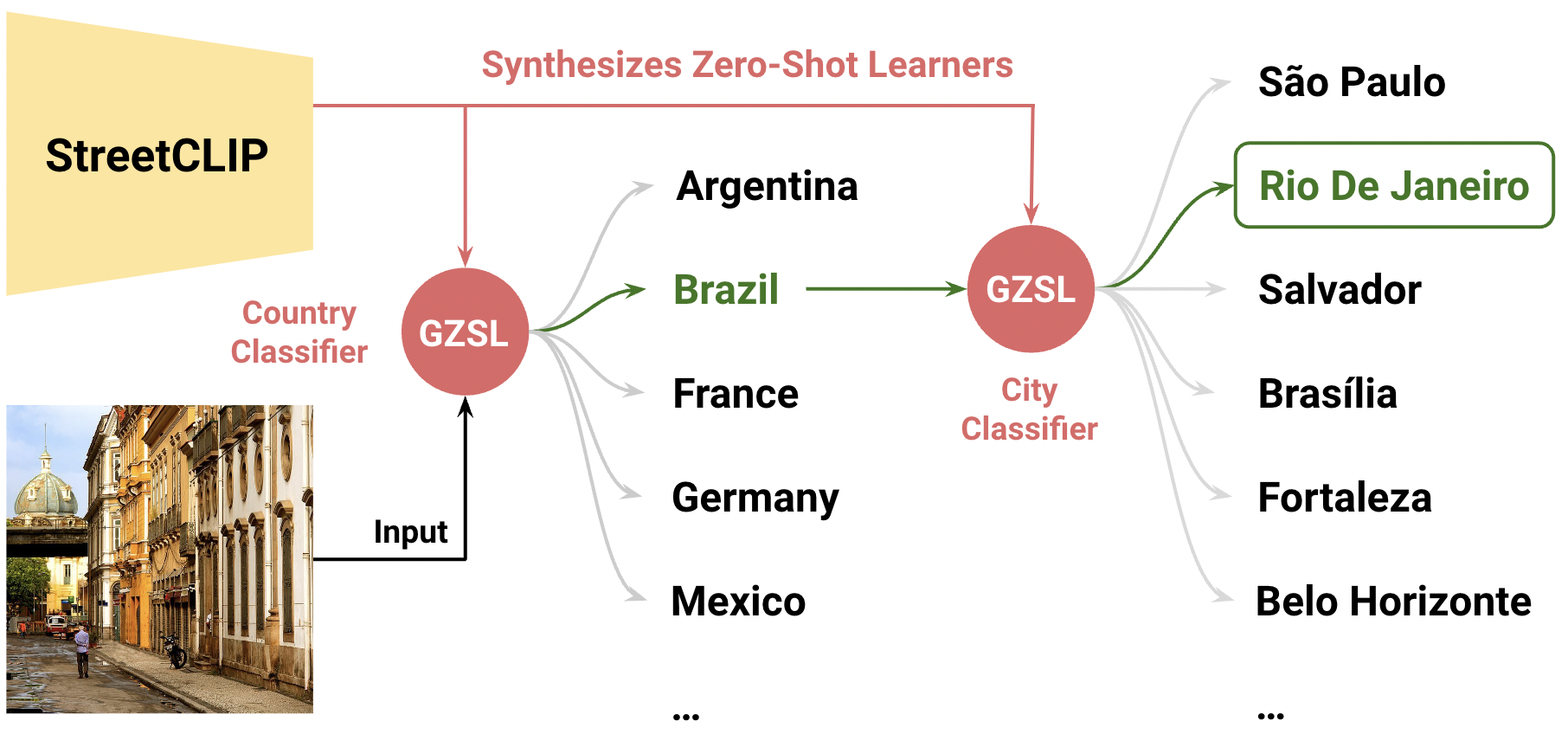
- Develop StreetCLIP and a hierarchical linear probing strategy to enable zero-shot, planet-scale inference.
- Demonstrate that synthetic-caption pretraining improves generalized zero-shot performance over zero-shot CLIP.
- Provide a publicly available StreetCLIP model and dataset to enable broader research.
Proposed method
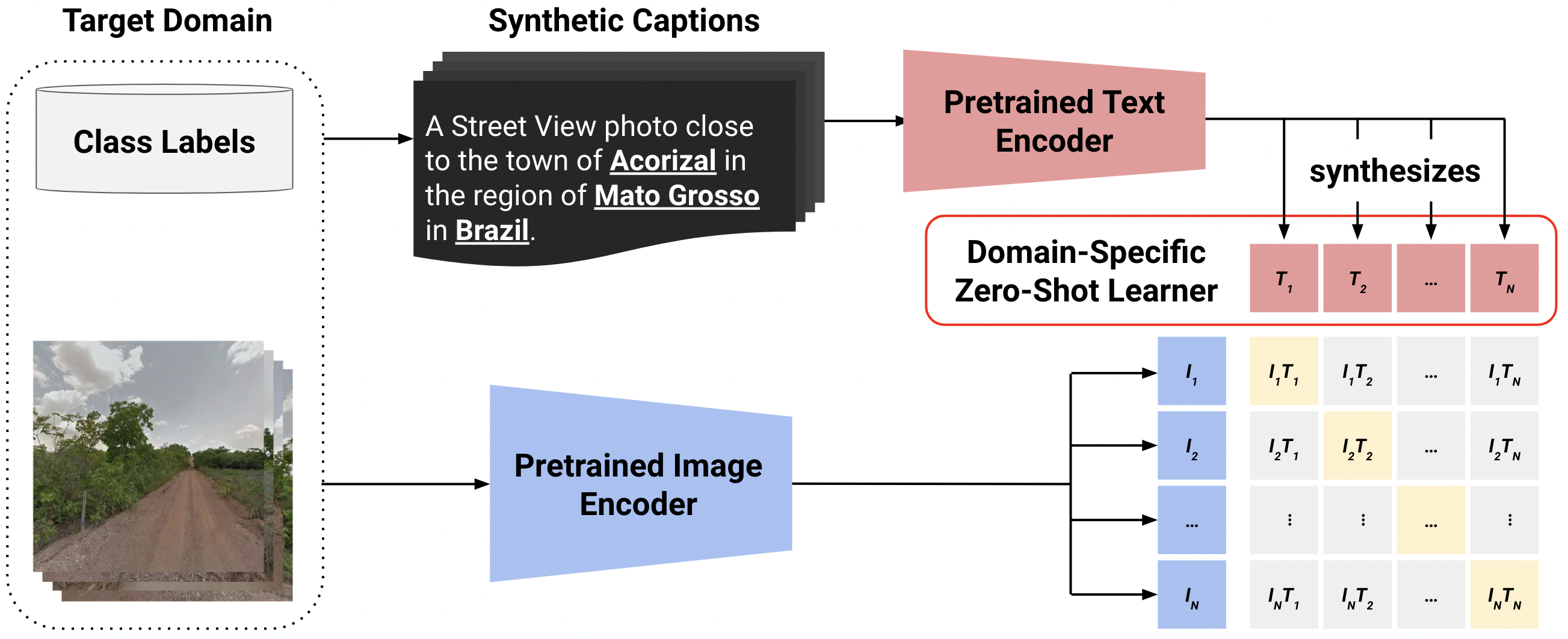
- Pretrain CLIP with synthetic captions derived from a geolocation template to create a domain-specific generalized zero-shot learner each training batch.
- Formulate CLIP’s loss as a combination of generalized-zero-shot loss (GZSL) and vision-representation alignment, enabling meta-learning for GZSL.
- Create StreetCLIP by further pretraining on a 1.1M Street View image dataset with city/region/country-level labels.
- Apply hierarchical linear probing at inference by first predicting country then refining to city within the top 30 cities per country.
- Employ standard CLIP backbones with domain-specific prompts to ground the model in geographic knowledge.
Experimental results
Research questions
- RQ1How can generalized zero-shot learning be improved for open-domain image geolocalization without task-specific finetuning?
- RQ2Can domain-specific synthetic captions ground CLIP to transfer zero-shot capabilities to geolocation tasks?
- RQ3Does hierarchical probing speed up inference while maintaining or improving accuracy in open-domain geolocalization?
- RQ4What are the performance gains of synthetic-caption domain-specific pretraining over vanilla CLIP on ODIG benchmarks?
Key findings
- StreetCLIP achieves state-of-the-art performance on IM2GPS and IM2GPS3K open-domain geolocalization benchmarks under zero-shot inference.
- Synthetic-caption domain-specific pretraining yields 1.3 to 3.4 percentage point gains across distance thresholds compared to zero-shot CLIP.
- StreetCLIP outperforms supervised models trained on over 4 million images at certain thresholds.
- Hierarchical probing improves efficiency and accuracy, especially at larger distance thresholds.
- StreetCLIP maintains zero-shot capability while leveraging domain-specific grounding, suggesting broad applicability to other domains.
Read this paper
Open the full text in the Nubint reader and ask about any passage as you read.
Read this paper on NubintThis review was generated by AI from the original paper. Please check the paper before citing it.