
[Paper Review] Learning Granularity-Unified Representations for Text-to-Image Person Re-identification
This paper proposes LGUR, a transformer-based framework that learns granularity-unified representations for text-to-image person re-identification by aligning fine-grained visual features with coarse textual features. It introduces a Multi-modality Shared Dictionary (MSD) for cross-modal feature reconstruction with cross-modality guidance and foreground-centric optimization, followed by shared prototypes for unified feature extraction, achieving state-of-the-art performance on CUHK-PEDES and ICFG-PEDES with 6.58% and 6.93% Rank-1 accuracy gains, respectively.
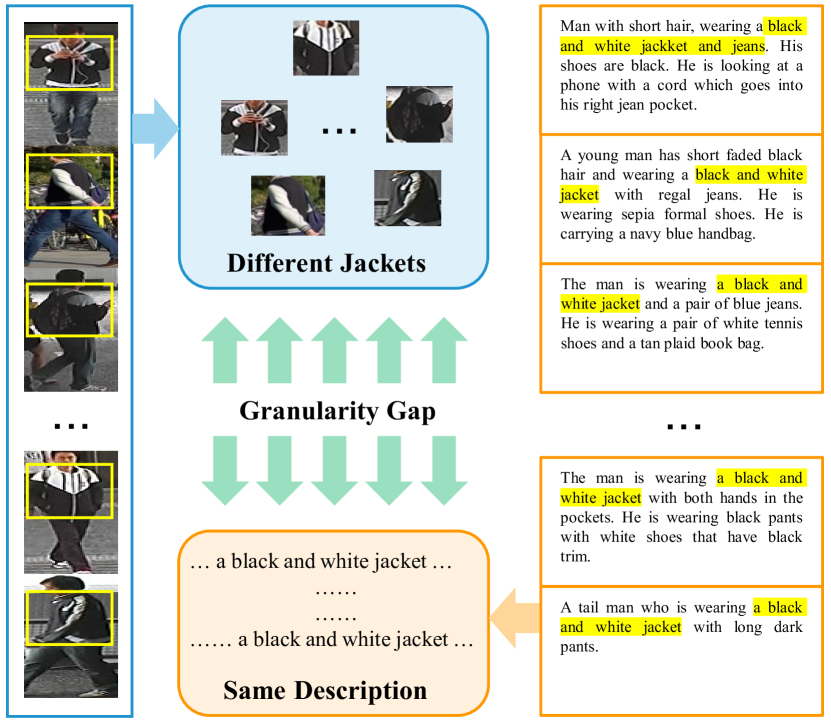
Text-to-image person re-identification (ReID) aims to search for pedestrian images of an interested identity via textual descriptions. It is challenging due to both rich intra-modal variations and significant inter-modal gaps. Existing works usually ignore the difference in feature granularity between the two modalities, i.e., the visual features are usually fine-grained while textual features are coarse, which is mainly responsible for the large inter-modal gaps. In this paper, we propose an end-to-end framework based on transformers to learn granularity-unified representations for both modalities, denoted as LGUR. LGUR framework contains two modules: a Dictionary-based Granularity Alignment (DGA) module and a Prototype-based Granularity Unification (PGU) module. In DGA, in order to align the granularities of two modalities, we introduce a Multi-modality Shared Dictionary (MSD) to reconstruct both visual and textual features. Besides, DGA has two important factors, i.e., the cross-modality guidance and the foreground-centric reconstruction, to facilitate the optimization of MSD. In PGU, we adopt a set of shared and learnable prototypes as the queries to extract diverse and semantically aligned features for both modalities in the granularity-unified feature space, which further promotes the ReID performance. Comprehensive experiments show that our LGUR consistently outperforms state-of-the-arts by large margins on both CUHK-PEDES and ICFG-PEDES datasets. Code will be released at https://github.com/ZhiyinShao-H/LGUR.
Motivation & Objective
- To address the significant modality gap in text-to-image person re-identification caused by differing feature granularities—fine-grained in images and coarse in text.
- To explicitly unify the granularity of visual and textual features through a shared, learnable dictionary and prototype-based mechanism.
- To improve cross-modal alignment by guiding the dictionary learning with textual features and focusing on foreground pedestrian regions.
- To achieve end-to-end learning of unified representations that enhance retrieval performance on benchmark datasets.
Proposed method
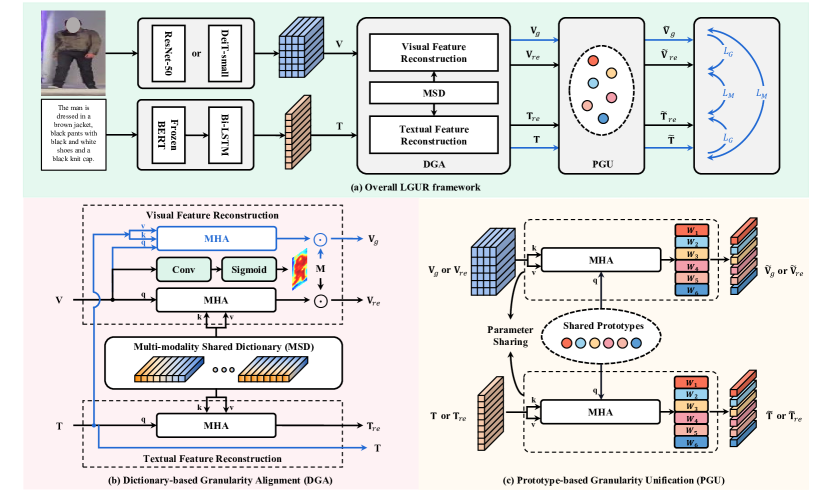
- The framework employs a Dictionary-based Granularity Alignment (DGA) module that reconstructs both visual and textual features using a Multi-modality Shared Dictionary (MSD) via a transformer layer.
- Cross-modality guidance is applied by using the matched textual feature as a value in the same transformer layer to reconstruct visual features, aligning the MSD to the granularity of textual descriptions.
- A foreground-centric reconstruction strategy suppresses background noise by applying a learned foreground mask, improving optimization stability and relevance.
- The Prototype-based Granularity Unification (PGU) module uses shared, learnable prototypes as queries to extract diverse and semantically aligned features from both modalities in the unified space.
- The entire framework is trained end-to-end with joint optimization of the MSD and prototypes, enabling joint granularity unification and representation learning.
- The method is designed to reduce the modality gap without introducing inference-time computational overhead.
Experimental results
Research questions
- RQ1How can we effectively align the granularity gap between fine-grained visual features and coarse textual features in text-to-image ReID?
- RQ2What role does a shared, learnable dictionary play in unifying cross-modal representations while preserving modality-specific semantics?
- RQ3Can cross-modality guidance and foreground-centric reconstruction improve the optimization and performance of the shared dictionary?
- RQ4How does using shared prototypes across modalities enhance feature diversity and alignment in the unified representation space?
- RQ5To what extent does the proposed LGUR framework outperform existing state-of-the-art methods on standard benchmarks?
Key findings
- LGUR achieves a 6.58% absolute improvement in Rank-1 accuracy over the baseline on the CUHK-PEDES dataset.
- On the ICFG-PEDES dataset, LGUR achieves a 6.93% absolute gain in Rank-1 accuracy compared to the baseline.
- The Multi-modality Shared Dictionary (MSD) significantly outperforms both self-attention layers and unshared dictionaries, demonstrating its effectiveness in reducing the granularity gap.
- Shared prototypes in the PGU module yield superior performance compared to unshared prototypes, confirming the benefit of cross-modal prototype sharing.
- Ablation studies confirm that both cross-modality guidance and foreground masking in DGA are essential for optimal MSD learning and performance.
- Qualitative attention visualizations show that matched phrase-patch pairs have similar attention scores on the dictionary atoms, while mismatched pairs do not, validating the model's ability to unify granularity.
Read this paper
Open the full text in the Nubint reader and ask about any passage as you read.
Read this paper on NubintThis review was generated by AI from the original paper. Please check the paper before citing it.