
[Paper Review] Learning Graph-Enhanced Commander-Executor for Multi-Agent Navigation
This paper proposes MAGE-X, a graph-enhanced hierarchical reinforcement learning framework for multi-agent navigation that uses a Goal Commander to assign optimal targets and a GNN-powered Action Executor to improve cooperation through dynamic subgraph construction and goal-aware representation. MAGE-X achieves 100% success rate with 50 agents in MPE and at least 12% higher success rate and 2× data efficiency in 3D quadrotor navigation compared to SOTA MARL baselines.
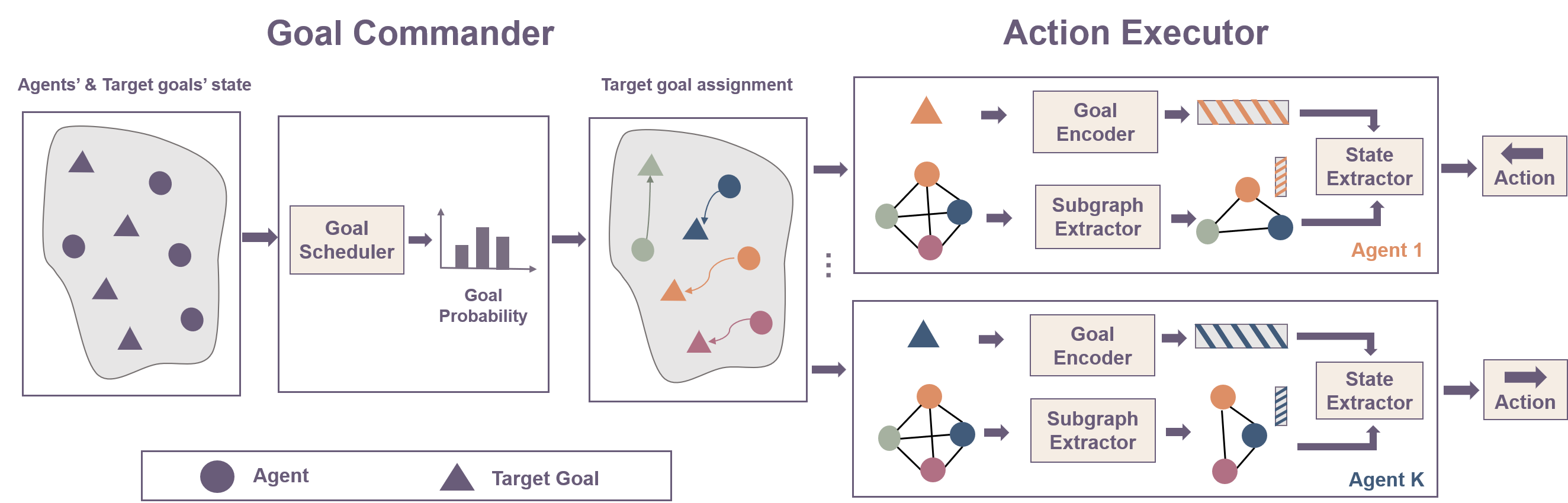
This paper investigates the multi-agent navigation problem, which requires multiple agents to reach the target goals in a limited time. Multi-agent reinforcement learning (MARL) has shown promising results for solving this issue. However, it is inefficient for MARL to directly explore the (nearly) optimal policy in the large search space, which is exacerbated as the agent number increases (e.g., 10+ agents) or the environment is more complex (e.g., 3D simulator). Goal-conditioned hierarchical reinforcement learning (HRL) provides a promising direction to tackle this challenge by introducing a hierarchical structure to decompose the search space, where the low-level policy predicts primitive actions in the guidance of the goals derived from the high-level policy. In this paper, we propose Multi-Agent Graph-Enhanced Commander-Executor (MAGE-X), a graph-based goal-conditioned hierarchical method for multi-agent navigation tasks. MAGE-X comprises a high-level Goal Commander and a low-level Action Executor. The Goal Commander predicts the probability distribution of goals and leverages them to assign each agent the most appropriate final target. The Action Executor utilizes graph neural networks (GNN) to construct a subgraph for each agent that only contains crucial partners to improve cooperation. Additionally, the Goal Encoder in the Action Executor captures the relationship between the agent and the designated goal to encourage the agent to reach the final target. The results show that MAGE-X outperforms the state-of-the-art MARL baselines with a 100% success rate with only 3 million training steps in multi-agent particle environments (MPE) with 50 agents, and at least a 12% higher success rate and 2x higher data efficiency in a more complicated quadrotor 3D navigation task.
Motivation & Objective
- To address the low data efficiency and poor cooperation in multi-agent reinforcement learning (MARL) for large-scale or complex navigation tasks.
- To overcome the limitations of direct MARL policy learning in high-dimensional, multi-agent search spaces.
- To improve target assignment and inter-agent coordination in multi-agent navigation using hierarchical, goal-conditioned learning.
- To enhance cooperation through graph neural networks (GNNs) that dynamically model agent relationships and prioritize key teammates.
- To achieve higher success rates and data efficiency than state-of-the-art MARL methods in both simple and complex environments.
Proposed method
- MAGE-X employs a two-level hierarchical structure: a high-level Goal Commander that predicts the probability distribution of target goals for each agent.
- The Goal Commander assigns final targets to agents, transforming multi-agent navigation into multiple single-agent tasks with goal-directed objectives.
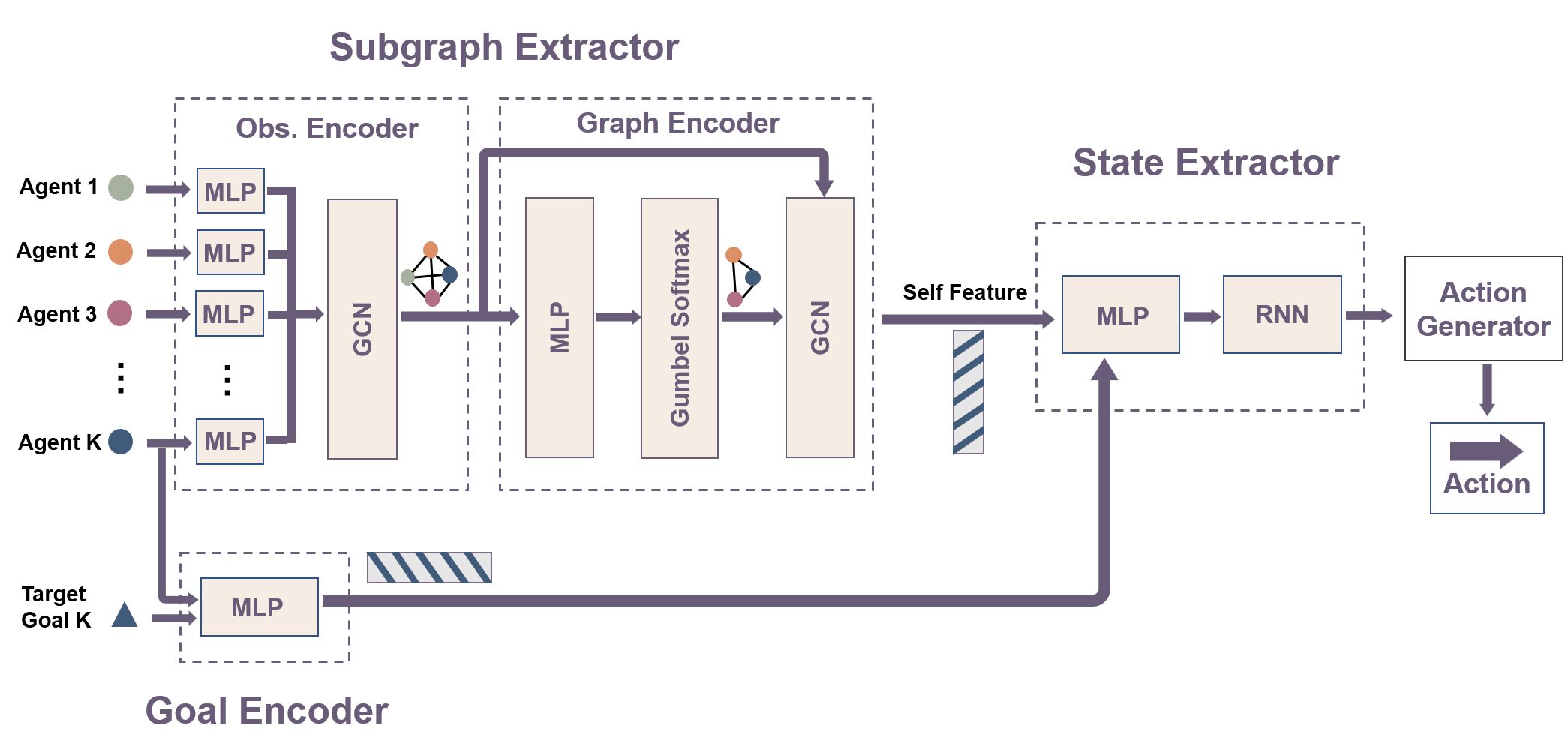
- The low-level Action Executor uses GNNs to construct a subgraph for each agent, focusing only on crucial partners to improve coordination and reduce noise.
- A Goal Encoder in the Action Executor captures the relationship between an agent and its assigned goal, enhancing goal-directed behavior.
- The State Extractor fuses the agent’s GNN-embedded features from its subgraph with goal-specific representations to produce a goal-aware team representation.
- The framework is trained using MAPPO with feature and reward normalization, orthogonal weight initialization, and hyperparameters tuned for stability and sample efficiency.
Experimental results
Research questions
- RQ1Can a goal-conditioned hierarchical framework improve data efficiency and success rates in large-scale multi-agent navigation?
- RQ2How does incorporating GNN-based dynamic subgraph construction enhance cooperation among agents in multi-agent navigation?
- RQ3Can a high-level policy that assigns final targets rather than subgoals lead to better performance than subgoal-based approaches?
- RQ4How does the integration of goal-aware representations in the Action Executor improve target-reaching performance?
- RQ5How does MAGE-X compare to planning-based and SOTA MARL methods in complex 3D environments?
Key findings
- MAGE-X achieves a 100% success rate in the Multi-Agent Particle Environment (MPE) with 50 agents using only 3 million training steps, outperforming all baselines.
- In the more complex 3D quadrotor navigation task, MAGE-X achieves at least a 12% higher success rate than the next-best baseline.
- MAGE-X demonstrates 2× higher data efficiency than SOTA MARL methods in the 3D navigation task, indicating superior sample efficiency.
- Compared to the planning-based MA A* baseline, MAGE-X maintains 100% success rate at N=50, while MA A* drops to 77% success rate, showing MAGE-X's scalability.
- The ablation study confirms that both the Goal Commander and GNN-based subgraph construction are essential for performance, with each component contributing significantly to success and efficiency.
- The use of goal-aware representations in the Action Executor leads to more consistent and accurate target reaching, especially in dense multi-agent scenarios.
Read this paper
Open the full text in the Nubint reader and ask about any passage as you read.
Read this paper on NubintThis review was generated by AI from the original paper. Please check the paper before citing it.