
[Paper Review] Learning Likelihood Ratios with Neural Network Classifiers
This paper proposes optimized loss functions and parametrizations for neural network classifiers to improve likelihood ratio estimation in statistical inference. By systematically evaluating MSE and SQR losses with tunable exponents $p$ and $r$, it identifies $p^*=1.25$ and $r^*=0.1$ as superior choices, reducing mean absolute error by up to 50% on complex datasets including high-energy physics simulations.
The likelihood ratio is a crucial quantity for statistical inference in science that enables hypothesis testing, construction of confidence intervals, reweighting of distributions, and more. Many modern scientific applications, however, make use of data- or simulation-driven models for which computing the likelihood ratio can be very difficult or even impossible. By applying the so-called ``likelihood ratio trick,'' approximations of the likelihood ratio may be computed using clever parametrizations of neural network-based classifiers. A number of different neural network setups can be defined to satisfy this procedure, each with varying performance in approximating the likelihood ratio when using finite training data. We present a series of empirical studies detailing the performance of several common loss functionals and parametrizations of the classifier output in approximating the likelihood ratio of two univariate and multivariate Gaussian distributions as well as simulated high-energy particle physics datasets.
Motivation & Objective
- To improve the accuracy of likelihood ratio estimation in scientific applications where analytical likelihoods are intractable.
- To investigate how different loss functionals and parametrizations of neural network classifiers affect likelihood ratio approximation performance.
- To identify optimal hyperparameters $p$ and $r$ for MSE and SQR loss functions that minimize mean absolute error in likelihood ratio estimation.
- To provide practical, empirically validated recommendations for loss function selection in real-world scientific machine learning workflows.
- To demonstrate that suboptimal loss choices can lead to significant performance degradation, especially in complex or high-dimensional data settings.
Proposed method
- Empirically evaluate four loss functionals: binary cross-entropy, MSE, SQR, and Maximum Likelihood Classifier (MLC) loss.
- Introduce parametrized forms of MSE and SQR losses using tunable exponents $p$ and $r$ to generalize the standard formulations.
- Train neural network classifiers on univariate and multivariate Gaussian distributions, as well as simulated high-energy physics datasets.
- Use the likelihood ratio trick: map classifier output $f(x)$ to the likelihood ratio via $\mathcal{L}(x) = \frac{f(x)}{1-f(x)}$ under balanced class priors.
- Optimize $p$ and $r$ via hyperparameter scans across multiple training runs to minimize mean absolute error (MAE) on test data.
- Compare performance across different loss types and parametrizations using MAE, numerical stability, and convergence behavior.
Experimental results
Research questions
- RQ1How do different loss functionals (e.g., binary cross-entropy, MSE, SQR, MLC) compare in approximating the likelihood ratio under finite training data?
- RQ2What is the impact of parametrizing the classifier output with tunable exponents $p$ and $r$ on likelihood ratio estimation accuracy?
- RQ3Which combination of loss functional and parametrization yields the lowest mean absolute error (MAE) across diverse data distributions, including high-dimensional and physics-inspired datasets?
- RQ4Can optimized values of $p^*$ and $r^*$ be generalized across different datasets, or are they highly dependent on data structure?
- RQ5How does the choice of loss functional affect the geometry of the loss landscape, and what implications does this have for training stability and convergence?
Key findings
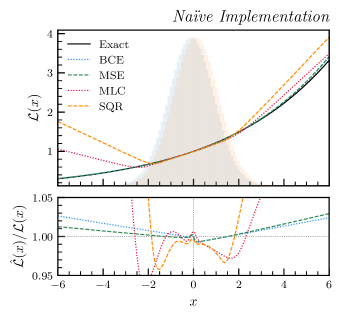
- The Maximum Likelihood Classifier (MLC) loss with exponential parametrization consistently outperforms other loss functionals on complex datasets, including multidimensional Gaussians and simulated high-energy physics data.
- Optimizing the exponents $p$ and $r$ in MSE and SQR losses leads to a 30–50% reduction in mean absolute error on Checker and Circle datasets compared to default values.
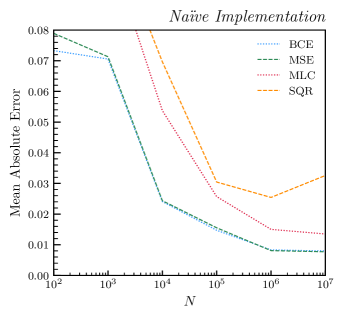
- For large datasets ($N > 10^5$), optimized $p^*=1.25$ and $r^*=0.1$ reduce errors by at least 50% compared to default settings.
- The recommended optimized loss forms are $L_{\text{MSE}}^*[f] = -\int \text{d}x \left( (1-f)^{1.25} p(x|\theta_0) + f^{1.25} p(x|\theta_1) \right)$ and $L_{\text{SQR}}^*[f] = -\int \text{d}x \left( f^{-0.05} p(x|\theta_0) + f^{0.05} p(x|\theta_1) \right)$, which yield lower MAE and better numerical stability.
- On Hyperbola and high-energy physics datasets, no significant improvement was found beyond the tested range $[-2,3]$ for $p$ and $r$, though better values may exist outside this interval.
- Suboptimal loss choices can lead to MAE increases of up to 82% compared to the best-performing configurations, highlighting the importance of careful hyperparameter selection.
Read this paper
Open the full text in the Nubint reader and ask about any passage as you read.
Read this paper on NubintThis review was generated by AI from the original paper. Please check the paper before citing it.