
[Paper Review] Learning Multiscale Consistency for Self-supervised Electron Microscopy Instance Segmentation
This paper proposes a self-supervised pretraining framework for electron microscopy instance segmentation that enforces multiscale consistency through voxel-level reconstruction, cross-attention-based feature matching, and contrastive learning across a feature pyramid. By leveraging a Siamese network with strong and weak augmentations on four large-scale EM datasets, the method achieves state-of-the-art performance, especially with limited fine-tuning data, improving VOI by up to 46.8% on neuron segmentation with only 10 images.
Instance segmentation in electron microscopy (EM) volumes is tough due to complex shapes and sparse annotations. Self-supervised learning helps but still struggles with intricate visual patterns in EM. To address this, we propose a pretraining framework that enhances multiscale consistency in EM volumes. Our approach leverages a Siamese network architecture, integrating both strong and weak data augmentations to effectively extract multiscale features. We uphold voxel-level coherence by reconstructing the original input data from these augmented instances. Furthermore, we incorporate cross-attention mechanisms to facilitate fine-grained feature alignment between these augmentations. Finally, we apply contrastive learning techniques across a feature pyramid, allowing us to distill distinctive representations spanning various scales. After pretraining on four large-scale EM datasets, our framework significantly improves downstream tasks like neuron and mitochondria segmentation, especially with limited finetuning data. It effectively captures voxel and feature consistency, showing promise for learning transferable representations for EM analysis.
Motivation & Objective
- To address the challenge of limited annotations in electron microscopy instance segmentation by developing a self-supervised pretraining framework.
- To improve robustness to complex morphologies in EM volumes through multiscale feature learning.
- To enhance representation quality by enforcing both voxel-level and feature-level consistency across data augmentations.
- To enable strong downstream performance with minimal fine-tuning data, especially in low-data regimes.
- To develop a generalizable pretraining method compatible with both CNN and Transformer backbones.
Proposed method
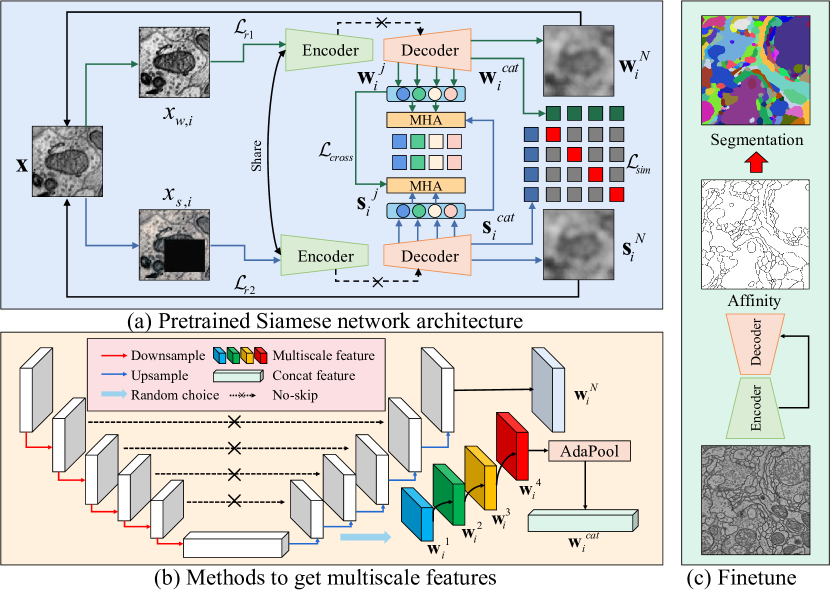
- A Siamese network architecture is used to process weak and strong augmented EM volume inputs, sharing weights to ensure consistent feature learning.
- Voxel-level reconstruction loss is applied to enforce consistency between original and reconstructed volumes from augmented inputs.
- Cross-attention mechanisms enable fine-grained feature matching between features extracted from weak and strong augmentations.
- A hierarchical contrastive learning scheme is applied across a feature pyramid to learn scale-invariant representations.
- Adaptive average pooling standardizes feature dimensions to 16×16×16 across scales for consistent comparison.
- The backbone network is trained without skip connections to avoid degenerate solutions based on encoder features.
Experimental results
Research questions
- RQ1Can enforcing multiscale consistency in self-supervised pretraining improve instance segmentation performance in electron microscopy?
- RQ2How does combining voxel-level reconstruction, feature matching, and contrastive learning affect representation quality in EM volumes?
- RQ3To what extent does the proposed method reduce dependency on annotated data in downstream segmentation tasks?
- RQ4How does the framework perform across different backbone architectures (CNN vs. Transformer) in EM instance segmentation?
- RQ5What is the contribution of each component (reconstruction, cross-attention, contrastive learning) to overall performance?
Key findings
- The proposed method achieved a 46.8% VOI gain on neuron segmentation when fine-tuned with only 10 images from the CREMI dataset.
- With 75 fine-tuning images, the method improved VOI by 8.6% compared to baseline, demonstrating strong low-data generalization.
- On mitochondria segmentation, the method achieved a 35.7% VOI on small mitochondria with only 100 training images, outperforming PCRLv2 by 2.8%.
- Ablation studies showed that combining reconstruction and cross-attention losses yielded the highest performance gain (49.1% VOI improvement) over the baseline.
- The method nearly matched full-dataset fine-tuning performance when using only 1/4 of the data, highlighting data efficiency.
- The framework demonstrated consistent improvements across both ViT and ResNet backbones, indicating broad architectural compatibility.

Read this paper
Open the full text in the Nubint reader and ask about any passage as you read.
Read this paper on NubintThis review was generated by AI from the original paper. Please check the paper before citing it.