
[Paper Review] Learning Neural Constitutive Laws From Motion Observations for Generalizable PDE Dynamics
This paper proposes Neural Constitutive Laws (NCLaw), a hybrid framework that embeds a differentiable, physics-informed neural network within a PDE-based simulator to learn constitutive laws from motion observations. By enforcing physical priors like rotation equivariance and using kinematic data for supervision, NCLaw achieves orders-of-magnitude better generalization than end-to-end neural networks across diverse geometries, initial/boundary conditions, and multi-physics systems—training on just one trajectory.
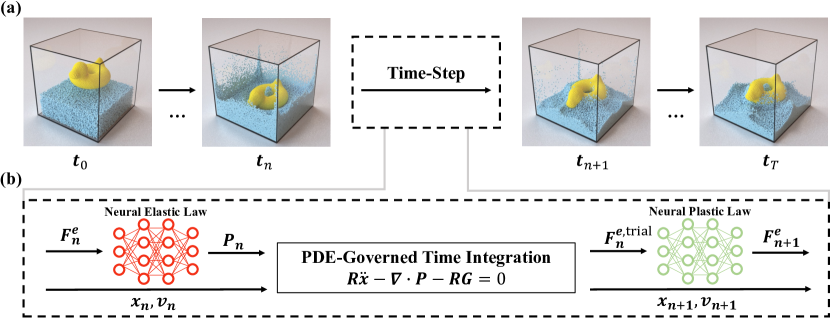
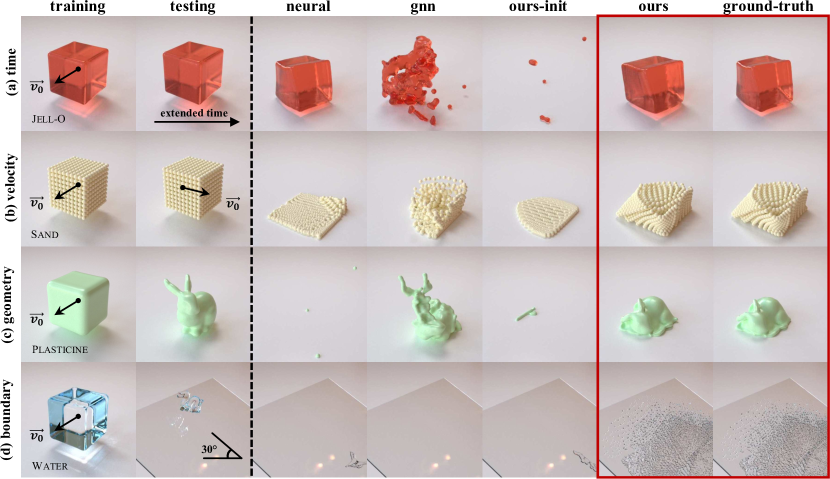
We propose a hybrid neural network (NN) and PDE approach for learning generalizable PDE dynamics from motion observations. Many NN approaches learn an end-to-end model that implicitly models both the governing PDE and constitutive models (or material models). Without explicit PDE knowledge, these approaches cannot guarantee physical correctness and have limited generalizability. We argue that the governing PDEs are often well-known and should be explicitly enforced rather than learned. Instead, constitutive models are particularly suitable for learning due to their data-fitting nature. To this end, we introduce a new framework termed "Neural Constitutive Laws" (NCLaw), which utilizes a network architecture that strictly guarantees standard constitutive priors, including rotation equivariance and undeformed state equilibrium. We embed this network inside a differentiable simulation and train the model by minimizing a loss function based on the difference between the simulation and the motion observation. We validate NCLaw on various large-deformation dynamical systems, ranging from solids to fluids. After training on a single motion trajectory, our method generalizes to new geometries, initial/boundary conditions, temporal ranges, and even multi-physics systems. On these extremely out-of-distribution generalization tasks, NCLaw is orders-of-magnitude more accurate than previous NN approaches. Real-world experiments demonstrate our method's ability to learn constitutive laws from videos.
Motivation & Objective
- To address the limited generalizability and physical consistency of end-to-end neural network models in PDE dynamics.
- To overcome the challenge of acquiring labeled stress-strain data in real-world physical systems.
- To improve generalization in PDE-based dynamics by learning only the constitutive law while enforcing known PDEs and physical priors.
- To enable data-efficient, generalizable modeling of complex dynamical systems using only motion observations.
Proposed method
- Introduce a neural network architecture that enforces physical priors—rotation equivariance and undeformed state equilibrium—by design.
- Embed the neural constitutive model within a differentiable PDE-based physical simulator for end-to-end backpropagation.
- Train the model using a loss function that minimizes the difference between simulated and observed motion trajectories (kinematic data).
- Use back-propagation through time (BPTT) to optimize the neural constitutive model based on trajectory-level supervision.
- Leverage the simulator to generate differentiable predictions, enabling gradient-based optimization without requiring direct stress or strain supervision.
- Apply the framework to a range of materials, including solids, fluids, and multi-physics systems, with zero-shot generalization to unseen geometries and conditions.
Experimental results
Research questions
- RQ1Can a neural network learn constitutive laws from motion observations while preserving fundamental physical symmetries like rotational invariance?
- RQ2How does learning only the constitutive law, while fixing the governing PDE, improve generalization compared to end-to-end neural PDE learning?
- RQ3Can a single neural architecture generalize across diverse materials (e.g., water, Jell-O, sand, plasticine) with minimal data?
- RQ4How does the method perform under extreme out-of-distribution generalization—e.g., new geometries, initial conditions, temporal ranges, and multi-physics systems?
- RQ5To what extent can kinematic data alone (position, velocity) serve as effective supervision when stress data is unavailable?
Key findings
- NCLaw generalizes to new geometries, initial and boundary conditions, and temporal ranges with a single training trajectory, achieving orders-of-magnitude lower error than baseline GNNs.
- On the velocity generalization task, NCLaw achieves a loss of 1.9e-5 with one trajectory, outperforming GNNs even with 100 trajectories (loss: 1.2e-2).
- The method achieves a mean squared error of 2.388e-6 for the elastic right Cauchy-Green tensor, comparable to the labeled baseline (2.381e-6), despite not using direct stress supervision.
- In parameter identification, NCLaw achieves a P-tensor error of 6.1e-1, which is higher than the labeled method (2.6e-3), but this is expected as the labeled method uses ground-truth stress supervision.
- Adding velocity-based auxiliary loss slightly improves performance in 3 out of 4 tasks, but positional supervision alone is sufficient for strong generalization.
- Real-world video-based experiments confirm the method's ability to learn constitutive laws from visual motion data, demonstrating practical applicability.
Read this paper
Open the full text in the Nubint reader and ask about any passage as you read.
Read this paper on NubintThis review was generated by AI from the original paper. Please check the paper before citing it.