
[Paper Review] Learning Object-Compositional Neural Radiance Field for Editable Scene Rendering
This paper proposes an object-compositional neural radiance field that enables high-fidelity novel view synthesis and editable scene rendering in real-world scenes using only posed images and rough 2D instance masks. It introduces a two-pathway architecture with a scene branch for background rendering and an object branch conditioned on learnable activation codes, combined with scene-guided training and a 3D guard mask to resolve occlusion ambiguity and produce sharp object boundaries, achieving state-of-the-art performance in both static view synthesis and dynamic editing tasks.
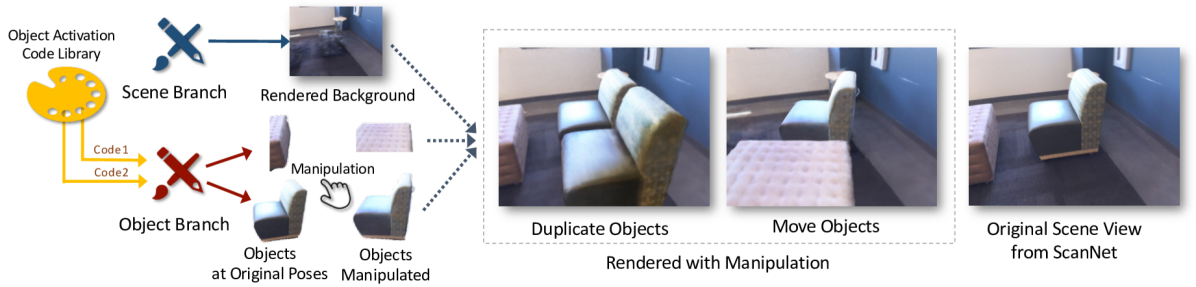
Implicit neural rendering techniques have shown promising results for novel view synthesis. However, existing methods usually encode the entire scene as a whole, which is generally not aware of the object identity and limits the ability to the high-level editing tasks such as moving or adding furniture. In this paper, we present a novel neural scene rendering system, which learns an object-compositional neural radiance field and produces realistic rendering with editing capability for a clustered and real-world scene. Specifically, we design a novel two-pathway architecture, in which the scene branch encodes the scene geometry and appearance, and the object branch encodes each standalone object conditioned on learnable object activation codes. To survive the training in heavily cluttered scenes, we propose a scene-guided training strategy to solve the 3D space ambiguity in the occluded regions and learn sharp boundaries for each object. Extensive experiments demonstrate that our system not only achieves competitive performance for static scene novel-view synthesis, but also produces realistic rendering for object-level editing.
Motivation & Objective
- To enable high-quality, editable scene rendering in real-world, cluttered environments where existing neural rendering methods fail to support object-level manipulation.
- To address the challenge of 3D space ambiguity in occluded regions during training, where object boundaries are hard to learn from partial observations.
- To design a neural rendering system that decomposes scenes into object-compositional components while preserving realistic appearance and geometry.
- To achieve sharp, bleeding-free object rendering without requiring precise 3D annotations or per-object training data.
Proposed method
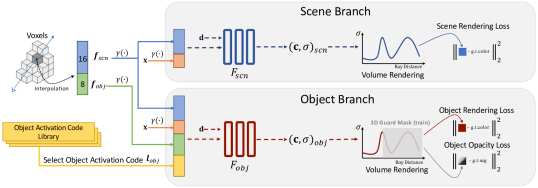
- A two-pathway neural radiance field architecture: a scene branch encodes global geometry and appearance, while an object branch renders individual objects conditioned on learnable object activation codes.
- Scene-guided training with biased ray sampling and online depth prediction to resolve 3D ambiguity in occluded regions, preventing the network from treating occluded object parts as empty space.
- A 3D guard mask mechanism that constrains the network to preserve object integrity by enforcing a spatial boundary around object voxels, improving rendering fidelity.
- Joint rendering of transformed objects (e.g., moved, rotated, duplicated) from the object branch and the background from the scene branch to enable dynamic scene editing.
- Use of 2D instance masks for supervision, with multi-view consistency helping to denoise and refine object boundaries during training.
- The object branch incorporates 3D voxel features to enhance local representational capacity and improve compositional rendering quality.
Experimental results
Research questions
- RQ1Can a neural radiance field be trained to support editable scene rendering in real-world, cluttered scenes using only posed images and rough 2D instance masks?
- RQ2How can 3D space ambiguity in occluded regions be resolved during training to prevent object boundary bleeding and ensure sharp rendering?
- RQ3What architectural design enables both high-fidelity static view synthesis and dynamic object-level editing in a unified framework?
- RQ4To what extent do scene guidance and 3D guard masks improve object rendering quality under partial occlusion?
- RQ5Can the model learn accurate, smooth object boundaries from noisy, 2D instance masks without requiring precise 3D annotations?
Key findings
- The proposed method achieves competitive or superior performance in standard novel-view synthesis metrics (PSNR, SSIM, LPIPS) compared to state-of-the-art methods on real-world ScanNet scenes.
- With scene guidance and a 3D guard mask, the PSNR for occluded objects in ScanNet 0038 reached 34.435, significantly outperforming baseline configurations.
- The 3D guard mask with ε = 0.05 yielded the best rendering quality, and results were robust across different ε values, indicating low sensitivity to hyperparameter choice.
- Object voxel features (f_obj) improved rendering quality, demonstrating that learnable 3D features enhance the model’s ability to represent object-specific details.
- Despite using only rough 2D instance masks, the model generated smooth, high-fidelity 2D object segmentation and sharp object renderings, indicating effective 3D structure inference from 2D supervision.
- Visualizations confirmed that the model successfully learned accurate object boundaries and preserved fine details (e.g., chair handles), even when input masks were noisy or jittery.
Read this paper
Open the full text in the Nubint reader and ask about any passage as you read.
Read this paper on NubintThis review was generated by AI from the original paper. Please check the paper before citing it.