
[Paper Review] Learning Perceptive Bipedal Locomotion over Irregular Terrain
This paper proposes a reinforcement learning-based bipedal locomotion controller that fuses noisy exteroceptive sensor data (e.g., from cameras or LiDAR) with proprioception using a recurrent attention-based belief encoder to form a robust internal representation of irregular terrain. The method outperforms proprioceptive baselines in speed, efficiency, and robustness, achieving near-100% success on 16 cm step heights where the baseline fails at 12 cm.
In this paper we propose a novel bipedal locomotion controller that uses noisy exteroception to traverse a wide variety of terrains. Building on the cutting-edge advancements in attention based belief encoding for quadrupedal locomotion, our work extends these methods to the bipedal domain, resulting in a robust and reliable internal belief of the terrain ahead despite noisy sensor inputs. Additionally, we present a reward function that allows the controller to successfully traverse irregular terrain. We compare our method with a proprioceptive baseline and show that our method is able to traverse a wide variety of terrains and greatly outperforms the state-of-the-art in terms of robustness, speed and efficiency.
Motivation & Objective
- Address the challenge of robust bipedal locomotion over irregular, unseen terrains where traditional state-machine controllers fail to generalize.
- Overcome the limitations of purely proprioceptive controllers that rely on reactive, precautionary behaviors and lack predictive planning.
- Enable efficient and stable locomotion on complex terrains by integrating noisy exteroceptive inputs with proprioception through a learned belief representation.
- Develop a reward function that supports learning diverse gaits and terrain traversal without relying on imitation of predefined trajectories.
- Demonstrate that a controller can learn to trust or disregard noisy exteroceptive data based on reliability, improving robustness in real-world-like conditions.
Proposed method
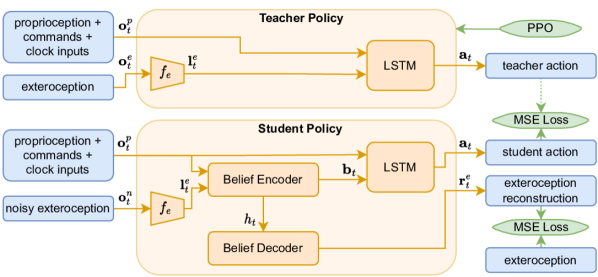
- Use privileged learning: train a teacher policy with access to noise-free terrain observations, then distill its behavior into a student policy that only uses noisy exteroception and proprioception.
- Implement a recurrent belief encoder with self-attention to fuse noisy exteroceptive height maps with proprioceptive state data into a reliable internal terrain belief.
- Employ Proximal Policy Optimization (PPO) for training the student policy to maximize a reward function that encourages forward progress, stability, and terrain traversal.
- Design a curriculum-based training schedule that gradually increases terrain complexity, starting from flat ground and progressing to irregular terrains like stairs and random terrain.
- Use a belief decoder to reconstruct a denoised, accurate terrain representation from the belief encoder output, enabling robust decision-making despite sensor noise.
- Integrate the belief representation into the policy network to condition step planning on predicted terrain ahead, enabling proactive rather than reactive navigation.
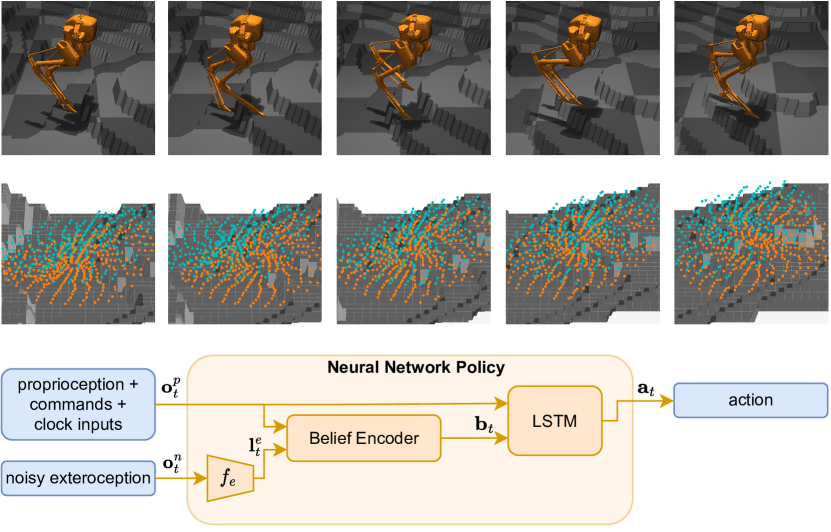
Experimental results
Research questions
- RQ1Can a bipedal locomotion policy learn to reliably traverse irregular and previously unseen terrains using only noisy exteroceptive inputs?
- RQ2How does the integration of a recurrent attention-based belief encoder improve robustness to sensor noise compared to purely proprioceptive control?
- RQ3To what extent can a single neural network policy learn diverse gaits and adapt to varying terrain types using a periodic reward function?
- RQ4How does the performance of an exteroceptive policy compare to a proprioceptive baseline in terms of speed, success rate, and energy efficiency on challenging terrains?
- RQ5Can the policy learn to selectively trust or ignore unreliable exteroceptive inputs (e.g., reflections, transparent surfaces) while maintaining accurate terrain perception?
Key findings
- The exteroceptive policy achieved a 100% success rate traversing staircases with 16 cm step heights, while the proprioceptive baseline failed at 12 cm.
- On the squares terrain, the exteroceptive policy maintained higher average forward speed and better command-following accuracy, especially in the x-direction.
- The belief encoder successfully denoised large, alternating offsets in the exteroceptive height maps, eliminating outliers while preserving accurate terrain structure.
- The policy demonstrated stable and efficient locomotion across diverse terrains, including random terrain and staircases, with minimal reliance on reactive corrections.
- The exteroceptive policy outperformed the proprioceptive baseline in both speed and robustness, with a significant margin in success rate on complex terrains.
- The system learned to dynamically weigh exteroceptive and proprioceptive inputs, effectively ignoring spurious sensor readings such as reflections or transparent surfaces.
Read this paper
Open the full text in the Nubint reader and ask about any passage as you read.
Read this paper on NubintThis review was generated by AI from the original paper. Please check the paper before citing it.