
[Paper Review] Learning Practically Feasible Policies for Online 3D Bin Packing
This paper proposes a deep reinforcement learning approach for online 3D bin packing with partial item sequence observation, using a novel stacking tree for efficient stability analysis, decoupled policy learning for high-resolution spatial placement, and a far-to-near reward function to reduce robotic collision. The method achieves 77.9% space utilization in real-world testing, outperforming humans and state-of-the-art baselines.
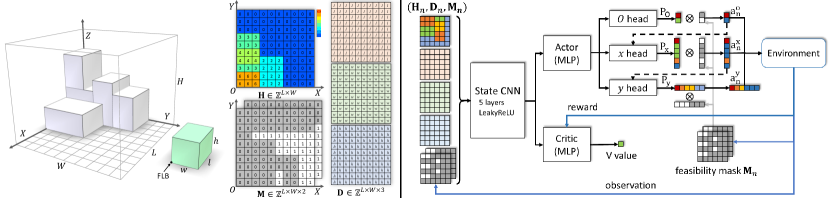
We tackle the Online 3D Bin Packing Problem, a challenging yet practically useful variant of the classical Bin Packing Problem. In this problem, the items are delivered to the agent without informing the full sequence information. Agent must directly pack these items into the target bin stably without changing their arrival order, and no further adjustment is permitted. Online 3D-BPP can be naturally formulated as Markov Decision Process (MDP). We adopt deep reinforcement learning, in particular, the on-policy actor-critic framework, to solve this MDP with constrained action space. To learn a practically feasible packing policy, we propose three critical designs. First, we propose an online analysis of packing stability based on a novel stacking tree. It attains a high analysis accuracy while reducing the computational complexity from $O(N^2)$ to $O(N \log N)$, making it especially suited for RL training. Second, we propose a decoupled packing policy learning for different dimensions of placement which enables high-resolution spatial discretization and hence high packing precision. Third, we introduce a reward function that dictates the robot to place items in a far-to-near order and therefore simplifies the collision avoidance in movement planning of the robotic arm. Furthermore, we provide a comprehensive discussion on several key implemental issues. The extensive evaluation demonstrates that our learned policy outperforms the state-of-the-art methods significantly and is practically usable for real-world applications.
Motivation & Objective
- Address the challenge of online 3D bin packing where item sequences are partially observable and real-time decisions are required.
- Develop a reinforcement learning framework that produces practically feasible, stable, and collision-avoiding packing policies for robotic systems.
- Overcome limitations of prior work in stability analysis accuracy, spatial resolution, and robot motion planning by introducing novel architectural and reward design components.
- Enable high-precision packing with up to 100×100 spatial discretization while maintaining computational efficiency for real-time inference.
- Demonstrate superior performance over human experts and existing algorithms in real-world robotic deployment.
Proposed method
- Proposes a stacking tree data structure to enable online, O(N log N) packing stability analysis with 99.9% accuracy, replacing O(N²) static equilibrium checks.
- Introduces a decoupled policy learning framework that separately models placement decisions along length, width, and orientation dimensions with conditional dependencies.
- Employs an on-policy actor-critic reinforcement learning framework to optimize policies under constrained action spaces in a Markov Decision Process (MDP).
- Designs a far-to-near reward function that encourages placing items from farther to nearer positions, simplifying robotic arm motion planning and reducing collisions.
- Uses RGB-D sensors to detect incoming items in real time, with dynamic k-item lookahead based on camera visibility, enabling BPP-k mode with variable observation windows.
- Applies feasibility masking during training to enforce physical constraints such as bin capacity and stability, ensuring only valid actions are considered.

Experimental results
Research questions
- RQ1Can a deep reinforcement learning agent learn stable, high-precision 3D packing policies under partial sequence observation?
- RQ2How can packing stability be analyzed efficiently and accurately in real-time during RL training?
- RQ3Can decoupled policy learning enable high-resolution spatial discretization without prohibitive computational cost?
- RQ4Does a far-to-near placement reward function significantly reduce robotic collision and simplify motion planning?
- RQ5How does the learned policy compare to human intuition and existing heuristic methods in real-world robotic deployment?
Key findings
- The proposed stacking tree enables O(N log N) stability analysis with 99.9% accuracy, reducing computational cost by orders of magnitude compared to O(N²) methods.
- The decoupled policy learning framework supports up to 100×100 spatial discretization, enabling high-precision packing unachievable with prior methods.
- In real-world testing, the BPP-k method achieved 77.9% space utilization, significantly outperforming human experts (56.3%) and the BPH baseline.
- The method achieved 100% packing stability across 50 test sequences with BPP-1 and BPP-k, demonstrating robustness in real deployment.
- With the collision-free reward, only 0% collision rate was observed in BPP-k mode, compared to 35% without the reward, confirming its effectiveness in motion planning.
- In head-to-head comparisons, the AI agent won 1,772 out of 2,104 trials against human players, showing superior performance to human intuition.
Read this paper
Open the full text in the Nubint reader and ask about any passage as you read.
Read this paper on NubintThis review was generated by AI from the original paper. Please check the paper before citing it.