
[Paper Review] Learning Robust Statistics for Simulation-based Inference under Model Misspecification
The paper introduces a general approach to learn robust statistics for simulation-based inference (SBI) that mitigates model misspecification across SBI methods (NPE, ABC) by regularizing the statistic-learning objective with an MMD-based misspecification penalty.
Simulation-based inference (SBI) methods such as approximate Bayesian computation (ABC), synthetic likelihood, and neural posterior estimation (NPE) rely on simulating statistics to infer parameters of intractable likelihood models. However, such methods are known to yield untrustworthy and misleading inference outcomes under model misspecification, thus hindering their widespread applicability. In this work, we propose the first general approach to handle model misspecification that works across different classes of SBI methods. Leveraging the fact that the choice of statistics determines the degree of misspecification in SBI, we introduce a regularized loss function that penalises those statistics that increase the mismatch between the data and the model. Taking NPE and ABC as use cases, we demonstrate the superior performance of our method on high-dimensional time-series models that are artificially misspecified. We also apply our method to real data from the field of radio propagation where the model is known to be misspecified. We show empirically that the method yields robust inference in misspecified scenarios, whilst still being accurate when the model is well-specified.
Motivation & Objective
- Identify how misspecification affects SBI when using summary statistics.
- Develop a regularized learning objective to obtain robust statistics.
- Demonstrate robustness of the approach across NPE and ABC (and comparison to RNPE).
- Show applicability to synthetic time-series models and a real radio propagation dataset.
Proposed method
- Define misspecification of model-summarizer pairs in SBI and quantify it via a misspecification margin.
- Introduce a robust statistics (RS) loss by adding a regularization term that penalizes discrepancy between simulated and observed statistics.
- Use maximum mean discrepancy (MMD) as the regularization distance to compare distributions of simulated statistics with the observed statistic.
- Learn the summary network jointly with the inference network (NPE) or jointly with the autoencoder (AE) using the RS loss.
- Provide closed-form estimators for the MMD term and describe practical choices (kernel, subset size l, etc.).
- Demonstrate how the regularization weight lambda trades off robustness and information content, interpolating between NPE/ABC and prior.
Experimental results
Research questions
- RQ1How does misspecification affect SBI posteriors produced by NPE and ABC?
- RQ2Can learning robust statistics via RS loss reduce posterior bias under misspecification while preserving performance when well-specified?
- RQ3Is the RS approach general across SBI methods (NPE, ABC) and adaptable to different data modalities?
- RQ4How should the regularization weight lambda be chosen in practice?
Key findings
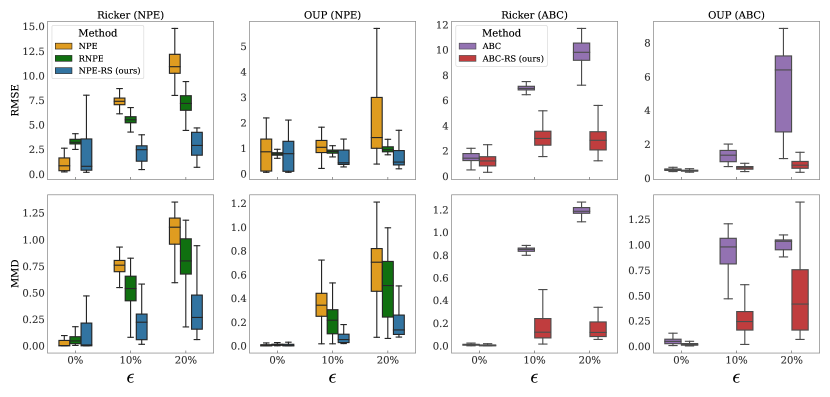
- NPE-RS and ABC-RS outperform their non-robust counterparts under misspecification (epsilon > 0) in RMSE and MMD metrics.
- Under well-specified settings, NPE-RS and ABC-RS perform comparably to standard NPE and ABC.
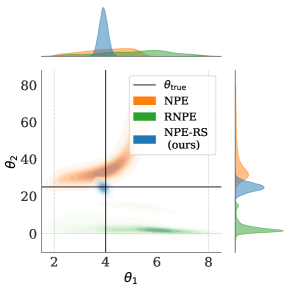
- RNPE improves robustness relative to standard NPE but may still drift away from the true parameter, while NPE-RS stays closer to the true value.
- The RS framework yields robustness to prior misspecification as well, keeping posteriors near the true parameters when the prior excludes them.
- The approach remains accurate when the model is well-specified and provides robust inference across time-series models (Ricker, OU) and a real radio propagation dataset.
Read this paper
Open the full text in the Nubint reader and ask about any passage as you read.
Read this paper on NubintThis review was generated by AI from the original paper. Please check the paper before citing it.