
[Paper Review] Learning Roles with Emergent Social Value Orientations
This paper proposes RESVO, a novel multi-agent reinforcement learning framework that transforms role learning into emergent social value orientation (SVO) formation by symmetrically endowing agents with altruism to share rewards. It uses an SVO-based role embedding space with a rank regularizer and mutual information maximizer, achieving stable division of labor and superior performance in intertemporal social dilemmas across diverse tasks.
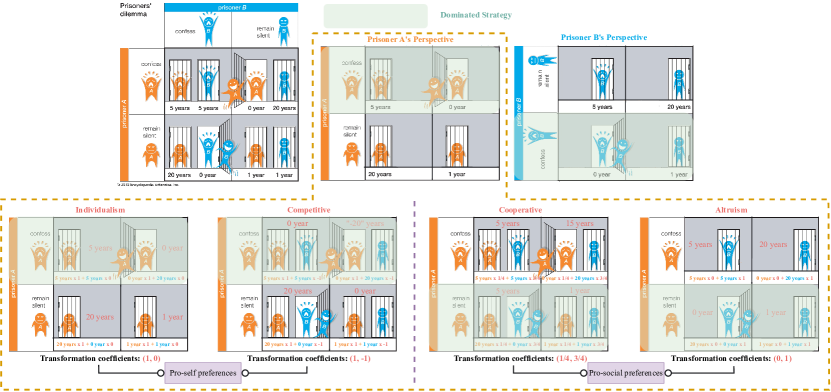
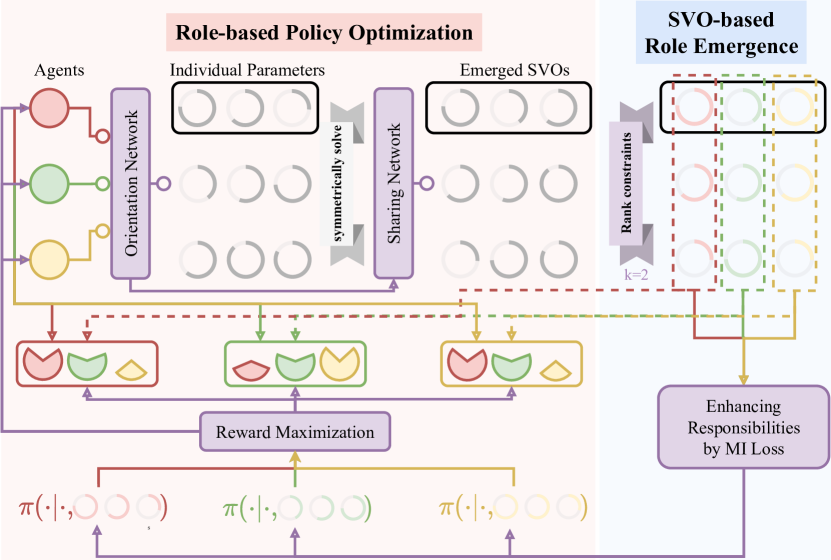
Social dilemmas can be considered situations where individual rationality leads to collective irrationality. The multi-agent reinforcement learning community has leveraged ideas from social science, such as social value orientations (SVO), to solve social dilemmas in complex cooperative tasks. In this paper, by first introducing the typical "division of labor or roles" mechanism in human society, we provide a promising solution for intertemporal social dilemmas (ISD) with SVOs. A novel learning framework, called Learning Roles with Emergent SVOs (RESVO), is proposed to transform the learning of roles into the social value orientation emergence, which is symmetrically solved by endowing agents with altruism to share rewards with other agents. An SVO-based role embedding space is then constructed by individual conditioning policies on roles with a novel rank regularizer and mutual information maximizer. Experiments show that RESVO achieves a stable division of labor and cooperation in ISDs with different complexity.
Motivation & Objective
- To address intertemporal social dilemmas (ISDs) in multi-agent reinforcement learning by leveraging human-like division of labor as a mechanism for sustainable cooperation.
- To model role emergence not as predefined assignments but as a dynamic outcome of social value orientation (SVO) emergence during training.
- To design a symmetric, altruism-driven learning framework that enables agents to share rewards with varying weights, promoting stable cooperation.
- To construct an SVO-based role embedding space using a rank regularizer and mutual information maximizer to ensure meaningful and distinct role differentiation.
- To empirically validate that static division of labor via SVO emergence outperforms dynamic reward-passing methods in tasks with fixed role assignments.
Proposed method
- Introduce a symmetric altruism mechanism where agents share rewards with others using learnable weights, enabling balanced reward distribution and promoting collective welfare.
- Formulate role learning as the emergence of distinct social value orientations (SVOs), where each agent’s SVO reflects its cooperative or competitive tendencies toward others.
- Construct an SVO-based role embedding space using a rank regularizer to control the number of distinct roles and a mutual information maximizer to preserve SVO diversity and distinctiveness.
- Train agents using a centralized training with decentralized execution (CTDE) paradigm, where individual policies are conditioned on SVO embeddings to enable role-specific behaviors.
- Use a contrastive learning objective to align similar SVOs and disentangle dissimilar ones, ensuring that agents with similar roles cluster in the SVO space.
- Apply a rank constraint on the SVO embedding matrix to control the number of emergent roles, with ablation studies showing optimal performance at moderate rank values (e.g., k=2 or k=4).
Experimental results
Research questions
- RQ1Can SVO emergence serve as a stable and scalable mechanism for role formation in multi-agent systems facing intertemporal social dilemmas?
- RQ2How does the rank constraint on SVO embeddings affect the number and distinctiveness of emergent roles and overall system performance?
- RQ3Does static division of labor via SVO-based role embedding outperform dynamic reward-passing mechanisms in terms of convergence speed and social welfare?
- RQ4Can the SVO-based role embedding module be integrated as a plug-in component into existing SVO-based MARL methods to boost performance?
- RQ5What is the relationship between SVO diversity, role distinctiveness, and collective efficiency in complex cooperative tasks?
Key findings
- RESVO achieves stable division of labor in intertemporal social dilemmas (ISDs) across three diverse tasks: Iterated Prisoner’s Dilemma, 3-player Escape Room, and 10-player Cleanup.
- With optimal rank constraints (e.g., k=2 or k=4), RESVO converges to higher social welfare than baseline methods, particularly in tasks with fixed role assignments.
- When the rank constraint is too low (e.g., k=2), agents converge to similar SVOs, leading to poor performance due to role indistinguishability or collective free-riding.
- When the rank constraint is too high (e.g., k=9), SVOs become overly random, causing agents to adopt erratic policies and perform useless work, degrading performance.
- The SVO-based role embedding mechanism enables better role differentiation than baseline methods, with visualizations showing clear clustering of similar roles in the SVO space.
- RESVO outperforms sanction-based LIO, SVO-based LToS, and D3C in tasks requiring stable, static role assignment, demonstrating the advantage of static division of labor in such settings.
Read this paper
Open the full text in the Nubint reader and ask about any passage as you read.
Read this paper on NubintThis review was generated by AI from the original paper. Please check the paper before citing it.