
[Paper Review] Learning Sample Difficulty from Pre-trained Models for Reliable Prediction
This paper proposes a novel method to improve model reliability by learning sample difficulty from pre-trained models using relative Mahalanobis distance (RMD) in feature space, enabling adaptive entropy regularization that reduces overconfidence. The approach boosts accuracy and uncertainty calibration—achieving +0.55% top-1 accuracy and -3.7% ECE on ImageNet1k with ResNet34—while outperforming baselines in selective classification and OOD detection.
Large-scale pre-trained models have achieved remarkable success in many applications, but how to leverage them to improve the prediction reliability of downstream models is undesirably under-explored. Moreover, modern neural networks have been found to be poorly calibrated and make overconfident predictions regardless of inherent sample difficulty and data uncertainty. To address this issue, we propose to utilize large-scale pre-trained models to guide downstream model training with sample difficulty-aware entropy regularization. Pre-trained models that have been exposed to large-scale datasets and do not overfit the downstream training classes enable us to measure each training sample's difficulty via feature-space Gaussian modeling and relative Mahalanobis distance computation. Importantly, by adaptively penalizing overconfident prediction based on the sample difficulty, we simultaneously improve accuracy and uncertainty calibration across challenging benchmarks (e.g., +0.55% ACC and -3.7% ECE on ImageNet1k using ResNet34), consistently surpassing competitive baselines for reliable prediction. The improved uncertainty estimate further improves selective classification (abstaining from erroneous predictions) and out-of-distribution detection.
Motivation & Objective
- To improve the reliability of deep learning models by enhancing uncertainty calibration and reducing overconfidence in predictions.
- To address the limitation that standard cross-entropy loss leads to overconfident predictions, especially on hard or ambiguous samples.
- To leverage large-scale pre-trained models as a source of robust, task-agnostic sample difficulty estimation for downstream fine-tuning.
- To develop a computationally efficient, scalable method that simultaneously improves accuracy and calibration without sacrificing performance.
Proposed method
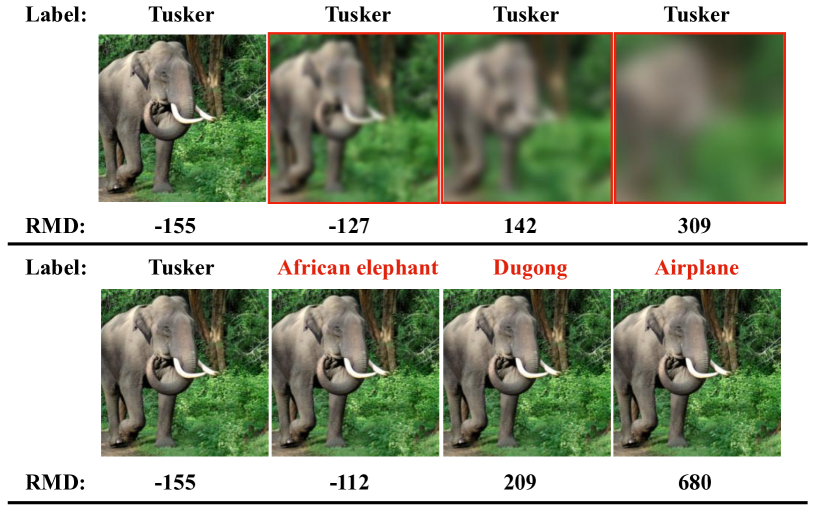
- Measure sample difficulty via Gaussian modeling of features from a pre-trained model, using the relative Mahalanobis distance (RMD) as a score.
- Compute RMD in the feature space of pre-trained models (e.g., CLIP-ViT-B) to quantify how typical or outlier-like each training sample is.
- Use the RMD score as an instance-wise adaptive weighting factor in an entropy regularization term during downstream training.
- Modify the standard cross-entropy loss by adding an adaptive entropic regularizer that penalizes overconfident predictions more strongly for hard samples.
- Train the downstream model with this difficulty-aware regularization to improve both predictive accuracy and uncertainty calibration.
- Apply the method across diverse benchmarks, including i.i.d., corrupted, and out-of-distribution settings, to validate generalization.
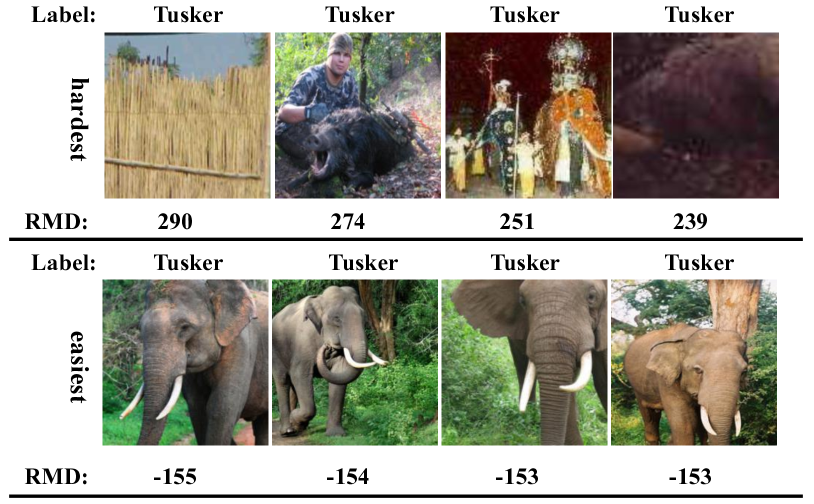
Experimental results
Research questions
- RQ1Can pre-trained models be used to reliably estimate sample difficulty in a way that improves downstream model calibration?
- RQ2How does RMD-based sample difficulty estimation compare to other methods like frequency-based ranking or K-means in measuring intrinsic sample difficulty?
- RQ3Can adaptive entropy regularization based on learned difficulty improve both accuracy and uncertainty calibration simultaneously?
- RQ4Does the proposed method outperform existing uncertainty regularization techniques in terms of ECE and selective classification performance?
- RQ5Is the method scalable and effective across different architectures and datasets, including corrupted and out-of-distribution settings?
Key findings
- The proposed method achieves +0.55% top-1 accuracy and -3.7% ECE on ImageNet1k using ResNet34, significantly outperforming standard cross-entropy training.
- RMD-based difficulty scoring leads to better uncertainty calibration than constant-weighted entropy regularization, with ECE reduced from 2.272% (CRL) to 1.602% on ImageNet1k.
- The method consistently improves performance across multiple benchmarks, including CIF-10, CIF-100, and corrupted ImageNet, demonstrating generalization.
- Among distance measures, RMD outperforms K-means and Mahalanobis distance in both accuracy and ECE, with 74.11% top-1 accuracy and 1.613% ECE on ImageNet1k.
- The method improves selective classification and out-of-distribution detection by providing more reliable uncertainty estimates.
- CLIP-ViT-B provides the most effective pre-trained features for difficulty estimation, outperforming other models like MAE-ViT-B and DINOv2 in ECE reduction.
Read this paper
Open the full text in the Nubint reader and ask about any passage as you read.
Read this paper on NubintThis review was generated by AI from the original paper. Please check the paper before citing it.