
[Paper Review] Learning stiff chemical kinetics using extended deep neural operators
This paper proposes an extended DeepONet framework—featuring autoencoder integration and a novel Partition-of-Unity (PoU-)DeepONet—to learn solution propagators for stiff chemical kinetics problems. By training on reduced latent representations of initial conditions, the model achieves <0.01% relative L2 error and enables fast inference (~10⁻² seconds), significantly outperforming traditional solvers in computational efficiency while maintaining high accuracy across complex syngas and benchmark kinetic systems.
We utilize neural operators to learn the solution propagator for the challenging chemical kinetics equation. Specifically, we apply the deep operator network (DeepONet) along with its extensions, such as the autoencoder-based DeepONet and the newly proposed Partition-of-Unity (PoU-) DeepONet to study a range of examples, including the ROBERS problem with three species, the POLLU problem with 25 species, pure kinetics of the syngas skeletal model for $CO/H_2$ burning, which contains 11 species and 21 reactions and finally, a temporally developing planar $CO/H_2$ jet flame (turbulent flame) using the same syngas mechanism. We have demonstrated the advantages of the proposed approach through these numerical examples. Specifically, to train the DeepONet for the syngas model, we solve the skeletal kinetic model for different initial conditions. In the first case, we parametrize the initial conditions based on equivalence ratios and initial temperature values. In the second case, we perform a direct numerical simulation of a two-dimensional temporally developing $CO/H_2$ jet flame. Then, we initialize the kinetic model by the thermochemical states visited by a subset of grid points at different time snapshots. Stiff problems are computationally expensive to solve with traditional stiff solvers. Thus, this work aims to develop a neural operator-based surrogate model to solve stiff chemical kinetics. The operator, once trained offline, can accurately integrate the thermochemical state for arbitrarily large time advancements, leading to significant computational gains compared to stiff integration schemes.
Motivation & Objective
- To address the computational bottleneck of stiff chemical kinetics in reactive CFD simulations.
- To develop a data-driven surrogate model that can extrapolate over large time advancements beyond chemistry time scales.
- To improve efficiency and accuracy in modeling complex, multi-species combustion systems like CO/H₂ syngas flames.
- To reduce reliance on computationally expensive integration schemes or model reduction techniques that compromise physical fidelity.
- To enable real-time or near-real-time simulation of transient combustion processes using trained neural operators.
Proposed method
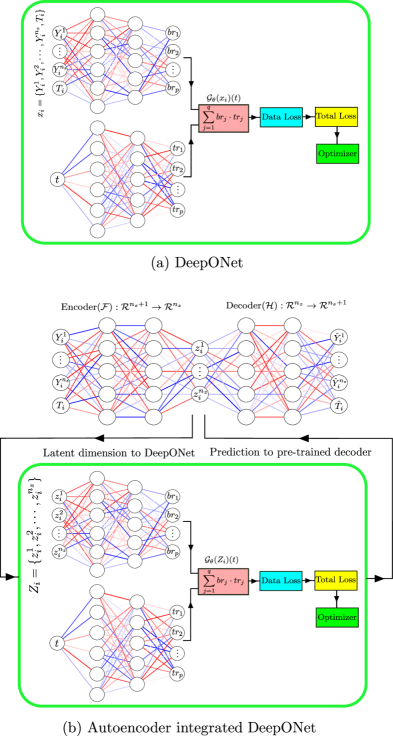
- Employ the DeepONet architecture to learn the solution propagator mapping initial conditions to time-evolved thermochemical states.
- Integrate an autoencoder to compress high-dimensional initial condition data into a low-dimensional latent space, reducing training cost and improving generalization.
- Use the Partition-of-Unity (PoU-)DeepONet to enhance local approximation accuracy across diverse input distributions.
- Train the model on synthetic initial conditions parameterized by equivalence ratio and temperature, and on direct numerical simulation snapshots from a 2D turbulent jet flame.
- Apply normalization on logarithmic values of training data to stabilize learning and improve convergence.
- Use the decoder to reconstruct full-state solutions from latent predictions, ensuring fidelity in the original state space.
Experimental results
Research questions
- RQ1Can DeepONet and its extensions accurately learn and generalize solution propagators for stiff chemical kinetics systems?
- RQ2How does the autoencoder-integrated DeepONet framework compare to standard DeepONet in terms of training cost and inference accuracy?
- RQ3To what extent can the trained operator extrapolate to out-of-distribution initial conditions or long-time advancements?
- RQ4Can the framework maintain high accuracy when applied to complex, real-world combustion systems such as a turbulent CO/H₂ jet flame?
- RQ5What is the computational gain in inference time and training efficiency compared to conventional stiff ODE solvers?
Key findings
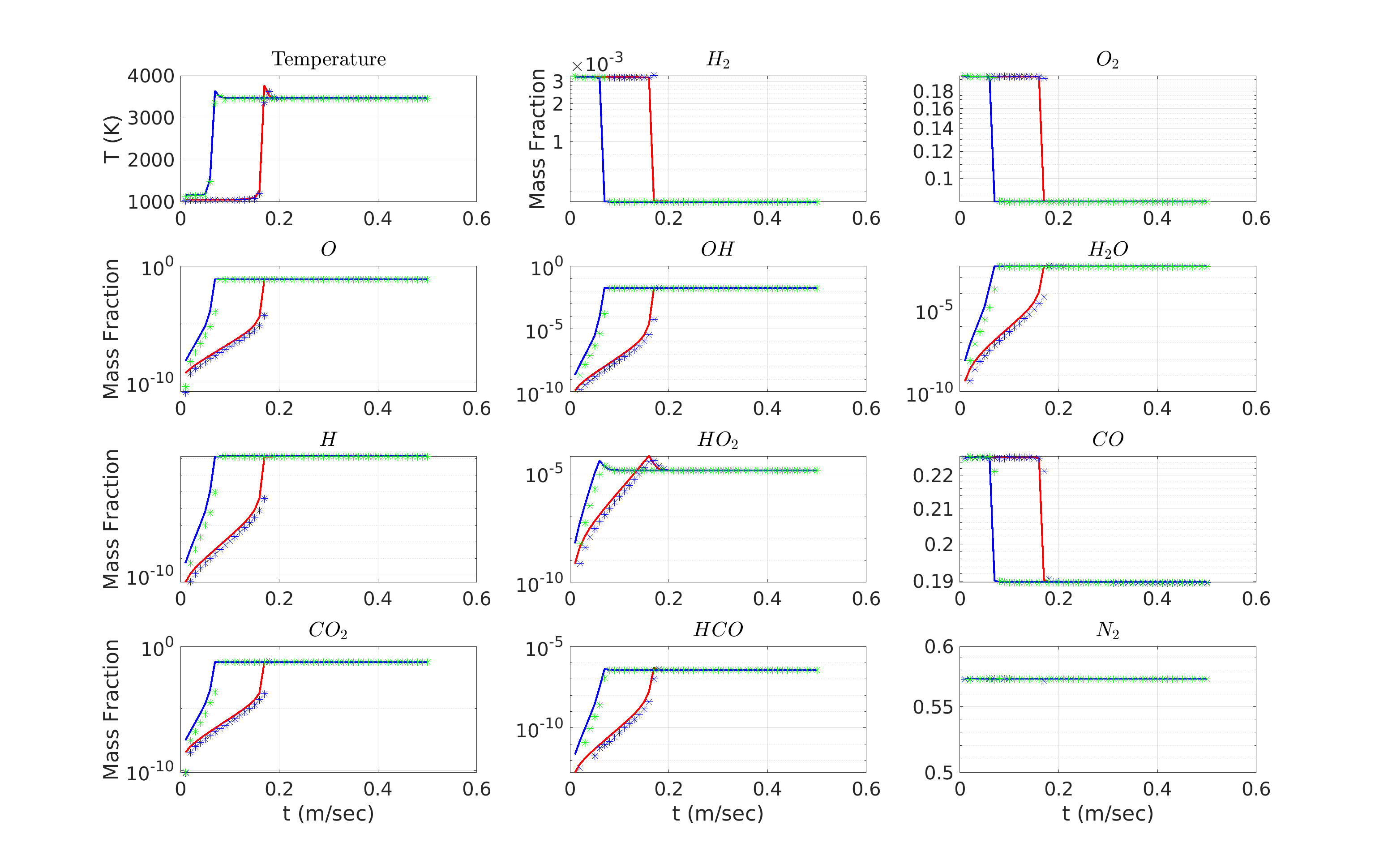
- The autoencoder-integrated DeepONet achieved a mean relative L2 error of 0.01% on the latent space and 0.01% on the reconstructed full-state solution for the syngas model.
- Training time was reduced by a factor of ~5.7 for Example 3 and ~3.8 for Example 4 when using AE+DeepONet versus standard DeepONet.
- Inference time on unseen test samples was approximately 10⁻² seconds, enabling near-instantaneous solution prediction.
- The PoU-DeepONet and AE+DeepONet frameworks demonstrated robust performance on both benchmark problems (ROBERS, POLLU) and real combustion scenarios.
- The model successfully extrapolated over time scales orders of magnitude beyond the training window, demonstrating strong generalization capability.
- The approach significantly outperformed traditional stiff solvers in computational efficiency while preserving physical fidelity.
Read this paper
Open the full text in the Nubint reader and ask about any passage as you read.
Read this paper on NubintThis review was generated by AI from the original paper. Please check the paper before citing it.