
[Paper Review] Learning to Compare Longitudinal Images
This paper proposes PaIRNet, a self-supervised and supervised deep learning model that compares pairs of longitudinal medical images to detect meaningful temporal changes while ignoring nuisance variations like contrast or orientation shifts. By training on temporal ordering or ground-truth change labels, PaIRNet localizes and quantifies clinically relevant changes—such as tumor growth or brain atrophy—without pre-processing, outperforming state-of-the-art methods in both quantification and visualization tasks.
Longitudinal studies, where a series of images from the same set of individuals are acquired at different time-points, represent a popular technique for studying and characterizing temporal dynamics in biomedical applications. The classical approach for longitudinal comparison involves normalizing for nuisance variations, such as image orientation or contrast differences, via pre-processing. Statistical analysis is, in turn, conducted to detect changes of interest, either at the individual or population level. This classical approach can suffer from pre-processing issues and limitations of the statistical modeling. For example, normalizing for nuisance variation might be hard in settings where there are a lot of idiosyncratic changes. In this paper, we present a simple machine learning-based approach that can alleviate these issues. In our approach, we train a deep learning model (called PaIRNet, for Pairwise Image Ranking Network) to compare pairs of longitudinal images, with or without supervision. In the self-supervised setup, for instance, the model is trained to temporally order the images, which requires learning to recognize time-irreversible changes. Our results from four datasets demonstrate that PaIRNet can be very effective in localizing and quantifying meaningful longitudinal changes while discounting nuisance variation. Our code is available at \url{https://github.com/heejong-kim/learning-to-compare-longitudinal-images.git}
Motivation & Objective
- To address the challenge of distinguishing clinically meaningful longitudinal changes from nuisance variations in medical imaging.
- To develop a model that bypasses traditional pre-processing steps like image registration by learning time-irreversible patterns directly from data.
- To enable both individual-level change detection and population-level temporal pattern learning without relying on manual annotations or complex statistical modeling.
- To demonstrate that self-supervised learning via temporal ordering can effectively capture longitudinal changes even without ground-truth labels.
- To provide interpretable visualizations of longitudinal changes using activation maps, improving clinical interpretability.
Proposed method
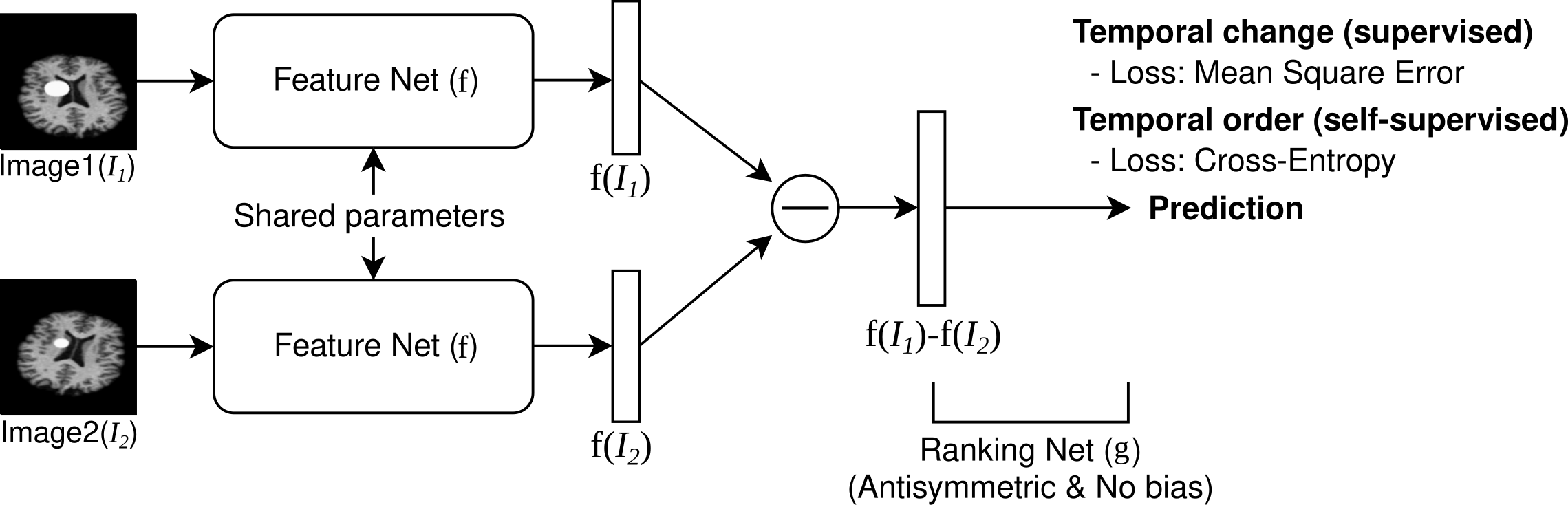
- PaIRNet uses a Siamese neural network architecture to process pairs of longitudinal images and learn a joint embedding space.
- In the self-supervised setting, the model is trained to predict the correct temporal order of image pairs, leveraging the assumption that meaningful changes are time-irreversible.
- In the supervised setting, the model predicts a target variable such as tumor volume difference, using ground-truth change labels.
- The model employs a contrastive learning objective to encourage embeddings of temporally ordered pairs to be closer than those of reversed pairs.
- Activation maps are generated using class activation mapping (CAM) techniques to visualize regions of significant longitudinal change.
- The approach does not require image registration or other pre-processing steps, relying instead on shared temporal patterns across subjects.
Experimental results
Research questions
- RQ1Can a self-supervised learning approach based on temporal ordering effectively detect meaningful longitudinal changes in medical images without ground-truth labels?
- RQ2How does PaIRNet compare to existing supervised and self-supervised methods in quantifying longitudinal change across diverse datasets?
- RQ3To what extent can PaIRNet localize changes at the individual level while suppressing inter-subject variability and nuisance variations?
- RQ4Does the self-supervised temporal ordering task yield comparable performance to supervised learning in change quantification?
- RQ5Can PaIRNet’s visualizations accurately reflect known biological changes, such as brain atrophy or tumor growth, without relying on pre-processing?
Key findings
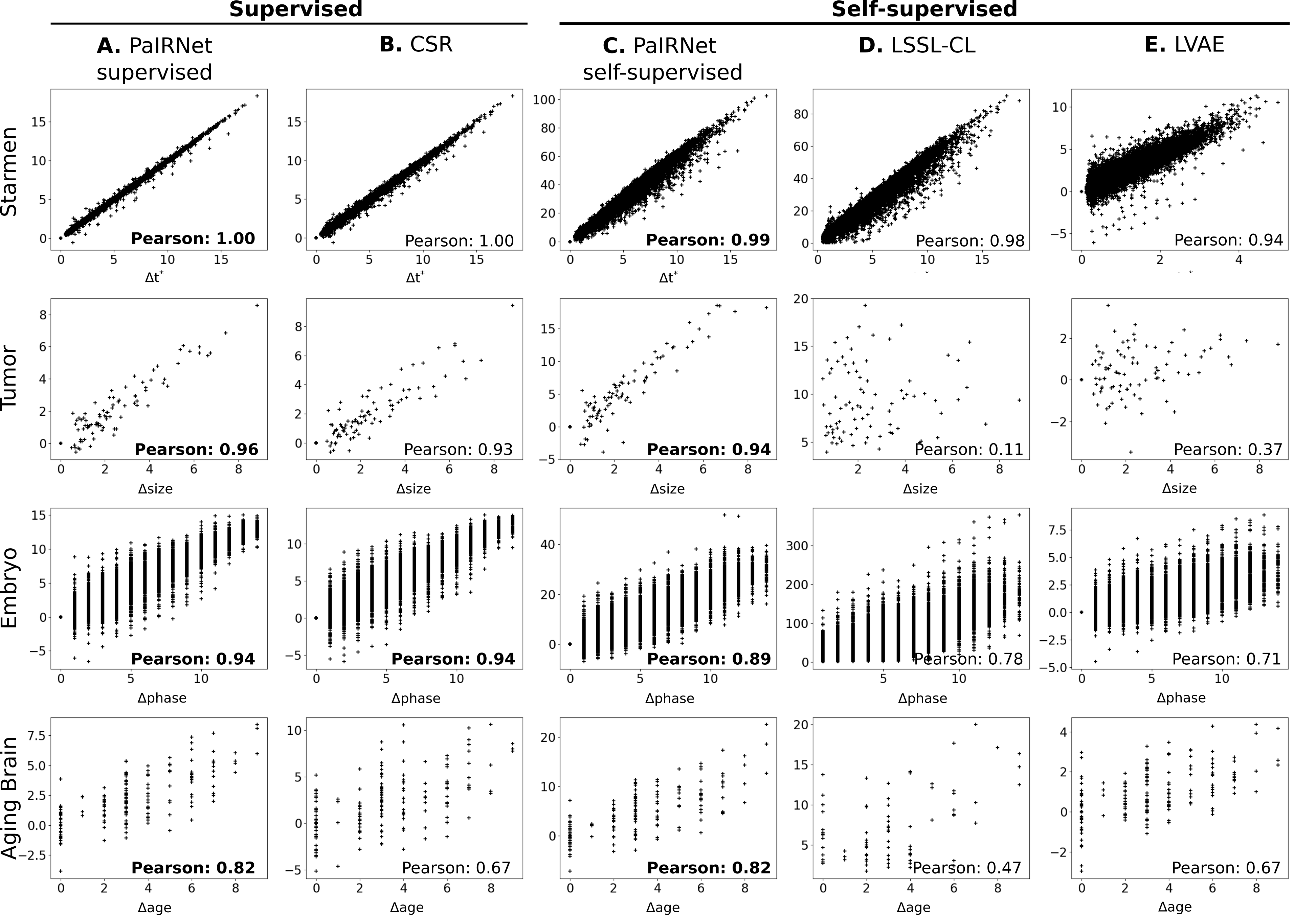
- Self-supervised PaIRNet achieved correlation scores close to those of supervised PaIRNet across all four datasets, demonstrating the effectiveness of temporal ordering as a self-supervised signal.
- On the Starmen and Embryo datasets, where longitudinal changes were larger than inter-subject variation, self-supervised PaIRNet outperformed LSSL-CL and LVAE in change quantification.
- In the brain aging and tumor datasets, where inter-subject variation was high, supervised PaIRNet significantly outperformed CSR, indicating its robustness in complex scenarios.
- PaIRNet’s activation maps successfully highlighted biologically relevant regions—such as ventricles in aging or tumor growth—while suppressing spurious changes due to motion or location shifts.
- The self-supervised model’s localization performance was comparable to the supervised version, underscoring the utility of temporal ordering as a proxy for meaningful change.
- Visualizations from PaIRNet clearly distinguished between real longitudinal changes and artifacts, unlike CSR, which often attended to irrelevant regions outside the anatomical structures of interest.
Read this paper
Open the full text in the Nubint reader and ask about any passage as you read.
Read this paper on NubintThis review was generated by AI from the original paper. Please check the paper before citing it.