
[Paper Review] Learning to Order for Inventory Systems with Lost Sales and Uncertain Supplies
This paper proposes an online learning algorithm for lost-sales inventory systems with stochastic lead times and uncertain supply, where both demand and supply distributions are unknown. By leveraging censored data through a novel simulation technique and a high-probability coupling argument, the algorithm achieves a regret bound of $\tilde{O}(L + \sqrt{T})$ against the optimal constant-order policy, representing the first finite-sample $\tilde{O}(\sqrt{T})$ regret in this setting with supply uncertainty.
We consider a stochastic lost-sales inventory control system with a lead time $L$ over a planning horizon $T$. Supply is uncertain, and is a function of the order quantity (due to random yield/capacity, etc). We aim to minimize the $T$-period cost, a problem that is known to be computationally intractable even under known distributions of demand and supply. In this paper, we assume that both the demand and supply distributions are unknown and develop a computationally efficient online learning algorithm. We show that our algorithm achieves a regret (i.e. the performance gap between the cost of our algorithm and that of an optimal policy over $T$ periods) of $O(L+\sqrt{T})$ when $L\geq\log(T)$. We do so by 1) showing our algorithm cost is higher by at most $O(L+\sqrt{T})$ for any $L\geq 0$ compared to an optimal constant-order policy under complete information (a well-known and widely-used algorithm) and 2) leveraging its known performance guarantee from the existing literature. To the best of our knowledge, a finite-sample $O(\sqrt{T})$ (and polynomial in $L$) regret bound when benchmarked against an optimal policy is not known before in the online inventory control literature. A key challenge in this learning problem is that both demand and supply data can be censored; hence only truncated values are observable. We circumvent this challenge by showing that the data generated under an order quantity $q^2$ allows us to simulate the performance of not only $q^2$ but also $q^1$ for all $q^1
Motivation & Objective
- To address the challenge of inventory control under both demand and supply uncertainty, where distributions are unknown and data is censored.
- To develop a computationally efficient online learning algorithm that can adapt to unknown demand and supply distributions in real time.
- To establish a finite-sample regret bound of $\tilde{O}(L + \sqrt{T})$ when benchmarked against the optimal constant-order policy.
- To overcome the lack of convexity in the objective function, which precludes standard learning methods like SGD or bisection.
- To enable performance evaluation of policies under steady-state conditions despite censored observations from both demand and supply.
Proposed method
- The algorithm uses a pseudo cost measure to evaluate policy performance based on censored data, enabling indirect comparison without full distribution knowledge.
- A key insight allows simulating the performance of any smaller order quantity $q^1 < q^2$ using data generated under a larger order $q^2$, reducing exploration cost.
- A high-probability coupling argument ensures that the system under the learning policy reaches steady state within $O(\log T)$ periods, enabling valid performance comparison.
- An active elimination method is designed to iteratively rule out suboptimal order quantities, avoiding reliance on convexity.
- The algorithm is structured to handle both random yield and random capacity supply functions, which are common in practice.
- The regret analysis leverages known performance guarantees of the optimal constant-order policy, bounding the gap between the algorithm’s cost and the optimal policy’s cost.
Experimental results
Research questions
- RQ1Can an online learning algorithm achieve a sublinear regret bound in inventory systems with both lost sales and uncertain supply?
- RQ2How can performance be evaluated for different order policies when both demand and supply data are censored?
- RQ3What is the minimal exploration cost required to learn optimal ordering decisions under censored observations?
- RQ4Can a non-convex inventory control problem be effectively solved using an active elimination-based learning approach?
- RQ5How does the regret scale with lead time $L$ and planning horizon $T$ in the presence of supply uncertainty?
Key findings
- The proposed algorithm achieves a regret bound of $\tilde{O}(L + \sqrt{T})$ when compared to the optimal constant-order policy, which is the first finite-sample $\tilde{O}(\sqrt{T})$ regret in this setting with supply uncertainty.
- When $L \geq \Omega(\log T)$, the algorithm’s regret matches the rate of convergence to the optimal policy, indicating asymptotic optimality.
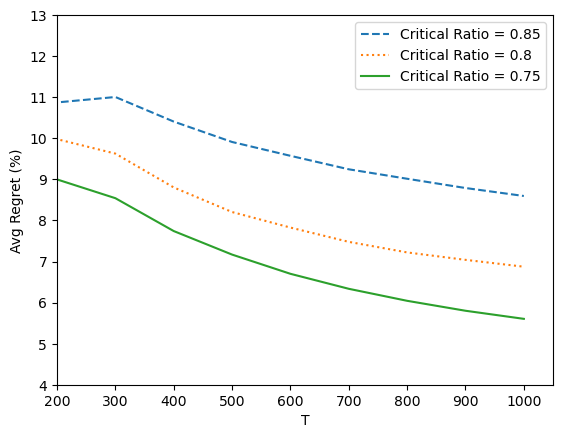
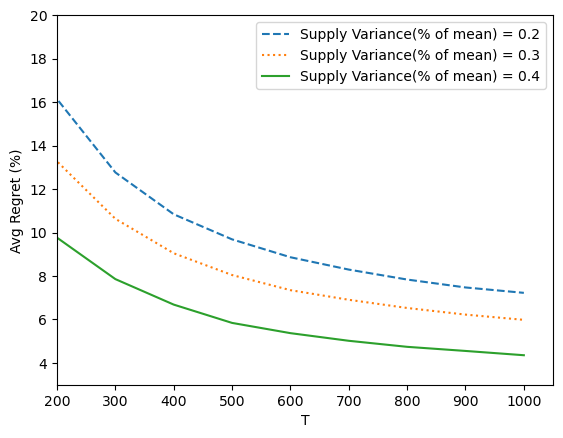
- Numerical experiments show that supply variance has negligible influence on regret, with relative regret shrinking to within 5% as $T$ increases to 1000.
- Regret increases with lead time $L$, consistent with the theoretical $\tilde{O}(L)$ dependence in the regret bound.
- The performance of the optimal constant-order policy is within 2% of the dynamic programming solution, validating its use as a benchmark.
- The algorithm’s performance is robust across varying demand variance, with regret increasing as demand uncertainty grows.
Read this paper
Open the full text in the Nubint reader and ask about any passage as you read.
Read this paper on NubintThis review was generated by AI from the original paper. Please check the paper before citing it.