
[Paper Review] Learning to reason over visual objects
This paper proposes a general-purpose visual reasoning model, Slot Transformer Scoring Network (STSN), which combines object-centric slot attention with a transformer reasoning module to achieve state-of-the-art performance on multiple RPM-like benchmarks. By leveraging precise object-centric representations without task-specific inductive biases, STSN achieves strong generalization and abstract visual reasoning, demonstrating that object-centric processing is a key inductive bias for such tasks.
A core component of human intelligence is the ability to identify abstract patterns inherent in complex, high-dimensional perceptual data, as exemplified by visual reasoning tasks such as Raven's Progressive Matrices (RPM). Motivated by the goal of designing AI systems with this capacity, recent work has focused on evaluating whether neural networks can learn to solve RPM-like problems. Previous work has generally found that strong performance on these problems requires the incorporation of inductive biases that are specific to the RPM problem format, raising the question of whether such models might be more broadly useful. Here, we investigated the extent to which a general-purpose mechanism for processing visual scenes in terms of objects might help promote abstract visual reasoning. We found that a simple model, consisting only of an object-centric encoder and a transformer reasoning module, achieved state-of-the-art results on both of two challenging RPM-like benchmarks (PGM and I-RAVEN), as well as a novel benchmark with greater visual complexity (CLEVR-Matrices). These results suggest that an inductive bias for object-centric processing may be a key component of abstract visual reasoning, obviating the need for problem-specific inductive biases.
Motivation & Objective
- To investigate whether object-centric visual representations can serve as a general-purpose inductive bias for abstract visual reasoning.
- To evaluate whether a model without task-specific architectural inductive biases can outperform prior methods on RPM-like reasoning tasks.
- To assess the role of high-quality reconstruction loss in promoting object-centric encoding and improved reasoning generalization.
- To develop and evaluate a novel, more complex benchmark, CLEVR-Matrices, to test reasoning under increased visual complexity.
Proposed method
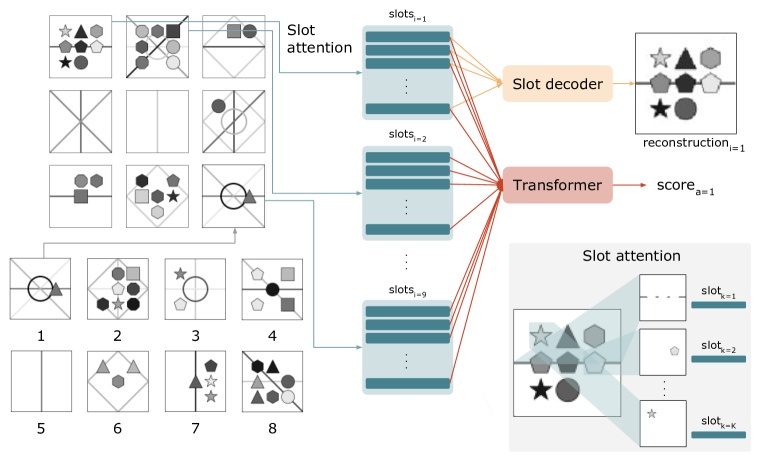
- The model uses slot attention to extract K object slots from each image panel, enabling object-centric encoding without ground-truth segmentation.
- Each image panel's slots are concatenated with the slots of a candidate answer choice to form a sequence for the transformer reasoning module.
- The transformer generates a score for each answer choice, with the final prediction derived from a softmax over these scores.
- The model is trained with a multi-task objective: minimizing both task loss (for reasoning accuracy) and reconstruction loss (for slot quality).
- A high weight (λ=1000) on the reconstruction loss ensures high-quality, object-specific slot reconstructions, which are critical for performance.
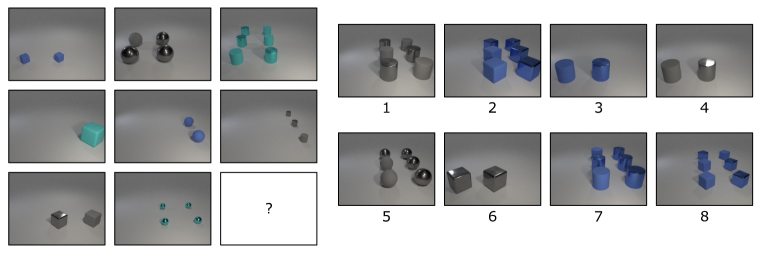
- The architecture is evaluated on three benchmarks: PGM, I-RAVEN, and a new CLEVR-Matrices dataset with higher visual complexity.
Experimental results
Research questions
- RQ1Can a general-purpose model using only object-centric encoding and a transformer achieve state-of-the-art performance on abstract visual reasoning tasks?
- RQ2Does object-centric representation learning, without task-specific inductive biases, lead to better generalization in visual reasoning?
- RQ3How does the quality of slot-based reconstruction influence reasoning performance and generalization?
- RQ4Is the performance gain from object-centric processing robust across datasets of varying visual complexity?
Key findings
- STSN achieved state-of-the-art test accuracy of 95.7% on the I-RAVEN benchmark, outperforming prior methods without task-specific inductive biases.
- On the PGM benchmark, STSN achieved 97.8% accuracy, demonstrating strong performance on a standard RPM-like task.
- On the novel, more complex CLEVR-Matrices benchmark, STSN achieved state-of-the-art performance, confirming its robustness to increased visual complexity.
- Ablation studies showed that removing slot attention reduced accuracy to 71.0%, highlighting its central role in performance.
- Reducing the reconstruction loss weight (λ) from 1000 to 1 caused reasoning accuracy to drop from 95.7% to 74.2%, confirming the importance of high-quality reconstruction for object-centric learning.
- The model's slot-specific reconstructions closely matched individual objects in input images, even without ground-truth segmentation, confirming effective object-centric processing.
Read this paper
Open the full text in the Nubint reader and ask about any passage as you read.
Read this paper on NubintThis review was generated by AI from the original paper. Please check the paper before citing it.