
[Paper Review] Learning to Tokenize for Generative Retrieval
GenRet learns semantic document identifiers (docids) via discrete auto-encoding to enable end-to-end generative retrieval, achieving state-of-the-art on NQ320K and strong results on MS MARCO and BEIR.
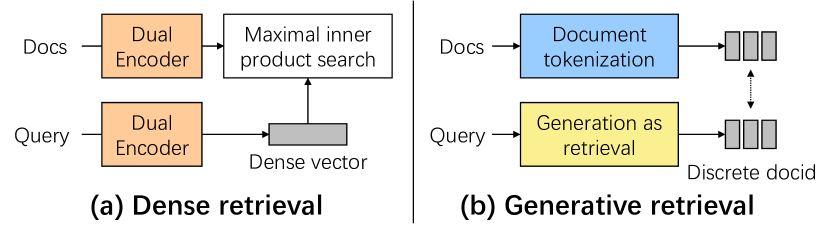
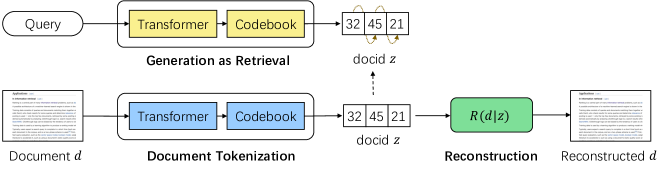
Conventional document retrieval techniques are mainly based on the index-retrieve paradigm. It is challenging to optimize pipelines based on this paradigm in an end-to-end manner. As an alternative, generative retrieval represents documents as identifiers (docid) and retrieves documents by generating docids, enabling end-to-end modeling of document retrieval tasks. However, it is an open question how one should define the document identifiers. Current approaches to the task of defining document identifiers rely on fixed rule-based docids, such as the title of a document or the result of clustering BERT embeddings, which often fail to capture the complete semantic information of a document. We propose GenRet, a document tokenization learning method to address the challenge of defining document identifiers for generative retrieval. GenRet learns to tokenize documents into short discrete representations (i.e., docids) via a discrete auto-encoding approach. Three components are included in GenRet: (i) a tokenization model that produces docids for documents; (ii) a reconstruction model that learns to reconstruct a document based on a docid; and (iii) a sequence-to-sequence retrieval model that generates relevant document identifiers directly for a designated query. By using an auto-encoding framework, GenRet learns semantic docids in a fully end-to-end manner. We also develop a progressive training scheme to capture the autoregressive nature of docids and to stabilize training. We conduct experiments on the NQ320K, MS MARCO, and BEIR datasets to assess the effectiveness of GenRet. GenRet establishes the new state-of-the-art on the NQ320K dataset. Especially, compared to generative retrieval baselines, GenRet can achieve significant improvements on the unseen documents. GenRet also outperforms comparable baselines on MS MARCO and BEIR, demonstrating the method's generalizability.
Motivation & Objective
- Motivate end-to-end document retrieval beyond traditional index-retrieve pipelines.
- Address the challenge of defining document identifiers for generative retrieval beyond fixed rule-based tokenizers.
- Propose a discrete auto-encoding tokenization framework that preserves document semantics.
- Enable end-to-end optimization of tokenization, reconstruction, and retrieval components.
- Demonstrate generalizability across diverse datasets including NQ320K, MS MARCO, and BEIR.
Proposed method
- Introduce GenRet with three components: a tokenization model Q that maps documents to docids, a reconstruction model R that regenerates the original document from docids, and a retrieval model P that generates docids from a query.
- Use a shared T5-based architecture for tokenization and retrieval with a discrete latent codebook of size K per time step (K=512).
- Train with an auto-encoding objective comprising reconstruction loss, commitment loss, and retrieval loss to align docids with document semantics and query-based retrieval.
- Adopt a progressive training scheme to optimize docids autoregressively while fixing prior prefixes to stabilize learning.
- Incorporate diverse clustering techniques (codebook initialization and docid re-assignment via Sinkhorn-Knopp) to promote docid diversity and balanced semantic space partitioning.
- Apply constrained decoding to ensure generated docids are valid within the corpus and use beam search for retrieval.
Experimental results
Research questions
- RQ1Can a learned, discrete tokenization of documents (docids) capture semantic information more effectively than fixed rule-based tokens for generative retrieval?
- RQ2Does end-to-end training of tokenization, reconstruction, and retrieval improve retrieval performance, especially on unseen documents?
- RQ3How can we stabilize autoregressive docid generation and promote diversity in docid assignments without sacrificing accuracy?
- RQ4Do GenRet's learned docids generalize to diverse datasets beyond the training distribution (MS MARCO and BEIR)?
Key findings
- GenRet achieves new state-of-the-art on NQ320K, with notable gains on unseen test data (+14% relative improvements in R@1 over the best generative baselines).
- GenRet outperforms existing generative retrieval baselines on MS MARCO and BEIR, demonstrating strong generalizability.
- The auto-encoding tokenization framework helps generate semantically meaningful docids that can reconstruct original documents, improving retrieval of documents not seen during training.
- Progressive training and diverse docid clustering stabilize training and increase docid diversity, addressing autoregressive learning and token assignment challenges.
- Compared to rule-based tokenizers, GenRet better represents and retrieves unseen documents, showing robustness to out-of-distribution data.
Read this paper
Open the full text in the Nubint reader and ask about any passage as you read.
Read this paper on NubintThis review was generated by AI from the original paper. Please check the paper before citing it.