
[Paper Review] Learning with 3D rotations, a hitchhiker's guide to SO(3)
This paper provides a comprehensive guide to selecting rotation representations for deep learning on SO(3), evaluating their impact on gradient-based optimization. It finds that high-dimensional representations like ℝ⁹+SVD and ℝ⁶+GSO outperform low-dimensional ones due to continuity and better generalization, especially when rotations are in the model's output; quaternions with half-space mapping are effective for small-angle data.
Many settings in machine learning require the selection of a rotation representation. However, choosing a suitable representation from the many available options is challenging. This paper acts as a survey and guide through rotation representations. We walk through their properties that harm or benefit deep learning with gradient-based optimization. By consolidating insights from rotation-based learning, we provide a comprehensive overview of learning functions with rotation representations. We provide guidance on selecting representations based on whether rotations are in the model's input or output and whether the data primarily comprises small angles.
Motivation & Objective
- To address the challenge of selecting optimal rotation representations for deep learning on SO(3), particularly in gradient-based optimization.
- To analyze how discontinuities in low-dimensional representations (e.g., Euler angles, quaternions) hinder learning when rotations are in the model output.
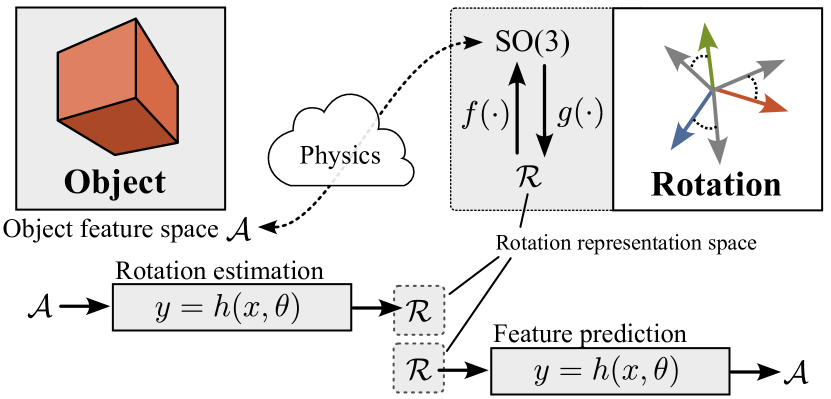
- To evaluate the impact of representation choice on both rotation estimation (rotations in output) and feature prediction (rotations in input).
- To provide practical guidance on representation selection based on data characteristics, such as angle size and memory constraints.
- To investigate the effectiveness of data augmentation and half-space mapping in mitigating boundary and double-cover issues in rotation representations.
Proposed method
- Proposes a framework to evaluate rotation representations by analyzing the continuity and Lipschitz properties of the mapping g: SO(3) → ℝ^d.
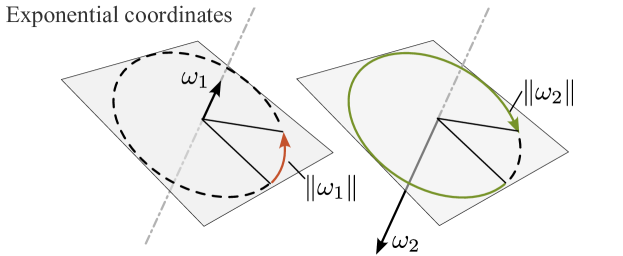
- Compares representations including Euler angles, exponential coordinates, unit quaternions, axis-angle, and high-dimensional embeddings via ℝ⁶+GSO and ℝ⁹+SVD.
- Employs sinusoidal angle wrapping and half-space mapping to reduce discontinuities in low-dimensional representations.
- Uses neural network regression with standard loss functions (e.g., MSE) to evaluate performance on rotation estimation and feature prediction tasks.
- Applies data augmentation with threshold-based sampling to improve generalization in representations with non-cyclic boundaries.
- Employs a 2-layer MLP to parameterize rotation-dependent functions, enabling controlled evaluation of function complexity in feature prediction.
Experimental results
Research questions
- RQ1Which rotation representations in SO(3) enable sample-efficient learning with gradient-based optimization in deep neural networks?
- RQ2How do discontinuities in low-dimensional representations (e.g., due to double cover or angle singularities) affect training when rotations are in the model output?
- RQ3To what extent do high-dimensional representations like ℝ⁶+GSO and ℝ⁹+SVD outperform low-dimensional ones in rotation estimation and feature prediction tasks?
- RQ4How does data augmentation improve performance in rotation representations with non-cyclic boundaries or double-cover issues?
- RQ5Under what conditions do quaternions with half-space mapping outperform other representations, particularly in small-angle regimes?
Key findings
- High-dimensional representations such as ℝ⁹+SVD and ℝ⁶+GSO consistently outperform low-dimensional ones in rotation estimation tasks, with ℝ⁹+SVD showing notably better performance than ℝ⁶+GSO on the YCB-Video dataset.
- Euler angles perform significantly worse than other representations in 6D pose estimation, especially due to singularities and discontinuities.
- Quaternions with half-space mapping achieve strong performance in rotation estimation, particularly when data primarily consists of small angles, suggesting their practicality in such regimes.
- In feature prediction tasks with increasing function complexity (n_b from 1 to 7), augmented quaternions (Quat⁺) show notable performance gains for low to moderate complexity, though the benefit diminishes as complexity increases.
- Discontinuities in g(R) mappings for 3D and 4D representations (e.g., quaternions, Euler angles) cannot be resolved by distance-picking, SO(3) metrics, or half-space maps when rotations are in the output, undermining learning.
- When rotations are in the input, discontinuities do not hinder learning, but high-dimensional representations still yield superior performance, indicating their general advantage in representation learning.
Read this paper
Open the full text in the Nubint reader and ask about any passage as you read.
Read this paper on NubintThis review was generated by AI from the original paper. Please check the paper before citing it.