
[Paper Review] Length-Controlled AlpacaEval: A Simple Way to Debias Automatic Evaluators
The paper presents a regression-based debiasing method to remove length bias from AlpacaEval, producing AlpacaEval-LC, which better aligns with human rankings and is more robust to verbosity cues.
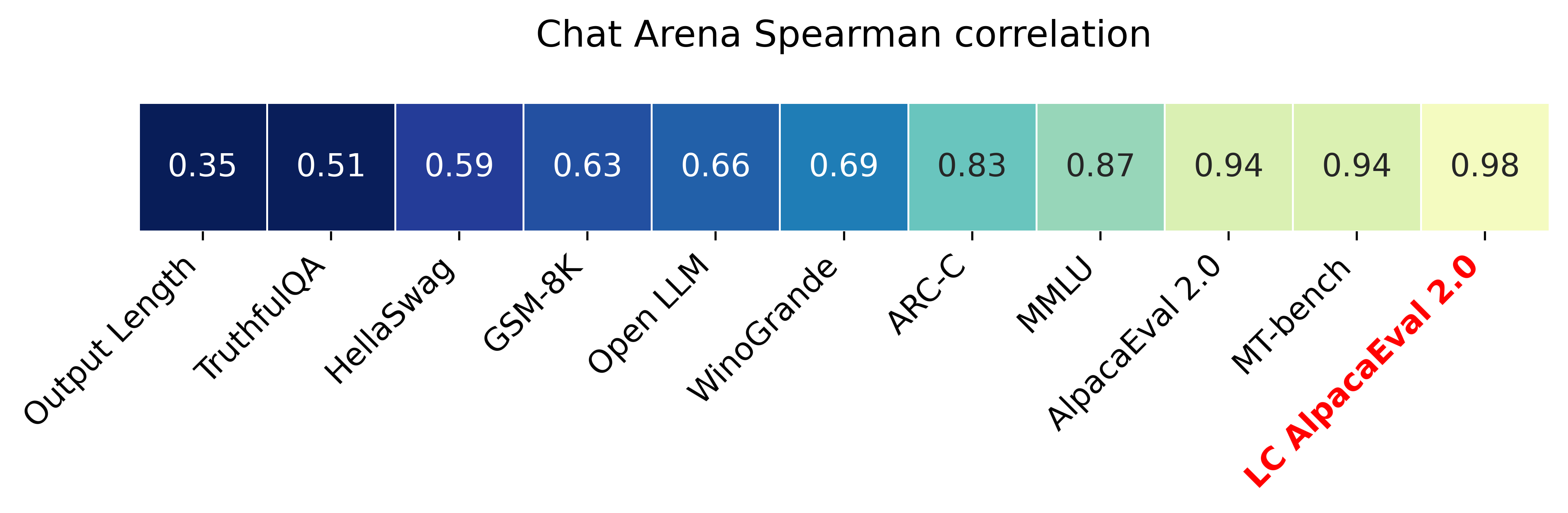
LLM-based auto-annotators have become a key component of the LLM development process due to their cost-effectiveness and scalability compared to human-based evaluation. However, these auto-annotators can introduce biases that are hard to remove. Even simple, known confounders such as preference for longer outputs remain in existing automated evaluation metrics. We propose a simple regression analysis approach for controlling biases in auto-evaluations. As a real case study, we focus on reducing the length bias of AlpacaEval, a fast and affordable benchmark for instruction-tuned LLMs that uses LLMs to estimate response quality. Despite being highly correlated with human preferences, AlpacaEval is known to favor models that generate longer outputs. We introduce a length-controlled AlpacaEval that aims to answer the counterfactual question: "What would the preference be if the model's and baseline's output had the same length?" To achieve this, we first fit a generalized linear model to predict the biased auto-annotator's preferences based on the mediators we want to control for (length difference) and other relevant features. We then obtain length-controlled preferences by predicting preferences while conditioning the GLM with a zero difference in lengths. Length-controlling not only improves the robustness of the metric to manipulations in model verbosity, but we also find that it increases the Spearman correlation with LMSYS Chatbot Arena from 0.94 to 0.98.
Motivation & Objective
- Reduce spurious length-based biases in automatic evaluation of chat LLMs.
- Provide a simple, interpretable debiasing method that preserves the desirable properties of AlpacaEval.
- Improve correlation with human judgments (Chatbot Arena) and robustness against gaming via verbosity changes.
- Offer a debiased, accessible evaluation framework usable on leaderboards and for RLHF contexts.
Proposed method
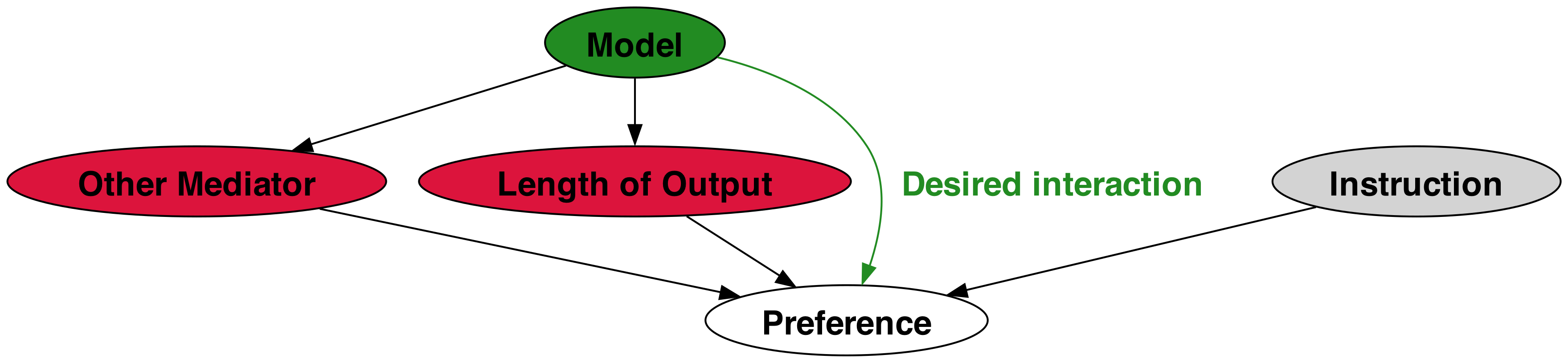
- Fit a generalized linear model to predict auto-evaluator preferences using three components: model identity, length of output, and instruction difficulty.
- Use a logistic regression with a length term modeled by tanh of the normalized length difference to capture diminishing returns.
- Obtain length-controlled win rates by removing the length term, yielding a counterfactual estimate where outputs have equal length.
- Train the GLM with cross-validated, L2-regularized fitting and separate model-specific coefficients to ensure robustness when adding new models.
- Incorporate a mild regularization on length-coupled terms to resist adversarial truncation attacks.
- Interpret the LC win rate as a standard win rate with an intuitive counterfactual framing and enable pairwise predictions between any two leaderboard models.
Experimental results
Research questions
- RQ1How much does output length confound AlpacaEval’s judgments?
- RQ2Can a regression-based debiasing approach remove length-related variance while preserving model identity and task difficulty effects?
- RQ3Does length-controlled AlpacaEval (AlpacaEval-LC) correlate better with human evaluations (Chatbot Arena) than the original metric?
- RQ4Is AlpacaEval-LC robust to simple adversarial games such as output truncation?
Key findings
- AlpacaEval-LC reduces susceptibility to length-based gameability compared to the original AlpacaEval.
- AlpacaEval-LC increases Spearman correlation with Chatbot Arena from 0.94 to 0.98.
- The length control improves leaderboard rankings for proprietary models that tend to be shorter, with open-source models being relatively penalized.
- The GLM-based debiasing remains interpretable as a win rate and can predict pairwise outcomes across the leaderboard baselines.
- Regularization reduces adversarial truncation attacks while maintaining performance on standard models.
Read this paper
Open the full text in the Nubint reader and ask about any passage as you read.
Read this paper on NubintThis review was generated by AI from the original paper. Please check the paper before citing it.