
[Paper Review] Let 2D Diffusion Model Know 3D-Consistency for Robust Text-to-3D Generation
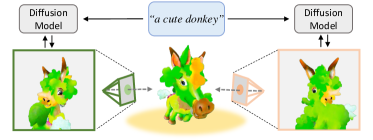
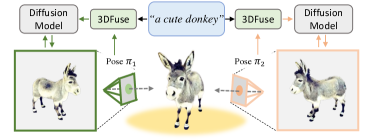
3DFuse injects 3D awareness into pretrained 2D diffusion models by conditioning on depth maps from coarse 3D priors and using semantic coding and LoRA to improve 3D consistency in SDS-based text-to-3D generation.
Text-to-3D generation has shown rapid progress in recent days with the advent of score distillation, a methodology of using pretrained text-to-2D diffusion models to optimize neural radiance field (NeRF) in the zero-shot setting. However, the lack of 3D awareness in the 2D diffusion models destabilizes score distillation-based methods from reconstructing a plausible 3D scene. To address this issue, we propose 3DFuse, a novel framework that incorporates 3D awareness into pretrained 2D diffusion models, enhancing the robustness and 3D consistency of score distillation-based methods. We realize this by first constructing a coarse 3D structure of a given text prompt and then utilizing projected, view-specific depth map as a condition for the diffusion model. Additionally, we introduce a training strategy that enables the 2D diffusion model learns to handle the errors and sparsity within the coarse 3D structure for robust generation, as well as a method for ensuring semantic consistency throughout all viewpoints of the scene. Our framework surpasses the limitations of prior arts, and has significant implications for 3D consistent generation of 2D diffusion models.
Motivation & Objective
- Motivate and address 3D inconsistency (“Janus problem”) in SDS-based text-to-3D generation.
- Introduce a 3D-aware conditioning mechanism to pretrained 2D diffusion models.
- Enable robust, geometrically coherent 3D scene generation across viewpoints.
- Improve semantic consistency and controllability in 3D generation via semantic coding and LoRA.
Proposed method
- Semantic code sampling to reduce prompt ambiguity by optimizing a text embedding to fit a generated image, yielding a semantic code s=(hat{x}, hat{e}).
- Construct a coarse 3D point cloud from the semantic code image using an off-the-shelf 3D model and project its depth map p for each view.
- Incorporate a sparse depth injector module that feeds the projected depth map into the diffusion U-net in a ControlNet-style residual manner to provide 3D-aware conditioning.
- Train only the depth injector (and optionally LoRA layers) while keeping the diffusion model frozen, enabling efficient fine-tuning.
- Apply LoRA to diffusion U-net to improve semantic consistency across viewpoints by tuning low-rank adaptation layers.
- Demonstrate adaptation across multiple SDS-based baselines (DreamFusion, SJC, ProlificDreamer) and MCC-based 3D priors.
Experimental results
Research questions
- RQ1Can conditioning pretrained 2D diffusion models on view-specific depth maps from coarse 3D priors improve 3D consistency in SDS-based text-to-3D generation?
- RQ2Does semantic coding reduce ambiguity in prompts to yield semantically consistent 3D scenes across viewpoints?
- RQ3How does 3D-aware conditioning affect fidelity and geometry robustness across different baselines?
- RQ4What is the impact of using LoRA for semantic consistency in 3D generation?
- RQ5Is the proposed approach scalable to various 2D diffusion backbones and 3D priors?
Key findings
- 3DFuse substantially improves 3D consistency and fidelity across DreamFusion, SJC, and ProlificDreamer baselines.
- A COLMAP-based metric shows 3DFuse achieving lower 3D inconsistency variance than the baseline SJC method (0.0499 vs 0.0870).
- User studies (102 participants) favor 3DFuse-enhanced results for 3D coherence, prompt adherence, and overall quality.
- Semantic coding reduces viewpoint-induced semantic and geometric inconsistencies.
- LoRA-based fine-tuning further improves semantic consistency without heavy modification to the diffusion model.
- Qualitative results extend to MCC-based 3D priors, confirming robustness across priors.
Read this paper
Open the full text in the Nubint reader and ask about any passage as you read.
Read this paper on NubintThis review was generated by AI from the original paper. Please check the paper before citing it.