
[Paper Review] Leveraging ChatGPT As Text Annotation Tool For Sentiment Analysis
The paper evaluates ChatGPT as a text-annotation tool for sentiment analysis and reports substantial accuracy gains over lexicon-based methods on two datasets (soccer tweets and Amazon reviews).
Sentiment analysis is a well-known natural language processing task that involves identifying the emotional tone or polarity of a given piece of text. With the growth of social media and other online platforms, sentiment analysis has become increasingly crucial for businesses and organizations seeking to monitor and comprehend customer feedback as well as opinions. Supervised learning algorithms have been popularly employed for this task, but they require human-annotated text to create the classifier. To overcome this challenge, lexicon-based tools have been used. A drawback of lexicon-based algorithms is their reliance on pre-defined sentiment lexicons, which may not capture the full range of sentiments in natural language. ChatGPT is a new product of OpenAI and has emerged as the most popular AI product. It can answer questions on various topics and tasks. This study explores the use of ChatGPT as a tool for data labeling for different sentiment analysis tasks. It is evaluated on two distinct sentiment analysis datasets with varying purposes. The results demonstrate that ChatGPT outperforms other lexicon-based unsupervised methods with significant improvements in overall accuracy. Specifically, compared to the best-performing lexical-based algorithms, ChatGPT achieves a remarkable increase in accuracy of 20% for the tweets dataset and approximately 25% for the Amazon reviews dataset. These findings highlight the exceptional performance of ChatGPT in sentiment analysis tasks, surpassing existing lexicon-based approaches by a significant margin. The evidence suggests it can be used for annotation on different sentiment analysis events and taskss.
Motivation & Objective
- Motivate the need for efficient, high-quality sentiment annotations without extensive human labeling.
- Assess whether ChatGPT can serve as a zero-shot text annotator for sentiment tasks across domains.
- Compare ChatGPT against lexicon-based baselines (VADER, TextBlob) using standard metrics.
- Demonstrate the potential of ChatGPT to handle emojis, sarcasm, and long-form reviews in sentiment labeling.
Proposed method
- Use GPT-3.5 turbo (ChatGPT) with a fixed prompt to label sentiment scores extracted from API responses.
- Evaluate on two datasets: soccer tweets (6,201 rows; 1,214 emojis; 2,551 positive, 2,710 negative, 943 neutral) and 2,000 Amazon reviews (positive 1,002, negative 998).
- Compare against lexicon-based tools VADER and TextBlob as baselines.
- Extract numerical sentiment scores from ChatGPT outputs to assign labels.
- Report precision, recall, F1, and accuracy for each label and dataset.
- Discuss qualitative aspects like emoji handling and sarcasm recognition.
Experimental results
Research questions
- RQ1Can ChatGPT serve as an effective zero-shot text annotator for sentiment analysis across different domains?
- RQ2How does ChatGPT’s sentiment labeling compare to lexicon-based approaches on social media and long-form reviews?
- RQ3Does ChatGPT handle emojis, sarcasm, and irony better than traditional lexicon-based methods?
- RQ4What are the practical considerations (speed, cost, bias) when using ChatGPT for annotation tasks?
Key findings
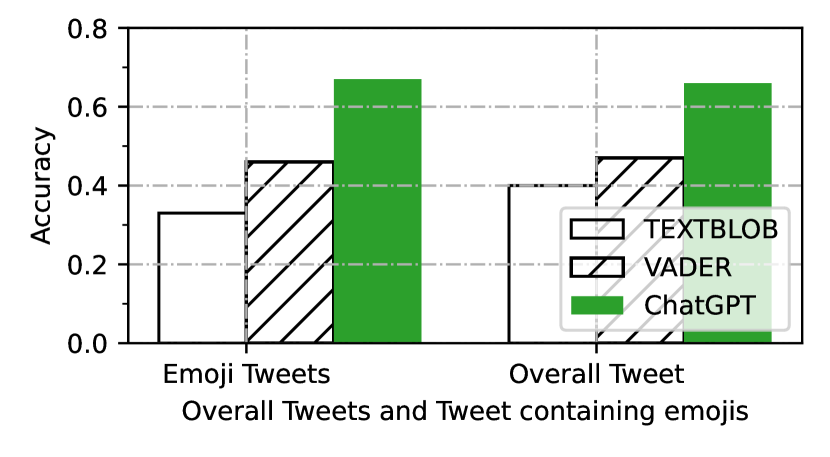
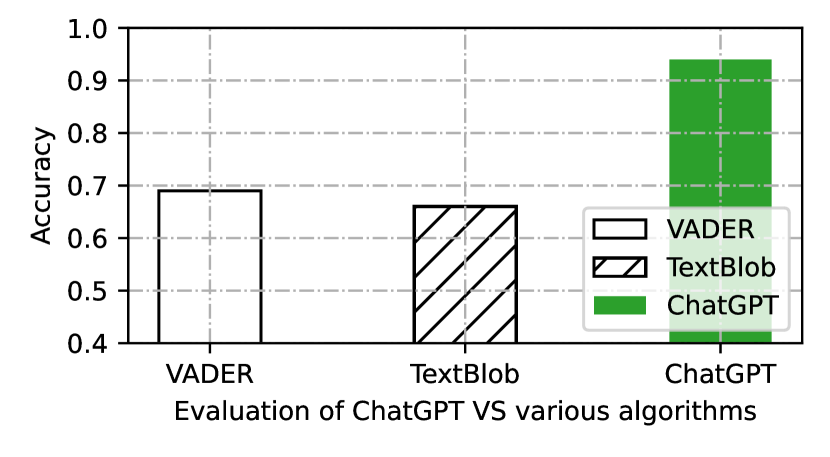
- ChatGPT achieves higher accuracy than VADER and TextBlob on both datasets (e.g., Soccer Tweets: 67% overall vs 47% VADER and 40% TextBlob; Amazon Reviews: 94% vs 69% VADER and 66% TextBlob).
- ChatGPT effectively handles emojis in sentiment classification, improving performance on emoji-containing tweets.
- ChatGPT demonstrates higher per-label precision, recall, and F1 across positive, neutral, and negative classes in the reported tables.
- ChatGPT’s zero-shot sentiment analysis shows strong performance, with notable gains over lexical methods on long-form reviews as well as short social media text.
- The study notes limitations including prompt dependence, potential biases in responses, and slower processing speed/cost compared to some tools.
Read this paper
Open the full text in the Nubint reader and ask about any passage as you read.
Read this paper on NubintThis review was generated by AI from the original paper. Please check the paper before citing it.