
[Paper Review] Leveraging Data-Driven Models for Accurate Analysis of Grid-Tied Smart Inverters Dynamics
This paper proposes a data-driven system identification approach to create accurate, reduced-order transfer function models for grid-tied smart inverters in converter-dominated power systems (CDPS), using experimental data from commercial off-the-shelf (COTS) inverters and detailed simulation models. The method enables precise dynamic modeling without requiring knowledge of internal control structures, achieving high-fidelity representation of Volt-Var support and reactive power dynamics for use in stability analysis, control design, and grid planning.
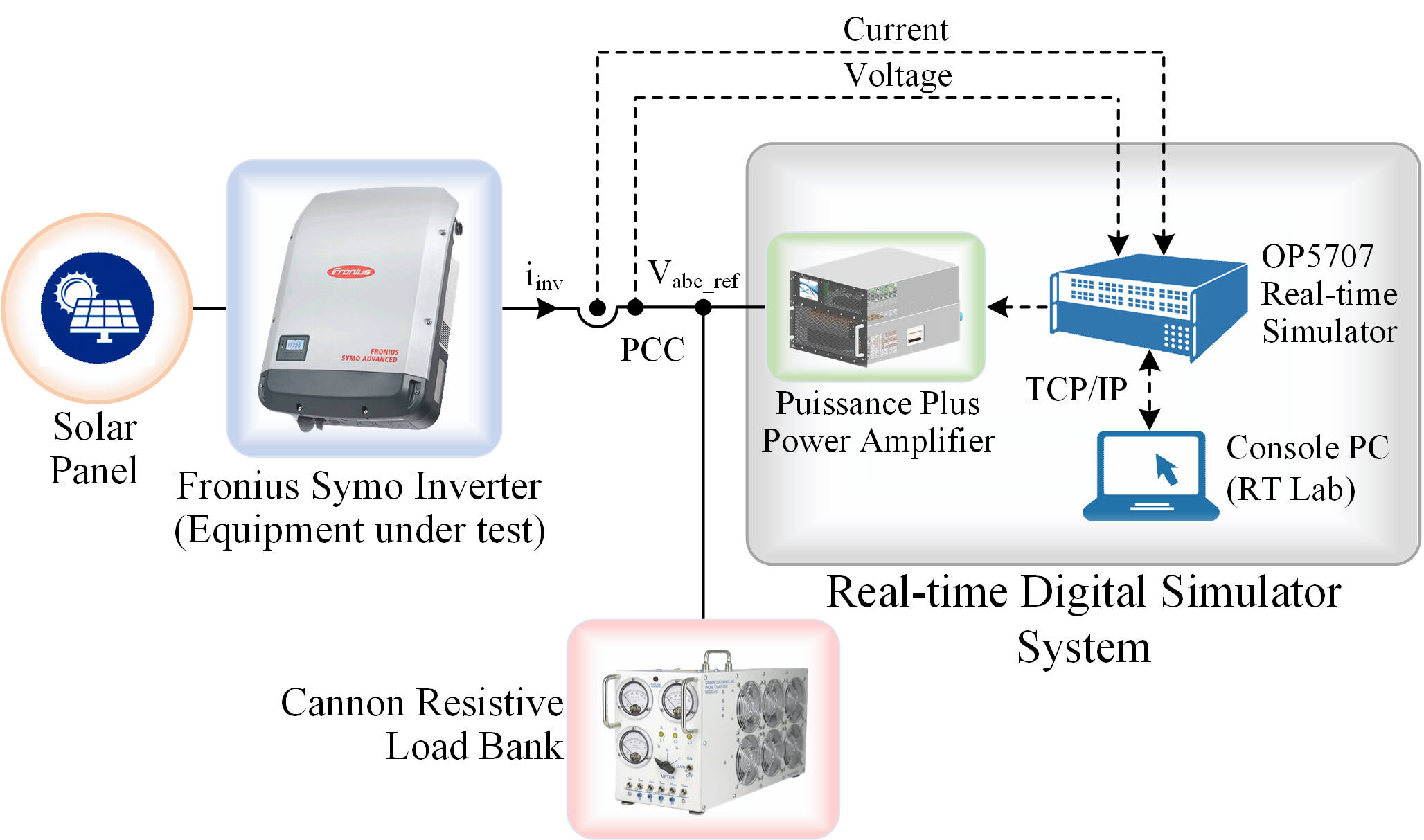
The integration of power electronic converters (PECs) and distributed energy resources (DERs) in modern power systems has introduced dynamism and complexity. Accurate simulation becomes essential to comprehend the influence of converter domination on the power grid. This study addresses the fast-switching and stochastic behaviors exhibited by inverter-based resources in converter-dominated power systems, highlighting the necessity for precise analytical models. In the realm of modeling real-world systems, multiple methodologies exist. Notably, black-box and data-driven system identification techniques are employed to construct PEC models using experimental data, without relying on a priori knowledge of the internal system physics. This approach entails a systematic process of model class selection, parameter estimation, and model validation. While a range of linear and nonlinear model structures and estimation algorithms are at our disposal, it remains imperative to harness creativity and a profound understanding of the physical system to craft data-driven models that align seamlessly with their intended applications. These applications may encompass simulation, prediction, control, or fault detection. This report offers valuable insights into the collection of datasets from commercial off-the-shelf inverters, along with the presentation of intricate simulation models.
Motivation & Objective
- Address the growing challenge of accurately modeling inverter-based resources (IBRs) in converter-dominated power systems (CDPS), where traditional synchronous machine models are no longer sufficient.
- Overcome the limitations of proprietary, black-box inverter control designs that hinder reliable system simulation and stability assessment.
- Develop data-driven models that capture the dynamic behavior of smart inverters—especially Volt-Var support—without requiring internal control or topology knowledge.
- Enable high-fidelity, computationally efficient models for use in power system planning, operation, stability analysis, and fault detection.
- Provide open-access datasets and validated models derived from real and simulated COTS inverters to support reproducible research and engineering applications.
Proposed method
- Collect experimental and simulated datasets from COTS inverters and detailed models under various grid support function (GSF) settings, including Volt-Var support.
- Use probing signals—specifically chirp signals with linearly increasing frequency (1–5 Hz) and amplitude modulation (0.8884–1.0884 p.u.)—to excite the system and capture input-output dynamics.
- Apply system identification (SysId) techniques to estimate reduced-order transfer functions from voltage and reactive current (Iq) data collected at the point of common coupling.
- Validate the identified models against high-fidelity simulation data, ensuring accuracy in capturing dynamic responses under different operating conditions.
- Focus on the reactive power side (RPS) of the inverter model, isolating Volt-Var functionality while excluding active power and other control loops.
- Use MATLAB-based data processing and model fitting to extract transfer functions from time-series data, with sampling at 100 µs for high temporal resolution.

Experimental results
Research questions
- RQ1How accurately can data-driven system identification capture the dynamic behavior of grid-tied smart inverters with Volt-Var support functions?
- RQ2To what extent do data-driven models replicate the behavior of detailed simulation models without requiring knowledge of internal control structures?
- RQ3What is the impact of different grid support function (GSF) settings on the dynamic response of inverters, and how can these be captured in a data-driven model?
- RQ4Can reduced-order transfer function models derived from real and simulated data be used reliably for power system stability and control analysis in CDPS?
- RQ5How do variations in probing signal parameters (frequency sweep rate, amplitude) affect the quality and accuracy of the identified models?
Key findings
- The data-driven models accurately replicate the dynamic response of detailed simulation models, particularly in capturing the reactive current (Iq) response to voltage variations under Volt-Var support.
- The identified transfer functions show high fidelity in representing the aggregated behavior of multiple inverters and loads, as demonstrated in both single-phase and three-phase low-voltage distribution network (LVDN) configurations.
- The use of chirp probing signals with a 5-second sweep time and 1% frequency rate increase successfully excites the system across the relevant frequency band (1–5 Hz), enabling effective system identification.
- The dataset, available at https://data.mendeley.com/datasets/82k8x5tpkn/2, includes time-series data sampled at 100 µs, with input (voltage in p.u.) and output (Iq current in A) clearly labeled in MAT files for single-phase, three-phase, and DER_A with CMLD configurations.
- The models derived from the CMLD (Combined Model of Load and Devices) configuration accurately reflect the aggregated Volt-Var response of multiple distributed energy resources (DERs), PECs, and loads.
- The approach enables reliable modeling of inverter dynamics without access to internal control logic, making it suitable for use in grid planning, stability assessment, and control design in CDPS.
Better researchstarts right now
From reading papers to final review, dramatically reduce your research time.
No credit card · Free plan available
This review was created by AI and reviewed by human editors.