
[Paper Review] Leveraging Hidden Positives for Unsupervised Semantic Segmentation
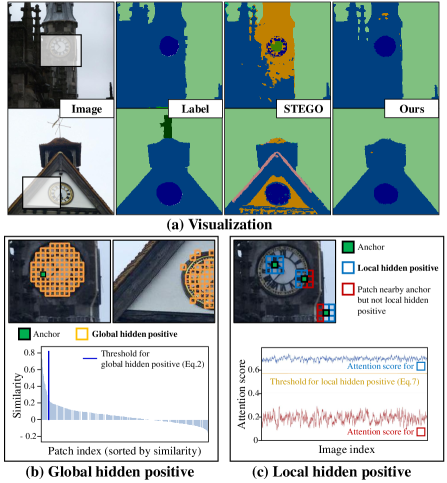
This paper proposes a novel unsupervised semantic segmentation method that leverages two types of hidden positives—global hidden positives (GHPs) for inter-patch semantic consistency and local hidden positives (LHPs) for spatial consistency—through contrastive learning. By progressively integrating task-specific features and propagating gradients to semantically similar neighboring patches, the method achieves state-of-the-art performance on COCO-stuff, Cityscapes, and Potsdam-3.
Dramatic demand for manpower to label pixel-level annotations triggered the advent of unsupervised semantic segmentation. Although the recent work employing the vision transformer (ViT) backbone shows exceptional performance, there is still a lack of consideration for task-specific training guidance and local semantic consistency. To tackle these issues, we leverage contrastive learning by excavating hidden positives to learn rich semantic relationships and ensure semantic consistency in local regions. Specifically, we first discover two types of global hidden positives, task-agnostic and task-specific ones for each anchor based on the feature similarities defined by a fixed pre-trained backbone and a segmentation head-in-training, respectively. A gradual increase in the contribution of the latter induces the model to capture task-specific semantic features. In addition, we introduce a gradient propagation strategy to learn semantic consistency between adjacent patches, under the inherent premise that nearby patches are highly likely to possess the same semantics. Specifically, we add the loss propagating to local hidden positives, semantically similar nearby patches, in proportion to the predefined similarity scores. With these training schemes, our proposed method achieves new state-of-the-art (SOTA) results in COCO-stuff, Cityscapes, and Potsdam-3 datasets. Our code is available at: https://github.com/hynnsk/HP.
Motivation & Objective
- Address the lack of task-specific guidance and local semantic consistency in unsupervised semantic segmentation.
- Overcome limitations of fixed backbones and reliance on data augmentation in prior contrastive learning-based methods.
- Improve model generalization by incorporating both task-agnostic and task-specific feature references during training.
- Enforce local consistency by propagating loss gradients to adjacent, semantically similar patches based on attention scores.
- Achieve state-of-the-art performance without pixel-level annotations by leveraging intrinsic semantic relationships in feature space.
Proposed method
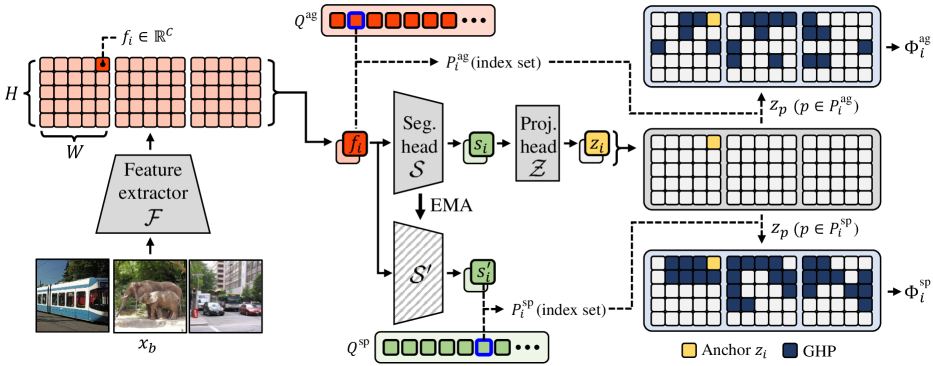
- Define two types of global hidden positives (GHPs): task-agnostic GHPs from a fixed pre-trained ViT backbone and task-specific GHPs from a segmentation head-in-training.
- Use a data-driven criterion per anchor to select semantically similar patches from both reference pools, ensuring reliable positive collection.
- Gradually increase the contribution of task-specific GHPs during training to guide the model toward segmentation-relevant features.
- Introduce a gradient propagation strategy that transfers loss gradients to nearby patches (local hidden positives, LHPs) in proportion to their attention scores.
- Leverage the inherent assumption that adjacent patches are likely to share the same semantic label to enforce local consistency.
- Apply contrastive learning using both GHPs and LHPs to optimize feature representations without any pixel-level supervision.
Experimental results
Research questions
- RQ1How can task-specific semantic features be progressively learned in unsupervised semantic segmentation without ground-truth annotations?
- RQ2To what extent can global hidden positives derived from both pre-trained and training-stage features improve semantic representation learning?
- RQ3Can gradient propagation to semantically similar neighboring patches enhance local consistency and segmentation quality?
- RQ4How does the proposed method compare to existing SOTA approaches in terms of mIoU and accuracy on standard benchmarks?
- RQ5How robust is the method to hyperparameter choices such as reference pool size and temperature scaling?
Key findings
- The proposed method achieves state-of-the-art performance on COCO-stuff, with a mIoU of 41.4 and accuracy of 75.1, surpassing prior methods.
- On Cityscapes, the method achieves a mIoU of 39.1 and accuracy of 74.1, outperforming DINO + GradProp and other baselines.
- On Potsdam-3, the method achieves a mIoU of 41.3 and accuracy of 74.9, demonstrating strong generalization across diverse datasets.
- Ablation studies show that the method is robust to hyperparameter variations, with minimal performance drop across different reference pool sizes and temperature values.
- Visualization results confirm that the GHP selection process captures fine-grained semantic distinctions, such as body parts of a person, beyond coarse annotations.
- The gradient propagation strategy effectively enforces local consistency, as shown by higher attention scores on semantically similar adjacent patches compared to dissimilar ones.
Read this paper
Open the full text in the Nubint reader and ask about any passage as you read.
Read this paper on NubintThis review was generated by AI from the original paper. Please check the paper before citing it.