
[Paper Review] Leveraging Large Language Models in Conversational Recommender Systems
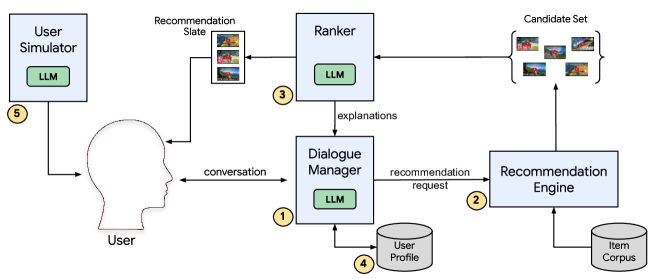
The paper introduces RecLLM, an end-to-end large language model–driven conversational recommender system architecture that unifies dialogue management, retrieval, ranking with explanations, and user profiles, plus synthetic data generation via a controllable LLM-based user simulator, demonstrated on YouTube content using LaMDA.
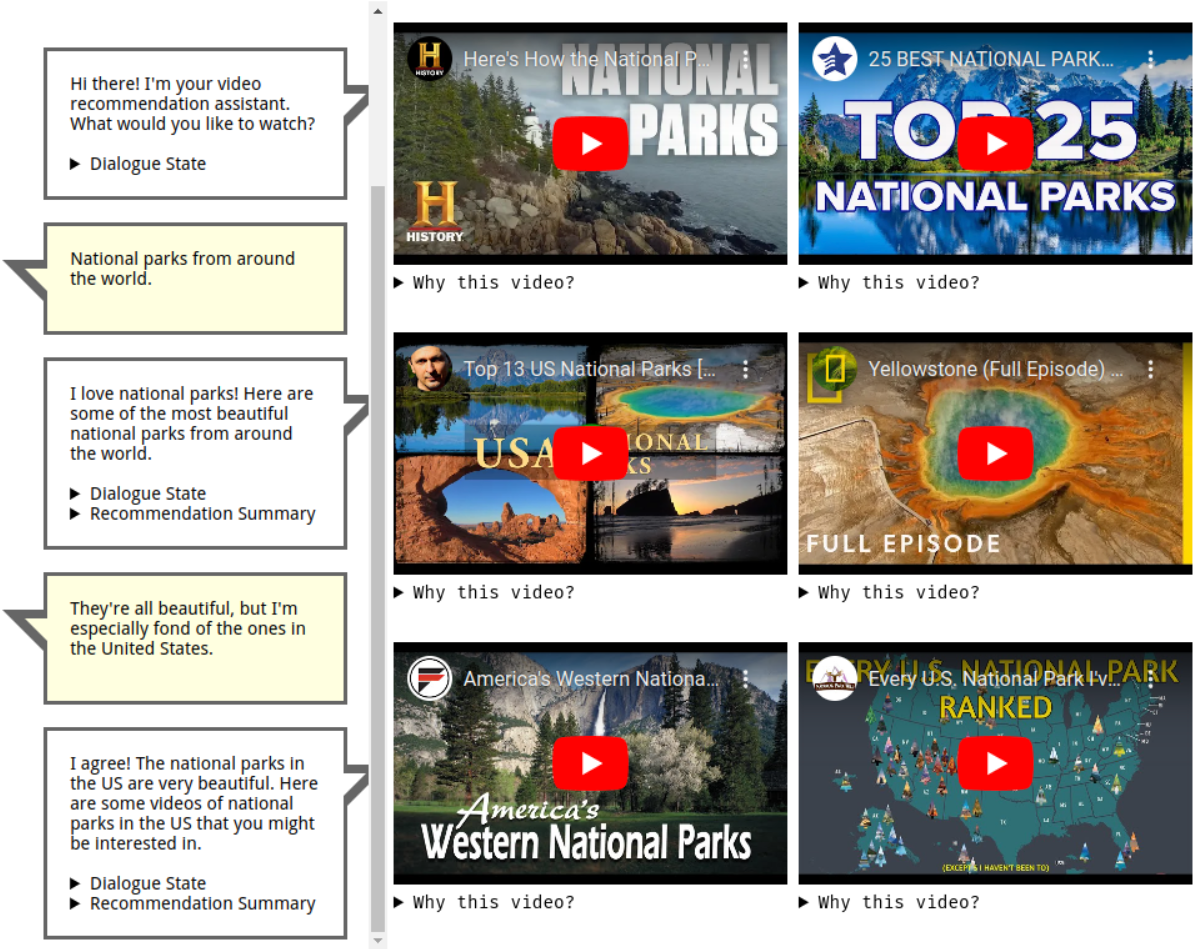
A Conversational Recommender System (CRS) offers increased transparency and control to users by enabling them to engage with the system through a real-time multi-turn dialogue. Recently, Large Language Models (LLMs) have exhibited an unprecedented ability to converse naturally and incorporate world knowledge and common-sense reasoning into language understanding, unlocking the potential of this paradigm. However, effectively leveraging LLMs within a CRS introduces new technical challenges, including properly understanding and controlling a complex conversation and retrieving from external sources of information. These issues are exacerbated by a large, evolving item corpus and a lack of conversational data for training. In this paper, we provide a roadmap for building an end-to-end large-scale CRS using LLMs. In particular, we propose new implementations for user preference understanding, flexible dialogue management and explainable recommendations as part of an integrated architecture powered by LLMs. For improved personalization, we describe how an LLM can consume interpretable natural language user profiles and use them to modulate session-level context. To overcome conversational data limitations in the absence of an existing production CRS, we propose techniques for building a controllable LLM-based user simulator to generate synthetic conversations. As a proof of concept we introduce RecLLM, a large-scale CRS for YouTube videos built on LaMDA, and demonstrate its fluency and diverse functionality through some illustrative example conversations.
Motivation & Objective
- Motivate the use of large language models to enable transparent, interactive, multi-turn conversational recommendations.
- Propose an end-to-end architecture where a single LLM handles dialogue management, retrieval, ranking, and explanations.
- Enable scalable retrieval over large item corpora via multiple retrieval strategies compatible with LLMs.
- Incorporate interpretable natural language user profiles to personalize session context.
- Provide a controllable LLM-based user simulator to generate synthetic conversations for tuning system modules.
Proposed method
- Unified LLM-based dialogue management that outputs system actions and responses as a single language modeling task.
- A general retrieval framework for large corpora enabling tractable candidate generation through methods like Generalized Dual Encoder, Direct LLM Search, Concept Based Search, and Search API Lookup.
- A joint LLM ranking module that scores items and generates natural language explanations using item and context summaries.
- Use of persistent, interpretable natural language user profiles as input to the LLM to modulate session context.
- Development of a controllable LLM-based user simulator to generate synthetic conversations for scalable tuning and evaluation.
Experimental results
Research questions
- RQ1How can an LLM be used to unify dialogue management, retrieval, and ranking in a CRS?
- RQ2What retrieval strategies enable tractable large-scale candidate generation for LLM-based CRSs?
- RQ3Can an LLM generate intelligible explanations for its recommendations within a CRS?
- RQ4How can interpretable natural language user profiles improve personalization in a CRS?
- RQ5Can synthetic conversations generated by a controllable LLM-based simulator effectively tune and evaluate CRS components?
Key findings
- Demonstrates a functional end-to-end RecLLM architecture that handles context tracking, API calls, and response generation within a unified LLM framework.
- Proposes multiple retrieval approaches suitable for large item corpora, balancing efficiency and accuracy.
- Shows the LLM-based ranker can produce scores and natural language explanations grounded in item and context summaries.
- Introduces interpretable natural language user profiles that can be incorporated into the dialogue management to personalize sessions.
- Presents a controllable LLM-based user simulator capable of generating synthetic conversations for system tuning and evaluation.
Read this paper
Open the full text in the Nubint reader and ask about any passage as you read.
Read this paper on NubintThis review was generated by AI from the original paper. Please check the paper before citing it.