
[Paper Review] LHC Dark Matter Working Group: Next-generation spin-0 dark matter models
This paper proposes the 2HDM+a model as a theoretically consistent, next-generation spin-0 dark matter framework that extends the simplified pseudoscalar DM model with a gauge-invariant, renormalizable two-Higgs-doublet model plus an additional pseudoscalar mediator. It demonstrates rich mono-X phenomenology across multiple LHC signatures and provides benchmark scans to test the model against LHC, direct-detection, indirect-detection, and relic density constraints, showing that the LHC already probes DM masses near $ m_\chi \simeq M_a/2 $, where the correct relic density is achieved.
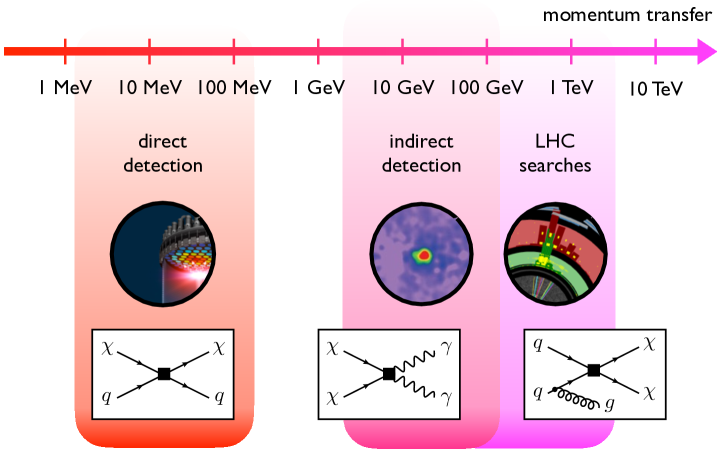
Dark matter (DM) simplified models are by now commonly used by the ATLAS and CMS Collaborations to interpret searches for missing transverse energy ($E_T^\mathrm{miss}$). The coherent use of these models sharpened the LHC DM search program, especially in the presentation of its results and their comparison to DM direct-detection (DD) and indirect-detection (ID) experiments. However, the community has been aware of the limitations of the DM simplified models, in particular the lack of theoretical consistency of some of them and their restricted phenomenology leading to the relevance of only a small subset of $E_T^\mathrm{miss}$ signatures. This document from the LHC Dark Matter Working Group identifies an example of a next-generation DM model, called $ extrm{2HDM+a}$, that provides the simplest theoretically consistent extension of the DM pseudoscalar simplified model. A comprehensive study of the phenomenology of the $ extrm{2HDM+a}$ model is presented, including a discussion of the rich and intricate pattern of mono-$X$ signatures and the relevance of other DM as well as non-DM experiments. Based on our discussions, a set of recommended scans are proposed to explore the parameter space of the $ extrm{2HDM+a}$ model through LHC searches. The exclusion limits obtained from the proposed scans can be consistently compared to the constraints on the $ extrm{2HDM+a}$ model that derive from DD, ID and the DM relic density.
Motivation & Objective
- To address theoretical inconsistencies and limited phenomenology in existing LHC dark matter simplified models.
- To propose a next-generation, gauge-invariant, and renormalizable extension of the simplified pseudoscalar DM model.
- To identify a model with rich mono-X signatures and cross-experimental constraints from LHC, direct/indirect detection, and relic density.
- To provide recommended parameter scans for LHC searches that enable consistent comparison with non-LHC DM constraints.
Proposed method
- The 2HDM+a model is constructed as a two-Higgs-doublet model with an additional singlet pseudoscalar boson mediating DM interactions.
- The model is embedded in a 5-flavor scheme (5FS) for efficient event generation, using MadGraph5_aMC@NLO and PYTHIA 8.2 for parton showering.
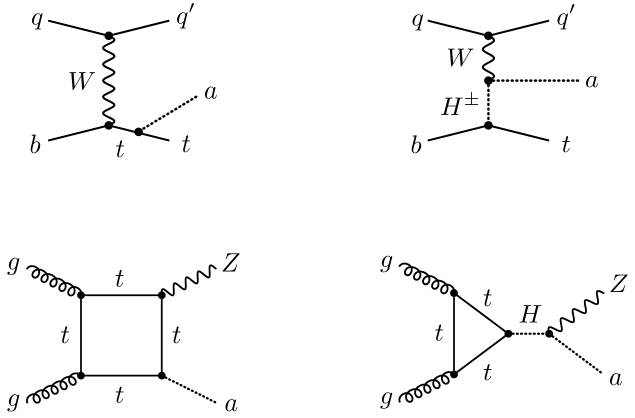
- Mono-jet, mono-Higgs (b\bar{b}), and mono-Z (l+l-) signatures are generated via gluon fusion and quark-antiquark fusion processes.
- Constraints from Higgs and flavor physics, electroweak precision measurements, vacuum stability, and LHC searches for additional spin-0 states are systematically evaluated.
- Benchmark points are selected based on theoretical consistency and phenomenological relevance, with emphasis on $ \sin\theta \approx 0.35 $ for optimal sensitivity.
- Sensitivity estimates are computed using $ E_T^{\text{miss}} $ binning and uncertainties derived from existing LHC limits (e.g., from [160]).
Experimental results
Research questions
- RQ1Can a theoretically consistent, renormalizable extension of the simplified pseudoscalar DM model be constructed that avoids the shortcomings of existing simplified models?
- RQ2What is the phenomenological richness of the 2HDM+a model across mono-X signatures, and which LHC search channels are most sensitive?
- RQ3How do constraints from direct detection, indirect detection, and the observed dark matter relic density compare with LHC exclusion limits in the 2HDM+a parameter space?
- RQ4At what DM mass does the LHC achieve sensitivity to models that reproduce the correct relic density?
- RQ5Which benchmark parameter points in the 2HDM+a model are optimal for future LHC searches and cross-experimental comparisons?
Key findings
- The 2HDM+a model achieves theoretical consistency through a gauge-invariant, renormalizable extension of the simplified pseudoscalar DM model.
- The model exhibits a rich pattern of mono-X signatures, including mono-jet, mono-Higgs (b\bar{b}), and mono-Z (l+l-), with significant sensitivity across multiple channels.
- LHC searches already have sensitivity to DM masses up to $ m_\chi \simeq 125\,\text{GeV} $, corresponding to $ m_\chi \simeq M_a/2 $, where the correct relic density is naturally achieved.
- The benchmark $ \sin\theta = 0.35 $ provides enhanced sensitivity in mono-Higgs searches compared to $ \sin\theta = 0.15 $ or $ 0.7 $, making it optimal for LHC studies.
- The model's parameter space is constrained by Higgs and flavor physics, electroweak precision measurements, and vacuum stability, with viable regions existing for $ M_a \sim 200-350\,\text{GeV} $.
- The proposed benchmark scans allow for consistent comparison of LHC results with constraints from direct detection, indirect detection, and the observed dark matter relic density $ \Omega h^2 $.
Read this paper
Open the full text in the Nubint reader and ask about any passage as you read.
Read this paper on NubintThis review was generated by AI from the original paper. Please check the paper before citing it.