
[Paper Review] LibriTTS: A Corpus Derived from LibriSpeech for Text-to-Speech
This paper introduces LibriTTS, a 585-hour English text-to-speech corpus derived from LibriSpeech, with 24kHz audio, sentence-level segmentation, preserved punctuation and capitalization, and noise-filtered utterances. Neural end-to-end TTS models trained on LibriTTS achieved mean opinion scores above 4.0 in naturalness for five out of six evaluation speakers, demonstrating its effectiveness for high-quality TTS research.
This paper introduces a new speech corpus called "LibriTTS" designed for text-to-speech use. It is derived from the original audio and text materials of the LibriSpeech corpus, which has been used for training and evaluating automatic speech recognition systems. The new corpus inherits desired properties of the LibriSpeech corpus while addressing a number of issues which make LibriSpeech less than ideal for text-to-speech work. The released corpus consists of 585 hours of speech data at 24kHz sampling rate from 2,456 speakers and the corresponding texts. Experimental results show that neural end-to-end TTS models trained from the LibriTTS corpus achieved above 4.0 in mean opinion scores in naturalness in five out of six evaluation speakers. The corpus is freely available for download from http://www.openslr.org/60/.
Motivation & Objective
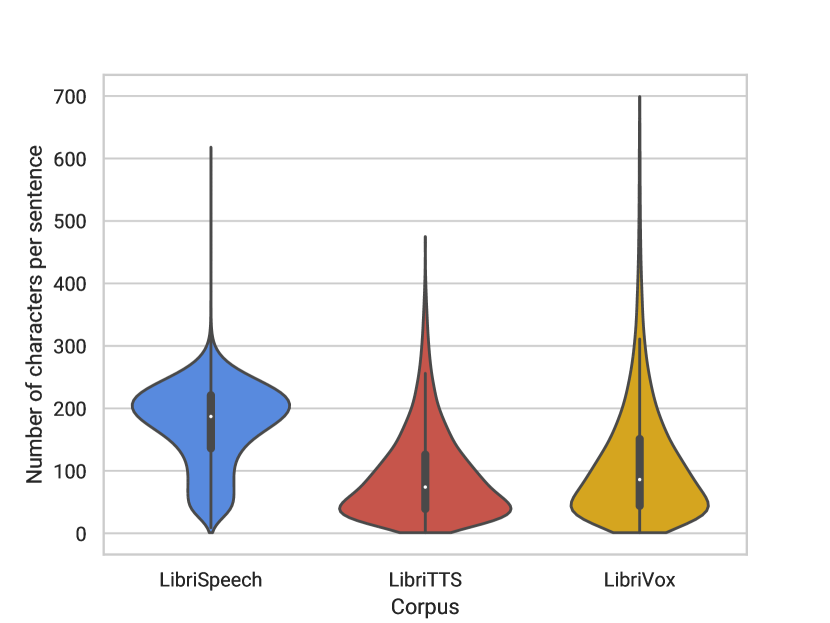
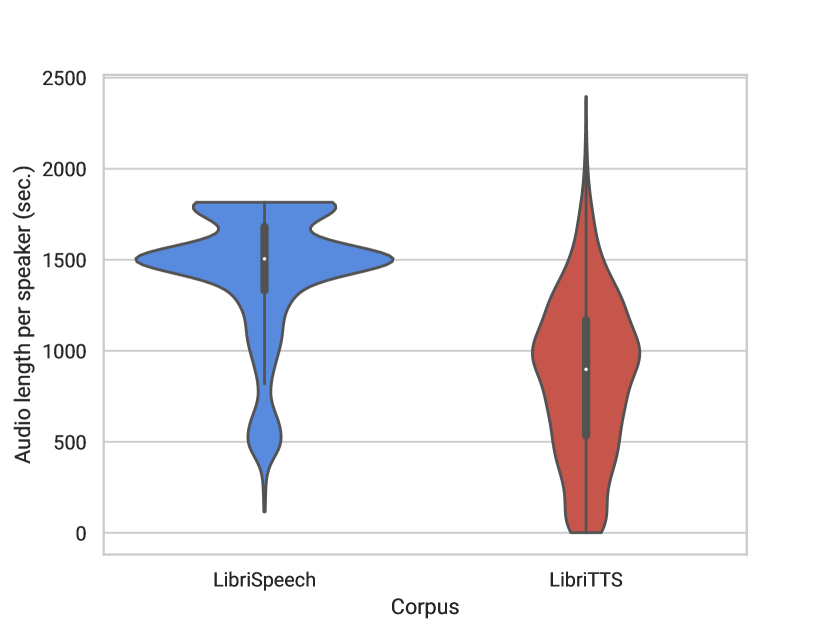
- To address limitations in LibriSpeech for text-to-speech research, such as low 16kHz sampling rate and fragmented utterances.
- To preserve linguistic features like punctuation and capitalization for better prosody modeling.
- To filter out noisy utterances and retain only high-quality, clean speech data.
- To create a large-scale, freely available TTS corpus with balanced speaker diversity and studio-quality recordings.
- To enable high-fidelity neural end-to-end TTS training with improved naturalness and speaker consistency.
Proposed method
- Derived from original LibriVox MP3s and Project Gutenberg texts, using automatic alignment to link audio and text.
- Resampled audio to 24kHz, excluding files below this rate to ensure high-fidelity input.
- Segmented speech at sentence boundaries using a proprietary sentence splitter, preserving inter-sentence context.
- Preserved both original and normalized text versions, including punctuation and capitalization.
- Applied signal-to-noise ratio (SNR) estimation to filter out utterances with significant background noise.
- Released the corpus under the same CC-BY 4.0 license as LibriSpeech, ensuring broad accessibility for research and commercial use.
Experimental results
Research questions
- RQ1Can a high-quality, large-scale TTS corpus derived from LibriSpeech improve neural TTS model performance in naturalness and prosody?
- RQ2How does increasing the sampling rate from 16kHz to 24kHz affect perceived speech quality in end-to-end TTS systems?
- RQ3To what extent do preserved punctuation and capitalization improve prosodic modeling in neural TTS?
- RQ4Does filtering out noisy utterances lead to measurable improvements in subjective speech quality?
- RQ5Can a multi-speaker TTS system trained on LibriTTS achieve high mean opinion scores (MOS) across diverse speakers?
Key findings
- Neural end-to-end TTS models trained on LibriTTS achieved mean opinion scores (MOS) above 4.0 in naturalness for five out of six evaluation speakers.
- The 24kHz version of LibriTTS yielded significantly higher MOS than its 16kHz downsampled counterpart, with gains of 0.175 (female) and 0.133 (male) on average.
- LibriTTS (24kHz) outperformed LibriSpeech (16kHz) in MOS for female speakers (0.15 gain), though no significant gain was observed for male speakers.
- Male speaker voices showed consistently lower MOS than female voices, with a gap of 0.48 for LibriTTS (24kHz), indicating room for improvement in modeling male speech.
- Despite high performance, a gap of 0.61 in MOS remained between natural and synthesized male speech, highlighting challenges in modeling male prosody.
- The corpus is the largest publicly available TTS-specific corpus to date, with 585 hours of 24kHz speech from 2,456 speakers, and is freely available at http://www.openslr.org/60/.
Read this paper
Open the full text in the Nubint reader and ask about any passage as you read.
Read this paper on NubintThis review was generated by AI from the original paper. Please check the paper before citing it.