
[Paper Review] LIDA: A Tool for Automatic Generation of Grammar-Agnostic Visualizations and Infographics using Large Language Models
LIDA presents a four-module, LLM-driven pipeline to automatically generate grammar-agnostic visualizations and data-faithful infographics, with a Python API and hybrid NL/direct-manipulation UI.
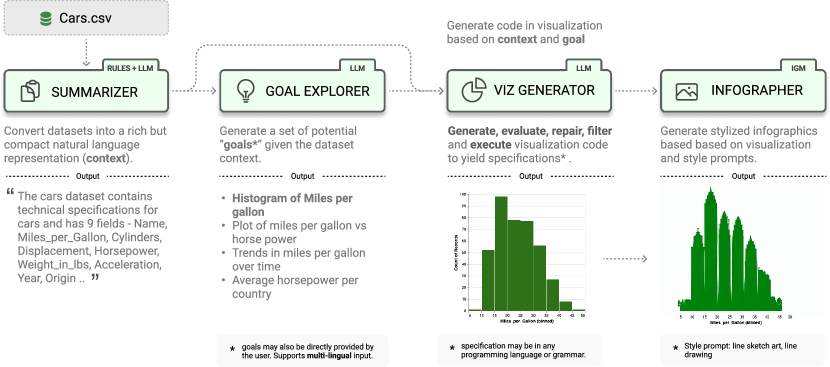
Systems that support users in the automatic creation of visualizations must address several subtasks - understand the semantics of data, enumerate relevant visualization goals and generate visualization specifications. In this work, we pose visualization generation as a multi-stage generation problem and argue that well-orchestrated pipelines based on large language models (LLMs) such as ChatGPT/GPT-4 and image generation models (IGMs) are suitable to addressing these tasks. We present LIDA, a novel tool for generating grammar-agnostic visualizations and infographics. LIDA comprises of 4 modules - A SUMMARIZER that converts data into a rich but compact natural language summary, a GOAL EXPLORER that enumerates visualization goals given the data, a VISGENERATOR that generates, refines, executes and filters visualization code and an INFOGRAPHER module that yields data-faithful stylized graphics using IGMs. LIDA provides a python api, and a hybrid user interface (direct manipulation and multilingual natural language) for interactive chart, infographics and data story generation. Learn more about the project here - https://microsoft.github.io/lida/
Motivation & Objective
- Convert dataset semantics into a compact natural language summary to ground visualization tasks.
- Enumerate relevant visualization goals and hypotheses from the data.
- Generate, refine, execute, and filter visualization code across multiple grammars.
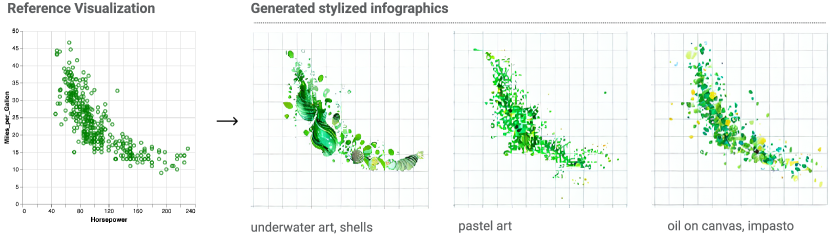
- Produce data-faithful, stylized infographics using text-conditioned image generation models.
- Offer a hybrid interface (direct manipulation and multilingual natural language) for interactive visualization and storytelling.
Proposed method
- Summarizer converts data properties into a compact NL summary, optionally enriched by an LLM.
- Goal Explorer uses the summary to generate visualization questions/hypotheses and corresponding goals.
- VisGenerator creates code scaffolds for multiple grammars (e.g., Matplotlib, GGPlot, Plotly, Altair, Seaborn, Bokeh), fills stubs via LLM-generated code, and executes with sandboxed validation and filtering.
- Infographer applies data-faithful/stylized graphics using diffusion-based image generators (text-conditioned) to produce infographics.
- VizOps provides NL-based refinement, explanations, accessibility descriptions, self-evaluation and repair, and recommendations based on generated visualizations.
- The system is exposed via a Python API, a web API, and a multilingual, hybrid UI for interactive use.
Experimental results
Research questions
- RQ1How can LLMs be orchestrated to generate visualization goals and grammar-agnostic specifications from data summaries?
- RQ2Can a multi-stage pipeline reliably produce data-faithful visualizations and aesthetically pleasing infographics across grammars?
- RQ3What metrics reliably evaluate the reliability and quality of LLM-enabled visualization pipelines?
- RQ4How can NL interactions and image generation models complement traditional visualization tooling to support diverse users?
Key findings
- The pipeline achieves a low visualization error rate of 3.5%.
- Using a compact NL data summary improves reliability over schema-only summaries in ablation studies.
- Enriching base summaries with LLM enrichment has variable impact depending on grammar; expressive grammars (e.g., Seaborn) show lower error rates.
- Self-evaluation and repair mechanisms via LLMs help identify semantic quality issues and enable automated corrections (e.g., suggesting a bar chart over a pie chart).
- The framework provides an end-to-end, grammar-agnostic approach that supports multiple grammars and the generation of both standard visualizations and data-driven infographics.
Read this paper
Open the full text in the Nubint reader and ask about any passage as you read.
Read this paper on NubintThis review was generated by AI from the original paper. Please check the paper before citing it.