
[Paper Review] LiDAR-NeRF: Novel LiDAR View Synthesis via Neural Radiance Fields
LiDAR-NeRF presents a differentiable end-to-end framework to render novel LiDAR views by learning a neural radiance field that encodes LiDAR range, intensity, and ray-drop probability, with structural regularization and a new object-centric dataset NeRF-MVL.
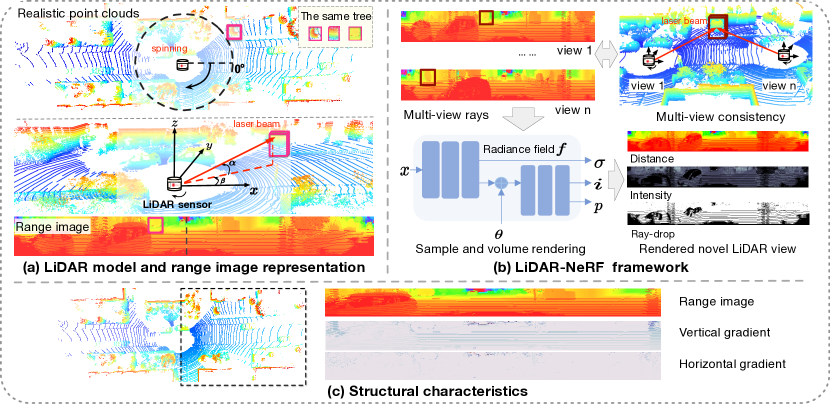
We introduce a new task, novel view synthesis for LiDAR sensors. While traditional model-based LiDAR simulators with style-transfer neural networks can be applied to render novel views, they fall short of producing accurate and realistic LiDAR patterns because the renderers rely on explicit 3D reconstruction and exploit game engines, that ignore important attributes of LiDAR points. We address this challenge by formulating, to the best of our knowledge, the first differentiable end-to-end LiDAR rendering framework, LiDAR-NeRF, leveraging a neural radiance field (NeRF) to facilitate the joint learning of geometry and the attributes of 3D points. However, simply employing NeRF cannot achieve satisfactory results, as it only focuses on learning individual pixels while ignoring local information, especially at low texture areas, resulting in poor geometry. To this end, we have taken steps to address this issue by introducing a structural regularization method to preserve local structural details. To evaluate the effectiveness of our approach, we establish an object-centric multi-view LiDAR dataset, dubbed NeRF-MVL. It contains observations of objects from 9 categories seen from 360-degree viewpoints captured with multiple LiDAR sensors. Our extensive experiments on the scene-level KITTI-360 dataset, and on our object-level NeRF-MVL show that our LiDAR-NeRF surpasses the model-based algorithms significantly.
Motivation & Objective
- Motivate and define the task of novel LiDAR view synthesis, addressing the gap where existing LiDAR simulators fail to produce realistic LiDAR patterns.
- Jointly learn geometry and per-pseudo-pixel LiDAR attributes (distance, intensity, ray-drop) via a NeRF-inspired framework without explicit 3D reconstruction.
- Introduce a structural regularization strategy to preserve local geometric details in low-texture regions.
- Create and release the NeRF-MVL object-centric LiDAR dataset to enable evaluation of LiDAR view synthesis on multiple objects and viewpoints.
Proposed method
- Convert LiDAR point clouds into a range pseudo-image per view, where each pseudo-pixel corresponds to a LiDAR beam.
- Use a two-MLP NeRF-style radiance field to predict per-pseudo-pixel attributes: depth-related density and a two-channel feature map for intensity and ray-drop probability; compute integrated per-view depth, intensity, and ray-drop along rays.
- Incorporate a structural regularization term that penalizes differences in local structure primarily in low-texture regions to improve geometry.
- Train with a multi-task loss combining depth distance, intensity, ray-drop, and structure regularization terms.

Experimental results
Research questions
- RQ1Can a differentiable LiDAR renderer be learned end-to-end to synthesize realistic LiDAR views from novel viewpoints?
- RQ2How can LiDAR-specific attributes (intensity and ray-drop) be modeled within a neural radiance field framework?
- RQ3Does a structural regularization strategy improve geometric fidelity for LiDARNeRF, especially in low-texture regions?
- RQ4How does LiDAR-NeRF perform on scene-level and object-level novel LiDAR view synthesis compared to model-based renderers?
Key findings
- LiDAR-NeRF outperforms baseline LiDAR renderers (LiDARsim, PCGen) across scene- and object-level tasks on KITTI-360 and NeRF-MVL.
- For KITTI-360, LiDAR-NeRF with iNGP base architecture and structural regularization achieves the best metrics among tested variants (C-D, F-score, RMSE, δ1/δ2/δ3, SSIM, MAE).
- For NeRF-MVL object-level data, LiDAR-NeRF with iNGP achieves superior C-D, RMSE, δ1/δ2/δ3, SSIM, and MAE relative to baselines.
- Ablations show the structural regularization and the choice of iNGP architecture significantly improve geometry and LiDAR pattern realism.
Read this paper
Open the full text in the Nubint reader and ask about any passage as you read.
Read this paper on NubintThis review was generated by AI from the original paper. Please check the paper before citing it.