
[Paper Review] Light-Matter Hybridization and Entanglement from the First-Principles
This paper proposes a variational squeeze transformation within the quantum electrodynamics Hartree-Fock (QEDHF) framework to capture anharmonic quantum fluctuations in strongly coupled light-matter systems. By optimizing squeezing parameters, the method accurately describes photon field fluctuations and quantifies light-matter entanglement, significantly improving predictive power in strong coupling regimes beyond traditional mean-field approximations.
The hybridization between light and matter is fundamental for achieving cavity-induced control over quantum materials, necessitating accurate ab initio methods for their analysis. Among these, the quantum electrodynamics Hartree-Fock framework stands out as an essential mean field approximation for electron-electron and electron-photon interactions, forming the basis for advanced post-Hartree-Fock methods like quantum electrodynamics coupled cluster and auxiliary field quantum Monte Carlo. However, trivial quantum electrodynamics Hartere-Fock (QEDHF) methods assume a product state ansätze and thus cannot describe the light-matter Entanglement. Furthermore, our previous work on variational ansätze approaches lacked the capability to capture anharmonic or nonlinear fluctuations, limiting their applicability to strongly coupled systems. To overcome these limitations, we propose an extended QEDHF formalism by introducing a variational Squeeze transformation capable of describing anharmonic quantum fluctuations in photon fields. By optimizing the squeezing parameters, our framework provides a more nuanced and accurate characterization of photon field quantum fluctuations, significantly enhancing the predictive power of QEDHF in strong coupling regimes. Moreover, this formalism enhances the description of light-matter Entanglement, providing a first-principles framework for understanding light-matter hybridization and paving the way for deeper insights into cavity-modified quantum phenomena.
Motivation & Objective
- To overcome the limitations of standard QEDHF in describing anharmonic and nonlinear quantum fluctuations in strongly coupled light-matter systems.
- To extend the variational displaced QEDHF framework by incorporating a variational squeeze transformation for improved treatment of photon field correlations.
- To enable quantitative characterization of light-matter entanglement from first principles in the strong coupling regime.
- To provide a more accurate mean-field reference for post-HF methods like QED-CC and QMC in quantum electrodynamics.
- To bridge the gap between mean-field approximations and strongly correlated photonic effects in quantum materials.
Proposed method
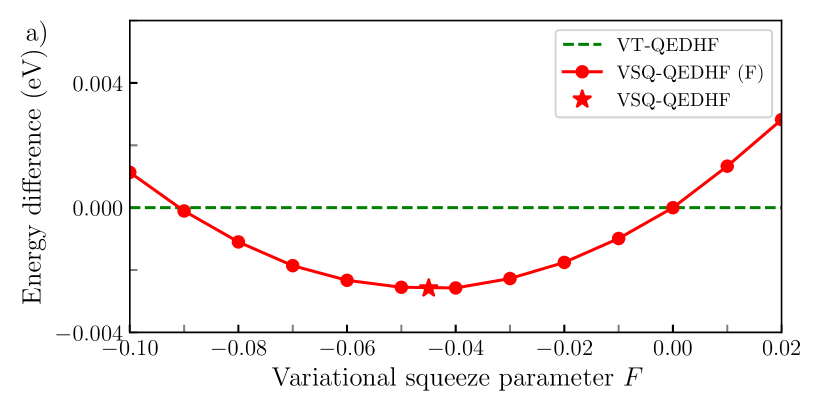
- Introduces a variational squeeze (VSQ) transformation to the QEDHF formalism, treating squeezing parameters as variational variables to minimize the energy.
- Applies the squeeze transformation to the photon field Hamiltonian, modifying the photon energy and coupling terms to account for anharmonic fluctuations.
- Derives an effective Hamiltonian in the squeezed coherent state (SCS) representation, which renormalizes bilinear and quadratic photon terms.
- Uses the coherent squeeze state (CSS) representation to compute the effective Hamiltonian and density matrix, enabling entanglement quantification.
- Computes the photon reduced density matrix via partial trace over electronic degrees of freedom, enabling calculation of von Neumann entropy as a measure of entanglement.
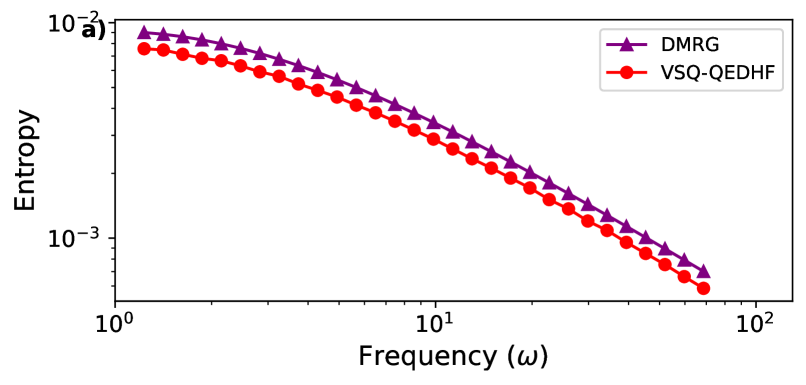
- Validates the approach against DMRG benchmarks, demonstrating improved accuracy in entanglement and energy predictions.
Experimental results
Research questions
- RQ1Can a variational squeeze transformation in QEDHF accurately describe anharmonic quantum fluctuations in strongly coupled light-matter systems?
- RQ2How does the inclusion of squeezing improve the description of light-matter entanglement compared to standard QEDHF?
- RQ3To what extent does the VSQ-QEDHF framework enhance the predictive power of mean-field theories in the strong coupling regime?
- RQ4Can the framework quantitatively reproduce entanglement measures benchmarked against DMRG calculations?
- RQ5What is the impact of photon anharmonicity on the ground state energy and electronic structure in cavity-modified quantum materials?
Key findings
- The variational squeeze transformation successfully captures anharmonic fluctuations in the photon field, improving the description of strongly coupled systems beyond harmonic approximations.
- The method enables quantitative computation of light-matter entanglement via von Neumann entropy, with results validated against DMRG benchmarks.
- Squeezing parameters are optimized variationally, leading to lower variational energy and improved accuracy in the strong coupling regime.
- The effective Hamiltonian in the coherent squeeze state (CSS) representation renormalizes both bilinear coupling and photon Hamiltonian terms, reflecting nontrivial photon correlations.
- In the many-photon basis set limit, the squeeze operation significantly affects the ground state energy, confirming its non-perturbative role.
- The framework provides a robust first-principles reference for post-Hartree-Fock methods such as QED-CC and QMC in quantum electrodynamics.
Read this paper
Open the full text in the Nubint reader and ask about any passage as you read.
Read this paper on NubintThis review was generated by AI from the original paper. Please check the paper before citing it.