
[Paper Review] LightGCL: Simple Yet Effective Graph Contrastive Learning for Recommendation
LightGCL proposes a simple SVD-guided augmentation for graph contrastive learning in recommender systems, avoiding stochastic perturbations and improving robustness and efficiency. It achieves state-of-the-art results on multiple real-world datasets.
Graph neural network (GNN) is a powerful learning approach for graph-based recommender systems. Recently, GNNs integrated with contrastive learning have shown superior performance in recommendation with their data augmentation schemes, aiming at dealing with highly sparse data. Despite their success, most existing graph contrastive learning methods either perform stochastic augmentation (e.g., node/edge perturbation) on the user-item interaction graph, or rely on the heuristic-based augmentation techniques (e.g., user clustering) for generating contrastive views. We argue that these methods cannot well preserve the intrinsic semantic structures and are easily biased by the noise perturbation. In this paper, we propose a simple yet effective graph contrastive learning paradigm LightGCL that mitigates these issues impairing the generality and robustness of CL-based recommenders. Our model exclusively utilizes singular value decomposition for contrastive augmentation, which enables the unconstrained structural refinement with global collaborative relation modeling. Experiments conducted on several benchmark datasets demonstrate the significant improvement in performance of our model over the state-of-the-arts. Further analyses demonstrate the superiority of LightGCL's robustness against data sparsity and popularity bias. The source code of our model is available at https://github.com/HKUDS/LightGCL.
Motivation & Objective
- Motivate robust graph contrastive learning for recommendation under data sparsity and noise.
- Introduce a lightweight augmentation scheme based on singular value decomposition (SVD) to inject global collaborative signals.
- Integrate SVD-based augmentation with a simplified contrastive learning objective to improve representation quality.
- Analyze robustness to data sparsity, popularity bias, and over-smoothing.
- Demonstrate improved efficiency compared with existing GCL-based methods.
Proposed method
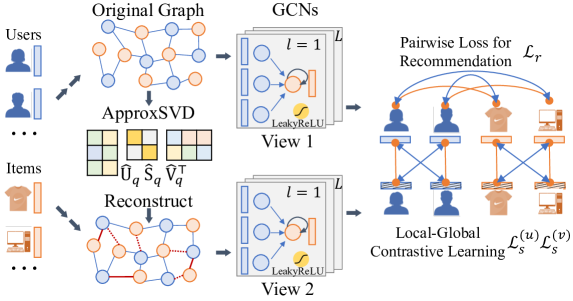
- Two-layer GCN backbone to capture local user-item interactions.
- SVD-guided augmentation of the interaction graph to inject global collaborative structure (via randomized SVD for scalability).
- Construct a single augmented view from the SVD-reconstructed graph and perform InfoNCE contrast with the main view.
- Precompute SVD components (Uq, Sq, Vq) for efficiency and use two-view contrastive learning with dropout for regularization.
- Jointly optimize the recommendation loss with the contrastive losses for users and items and an L2 regularization term.
- Provide complexity analysis showing reduced training cost relative to three-view CL methods.
Experimental results
Research questions
- RQ1How does LightGCL perform compared with state-of-the-art baselines on standard recommendation benchmarks?
- RQ2Does the SVD-guided augmentation improve robustness to data sparsity and popularity bias while maintaining efficient training?
- RQ3What is the impact of different hyperparameters (lambda1, tau, q) on performance?
- RQ4How does the local-global contrastive learning component contribute to performance?
- RQ5Is LightGCL resistant to over-smoothing and do embeddings maintain meaningful structure?
Key findings
- LightGCL consistently outperforms all listed contrastive baselines across five datasets on Recall@20, Recall@40, NDCG@20, and NDCG@40.
- The SVD-based augmentation provides robust, global structural signals that improve contrastive learning signals over noisy user-item interactions.
- LightGCL shows improved training efficiency with lower per-batch complexity and favorable preprocessing costs due to low-rank graph reconstruction.
- Ablation studies show SVD-based augmentation is effective, with MF-based alternatives performing worse than LightGCL’s SVD variant.
- Hyperparameter analyses indicate stable performance across a range of tau values and small q (rank) suffices (q=5).
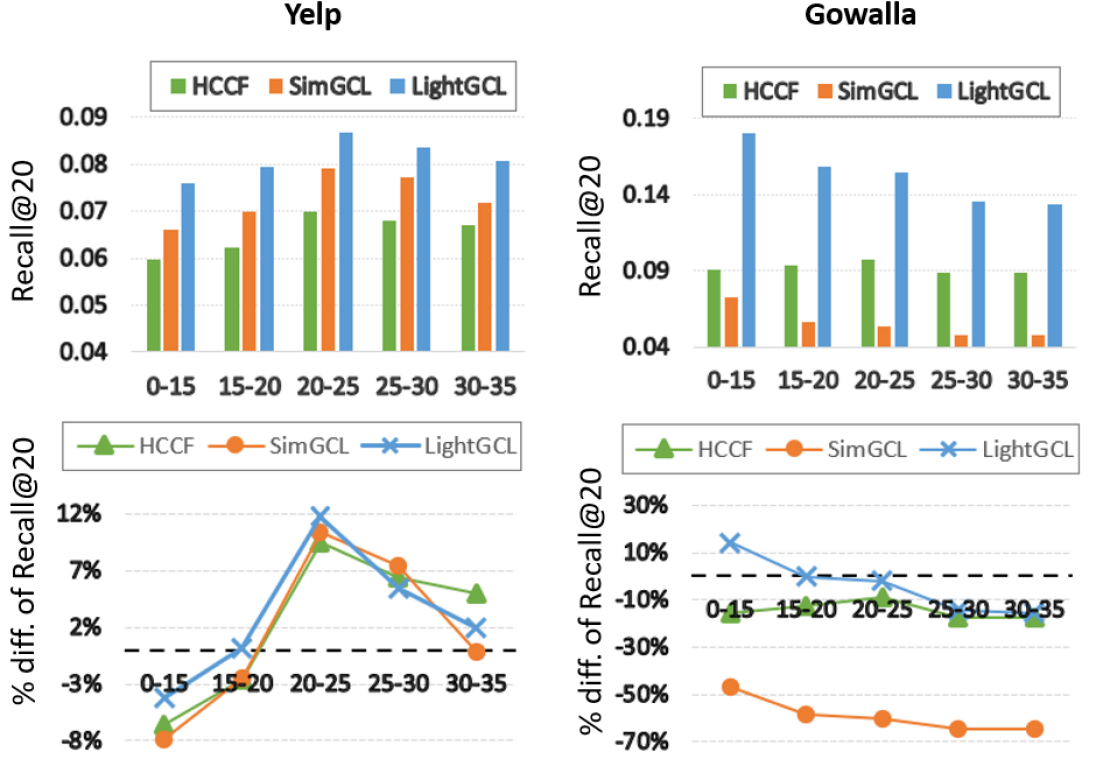
- LightGCL demonstrates robustness to data sparsity and popularity bias compared to HCCF and SimGCL.
Better researchstarts right now
From reading papers to final review, dramatically reduce your research time.
No credit card · Free plan available
This review was created by AI and reviewed by human editors.