
[Paper Review] Linear Cross-document Event Coreference Resolution with X-AMR
This paper proposes X-AMR, a linear cross-document event coreference resolution method using a graphical representation of events anchored in cross-document Abstract Meaning Representation. By transforming ECR into a multi-hop coreference task over event graphs, the approach reduces computational cost, enhances interpretability, and enables efficient LLM-based annotation and evaluation, achieving strong performance with GPT-4 while exposing its limitations in coreference reasoning.
Event Coreference Resolution (ECR) as a pairwise mention classification task is expensive both for automated systems and manual annotations. The task's quadratic difficulty is exacerbated when using Large Language Models (LLMs), making prompt engineering for ECR prohibitively costly. In this work, we propose a graphical representation of events, X-AMR, anchored around individual mentions using a extbf{cross}-document version of extbf{A}bstract extbf{M}eaning extbf{R}epresentation. We then linearize the ECR with a novel multi-hop coreference algorithm over the event graphs. The event graphs simplify ECR, making it a) LLM cost-effective, b) compositional and interpretable, and c) easily annotated. For a fair assessment, we first enrich an existing ECR benchmark dataset with these event graphs using an annotator-friendly tool we introduce. Then, we employ GPT-4, the newest LLM by OpenAI, for these annotations. Finally, using the ECR algorithm, we assess GPT-4 against humans and analyze its limitations. Through this research, we aim to advance the state-of-the-art for efficient ECR and shed light on the potential shortcomings of current LLMs at this task. Code and annotations: \url{https://github.com/ahmeshaf/gpt_coref}
Motivation & Objective
- To address the quadratic computational cost of traditional pairwise event coreference resolution (ECR) in large-scale corpora.
- To develop a scalable, interpretable, and LLM-friendly framework for ECR that avoids expensive pairwise comparisons.
- To enable efficient human and LLM-based annotation of event coreference using a novel graphical representation (X-AMR).
- To evaluate the performance of GPT-4 on ECR using X-AMR graphs and identify its limitations in coreference reasoning.
- To provide a new benchmark with enriched X-AMR annotations on the ECB+ corpus for future research.
Proposed method
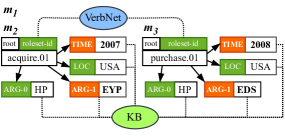
- Propose X-AMR, a cross-document extension of Abstract Meaning Representation (AMR), to represent events using triggers, arguments (ARG-0, ARG-1, ARG-Lo, ARG-Time), and links via VerbNet and a knowledge base.
- Construct corpus-level event graphs by extracting and linking event mentions across documents using semantic roles and lexical resources.
- Design a novel multi-hop coreference algorithm that traverses X-AMR graphs to resolve coreference without pairwise scoring.
- Use a custom, annotator-friendly tool to enrich the ECB+ dataset with X-AMR annotations by two linguistic experts.
- Employ GPT-4 in zero-shot and few-shot settings to generate X-AMR graphs using condensed annotation guidelines.
- Evaluate the ECR algorithm on gold-standard X-AMR annotations and compare GPT-4’s performance against human annotations.
Experimental results
Research questions
- RQ1Can X-AMR reduce the computational complexity of cross-document ECR from quadratic to linear while preserving accuracy?
- RQ2How effective is GPT-4 at generating accurate X-AMR graphs for ECR in zero-shot and few-shot settings?
- RQ3What are the key limitations of current LLMs like GPT-4 in resolving cross-document event coreference when using X-AMR representations?
- RQ4To what extent does the graphical structure of X-AMR improve interpretability and compositional reasoning in ECR?
- RQ5Can X-AMR annotations be reliably produced by humans and LLMs, enabling scalable and cost-effective ECR pipelines?
Key findings
- The X-AMR-based ECR algorithm achieves linear complexity by replacing pairwise comparisons with graph traversal, significantly reducing computational cost.
- GPT-4 generates X-AMR graphs with high quality in few-shot settings, demonstrating strong zero-shot and few-shot capabilities for event representation.
- Despite strong performance, GPT-4 exhibits notable limitations in resolving subtle cross-document coreference, especially when relying on long-range or extralinguistic context.
- The human-annotated X-AMR dataset on ECB+ provides a reliable benchmark for evaluating future ECR systems with improved interpretability.
- The use of X-AMR enables compositional and interpretable reasoning, making coreference decisions traceable through graph paths.
- The approach demonstrates that LLMs can be effectively used in a 'model-in-the-loop' annotation framework for ECR, reducing manual effort while maintaining quality.

Read this paper
Open the full text in the Nubint reader and ask about any passage as you read.
Read this paper on NubintThis review was generated by AI from the original paper. Please check the paper before citing it.