
[论文解读] Linear-in-temperature conductance in two-dimensional electron fluids
本文表明,具有简单费米表面的二维电子流体由于长寿命的奇宇称激发(其衰减速率为T⁴)驱动的非经典流体动力学,表现出线性于温度的电导率。异常的T线性标度源于柯尔莫哥洛夫类的分数幂律电导率σ(k) ∼ T/k⁵/³,为强关联体系中超级费米液体流体动力学提供了确凿证据。
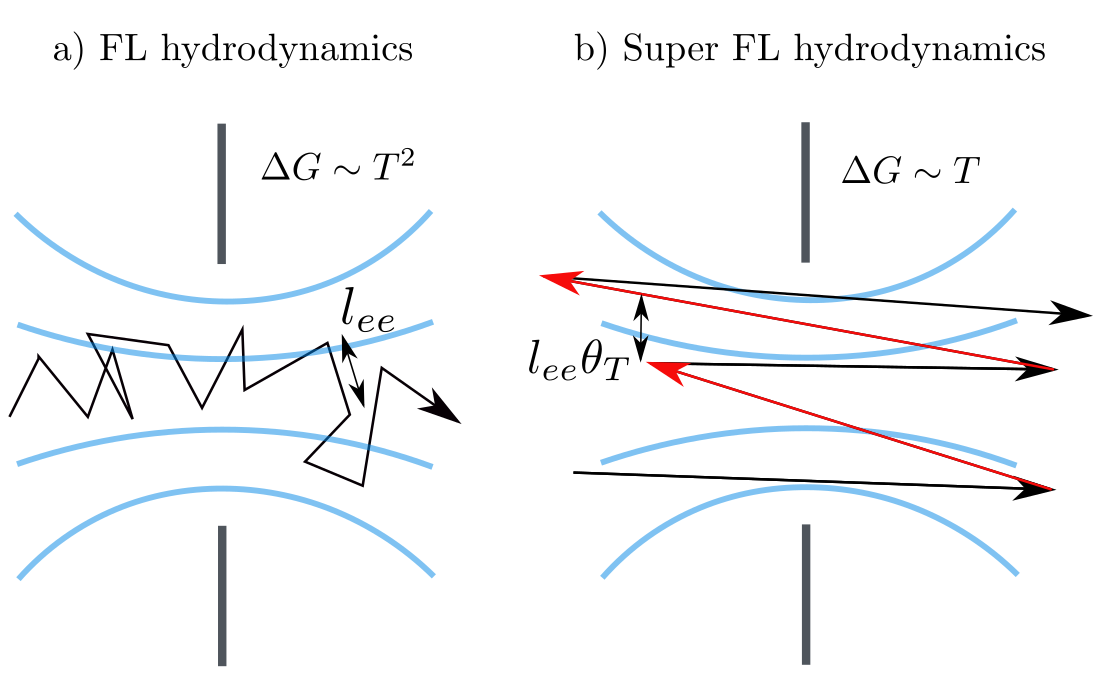
Linear temperature dependence of transport coefficients in metals is often ascribed to non-Fermi-liquid physics. Here we demonstrate the $T$-linear behavior of nonlocal conductivity in a clean 2D electron fluid, where carrier collisions assist conduction and lead to hydrodynamic transport with conductance rather than resistance growing with temperature. The key aspect is the occurrence of multiple hydrodynamic modes representing odd-parity modulations of the Fermi surface evolving in space and time. A cascade of such modes results in a linear $T$ dependence that extends to lowest temperatures, as well as a Kolmogorov-like fractional power $-5/3$ scaling of conductivity vs. wavenumber. These dependences provide a smoking gun for nonclassical hydrodynamics driven by such modes, expected to be generic for 2D electron fluids with simple near-circular Fermi surfaces.
研究动机与目标
- 解释实验观测到的二维电子流体中电导率随温度线性依赖的现象,该现象违背了传统费米液体的预期。
- 确定具有简单费米表面的体系中T线性电导率的微观起源,挑战‘T线性电阻率意味着非费米液体物理’的假设。
- 确立多个长寿命粘性模式——特别是衰减速率为T⁴的奇宇称激发——主导一种与标准费米液体流体动力学不同的新型流体动力学区域。
- 推导二维电子流体中非局域电导率的闭式解,表明在无动量弛豫条件下σ(k) ∼ T/k⁵/³。
- 将波数中的分数幂律标度与T线性输运的出现联系起来,为流体动力学实验提供可检验的预测。
提出的方法
- 作者分析了二维电子流体中的线性化碰撞算符,区分了衰减速率分别为γ_even ∼ T²和γ_odd ∼ T⁴的偶宇称与奇宇称集体激发。
- 他们推导了包含通过函数u(m)(其中m为谐波阶数)的长寿命模式层次的修正流体动力学方程,以描述电导率响应。
- 关键步骤是通过变量替换g ∝ m³,将二阶微分方程转化为贝塞尔方程,从而以修正贝塞尔函数的形式获得解析解。
- 在高m值(m ≳ m⋆)处施加边界条件,此时系统过渡到单模粘性区域,确保物理一致性并消除非物理解。
- 对小g(对应小k)展开解,得到Γ(k) ∝ (γγ′)⁻¹/⁶ z¹/⁶,代入γ和γ′分别对应T²和T⁴的依赖关系后,可导出T线性电导率。
- 该模型预测非局域电导率σ(k) ∼ T/k⁵/³,其在远超粘性-弹道交叉尺度的广泛k范围内有效。
实验结果
研究问题
- RQ1在不依赖非费米液体或量子临界行为的前提下,二维电子流体中具有简单费米表面的体系能否出现T线性电导率?
- RQ2在无杂质或声子散射的情况下,电子流体动力学中观测到的T线性电导率的微观起源是什么?
- RQ3长寿命奇宇称激发(衰减速率为T⁴)如何促成电导率中分数幂律标度的出现?
- RQ4多个粘性模式在产生具有k⁻⁵/³依赖关系和T线性标度的非局域电导率中起什么作用?
- RQ5二维体系中的流体动力学响应与传统费米液体流体动力学有何不同,特别是在温度依赖性和非局域性方面?
主要发现
- 本文推导出二维电子流体的非局域电导率满足σ(k) ∼ T/k⁵/³,该关系在孔径几何结构中直接导致T线性电导率,与传统费米液体流体动力学的T²标度形成鲜明对比。
- T线性电导率源于长寿命奇宇称激发的集体响应,其衰减速率与T⁴成正比,且在低温下主导于衰减速率为T²的偶宇称模式。
- 流体动力学方程的解具有贝塞尔函数形式,修正贝塞尔函数I₅/₆与I₋₅/₆的比值确保了物理一致性,并在施加正确边界条件后产生T线性电导率。
- 该模型预测在T=0时电导率超过弹道极限,并随温度线性增长,与石墨烯和GaAs体系中近期的实验观测结果一致。
- T线性标度是一种非微扰效应,源于随温度降低而不断增长的软且长寿命模式的累积影响。
- 该结果在广泛的波数k范围内具有鲁棒性,延伸至粘性-弹道交叉尺度kℓₑₑ ∼ 1之外,并在如孔径等实际几何结构中成立。
![Figure 2: Decay rates for even and odd excitations, $\gamma_{m}$ , vs. harmonic order $m$ at different temperatures [ 38 , 41 ] . Even- $m$ and odd- $m$ rates are shown by orange and blue dots, respectively, for three different temperatures $T=0.1T_{F}$ $T^{\prime}=0.01T_{F}$ , $T^{\prime\prime}=0.0](https://ar5iv.labs.arxiv.org/html/2310.08556/assets/x1.png)
更好的研究,从现在开始
从阅读论文到最终审阅,大幅缩短您的研究时间。
无需绑定信用卡
本解读由 AI 生成,并经人工编辑审核。