
[Paper Review] Linking fast and slow: the case for generative models
This paper advocates for hierarchical generative models and Bayesian inference to link fast neuronal dynamics (ms-scale) with slow system-level changes (min-to-year scale), enabling mechanistic inference beyond correlations. By leveraging the slaving principle and variational Bayes, it provides a principled framework for multiscale neuroscience modeling, with demonstrated utility in epilepsy research and broader applicability to brain network dynamics.
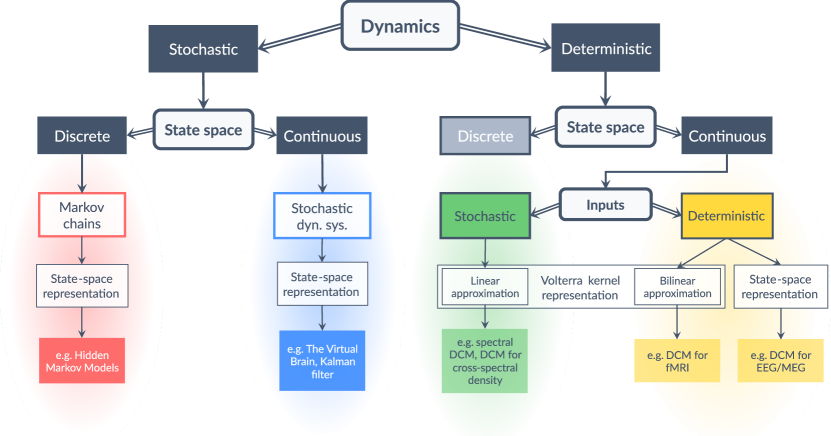
A pervasive challenge in neuroscience is testing whether neuronal connectivity changes over time due to specific causes, such as stimuli, events, or clinical interventions. Recent hardware innovations and falling data storage costs enable longer, more naturalistic neuronal recordings. The implicit opportunity for understanding the self-organised brain calls for new analysis methods that link temporal scales: from the order of milliseconds over which neuronal dynamics evolve, to the order of minutes, days, or even years over which experimental observations unfold. This review article demonstrates how hierarchical generative models and Bayesian inference help to characterise neuronal activity across different time scales. Crucially, these methods go beyond describing statistical associations among observations and enable inference about underlying mechanisms. We offer an overview of fundamental concepts in state-space modeling and suggest a taxonomy for these methods. Additionally, we introduce key mathematical principles that underscore a separation of temporal scales, such as the slaving principle, and review Bayesian methods that are being used to test hypotheses about the brain with multiscale data. We hope that this review will serve as a useful primer for experimental and computational neuroscientists on the state of the art and current directions of travel in the complex systems modelling literature.
Motivation & Objective
- To address the challenge of linking neuronal activity across multiple temporal scales in neuroscience, from milliseconds to years.
- To develop a systematic framework for evaluating neuroscientific hypotheses using multi-scale time series data.
- To enable inference about underlying mechanisms—not just statistical associations—by using generative models and Bayesian model comparison.
- To provide a practical, scalable method for modeling slow changes in brain connectivity using fast-scale dynamics as input.
- To demonstrate the utility of this approach in clinical neuroscience, particularly in epilepsy research, through the Virtual Epileptic Patient framework.
Proposed method
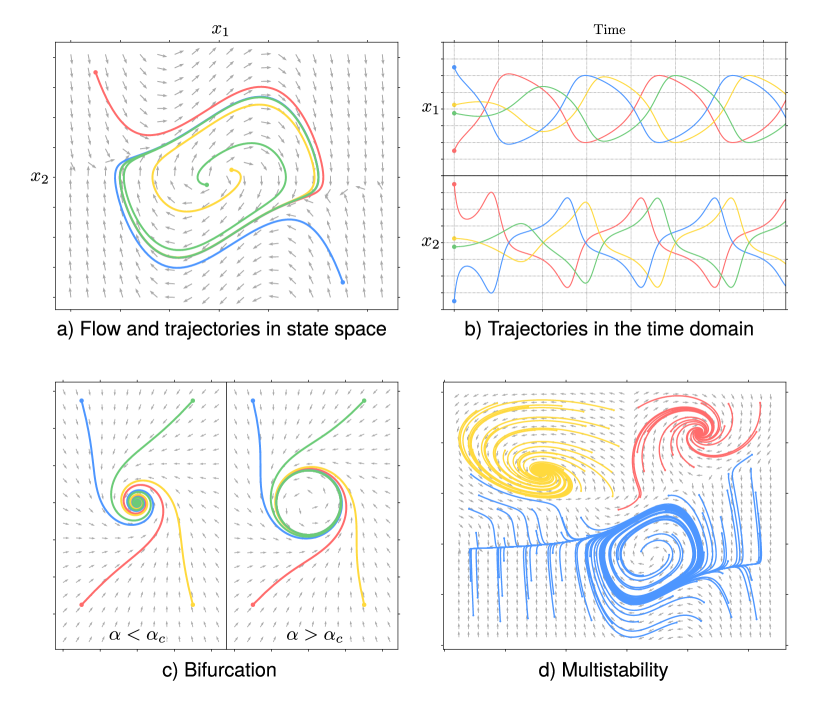
- Employing state-space models to represent latent neuronal dynamics, with continuous-time evolution equations and observation models incorporating measurement noise.
- Applying the slaving principle to separate fast and slow temporal scales, allowing independent modeling of each with hierarchical structure.
- Using variational Bayes to approximate the posterior distribution over model parameters, enabling inversion of complex hierarchical models.
- Implementing empirical Bayes to learn hyperpriors at intermediate levels, supporting model learning from data without strong prior assumptions.
- Constructing hierarchical models where fast-scale parameters (e.g., neural population activity) are treated as slow-changing observations for higher-level models.
- Using model evidence (approximated via variational free energy) to compare competing multiscale models and select the best-fitting hypothesis.
Experimental results
Research questions
- RQ1How can hierarchical generative models be used to link fast neuronal dynamics with slow system-level changes in brain connectivity?
- RQ2What mathematical principles justify separating temporal scales in multiscale brain modeling, and how can they be applied rigorously?
- RQ3How can Bayesian inference, particularly variational Bayes, be used to invert complex hierarchical models of multi-scale time series?
- RQ4What criteria should guide the decision to model multiple temporal scales, and how can model complexity be justified by data fit?
- RQ5How can generative models be used to uncover mechanistic explanations for state transitions in brain networks, such as in epilepsy?
Key findings
- The slaving principle enables rigorous separation of temporal scales, allowing fast and slow dynamics to be modeled independently while preserving their causal interdependence.
- Hierarchical generative models with Bayesian inversion allow for inference about underlying mechanisms, not just statistical associations, in multi-scale data.
- Variational Bayes with empirical Bayes provides a scalable and practical method for inverting complex hierarchical models of neuronal time series.
- Model evidence, approximated via variational free energy, offers a principled way to compare competing multiscale models and select the most plausible hypothesis.
- The approach has been successfully applied to epilepsy research through the Virtual Epileptic Patient, enabling personalized modeling of seizure dynamics.
- Extending hidden Markov models to include escape rates and continuous slow dynamics can link network attractor transitions to synaptic and predictive coding mechanisms.
Read this paper
Open the full text in the Nubint reader and ask about any passage as you read.
Read this paper on NubintThis review was generated by AI from the original paper. Please check the paper before citing it.