
[Paper Review] LISA: Learning Implicit Shape and Appearance of Hands
LISA is a neural implicit model for human hands that jointly learns accurate 3D shape, appearance, and pose from multi-view RGB videos with coarse 3D hand poses. By using per-bone signed distance fields and color predictions combined via learned skinning weights, LISA achieves state-of-the-art reconstruction quality from images and point clouds, with disentangled control over shape, color, and pose parameters.
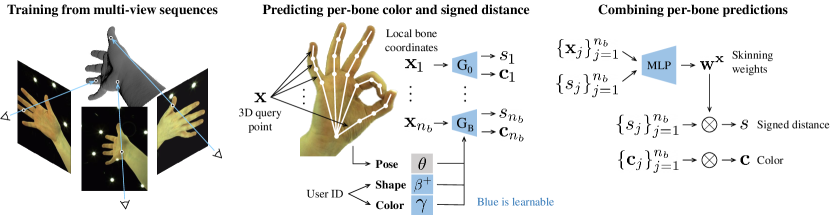
This paper proposes a do-it-all neural model of human hands, named LISA. The model can capture accurate hand shape and appearance, generalize to arbitrary hand subjects, provide dense surface correspondences, be reconstructed from images in the wild and easily animated. We train LISA by minimizing the shape and appearance losses on a large set of multi-view RGB image sequences annotated with coarse 3D poses of the hand skeleton. For a 3D point in the hand local coordinate, our model predicts the color and the signed distance with respect to each hand bone independently, and then combines the per-bone predictions using predicted skinning weights. The shape, color and pose representations are disentangled by design, allowing to estimate or animate only selected parameters. We experimentally demonstrate that LISA can accurately reconstruct a dynamic hand from monocular or multi-view sequences, achieving a noticeably higher quality of reconstructed hand shapes compared to baseline approaches. Project page: https://www.iri.upc.edu/people/ecorona/lisa/.
Motivation & Objective
- To develop a neural implicit model that captures detailed hand shape and appearance across diverse subjects.
- To enable accurate 3D hand reconstruction from monocular or multi-view images in the wild, even with partial occlusion.
- To provide dense surface correspondences via explicitly predicted skinning weights for improved animation and control.
- To disentangle shape, color, and pose representations for fine-grained manipulation and generalization.
- To outperform existing parametric mesh and implicit models in reconstruction accuracy on both synthetic and real-world data.
Proposed method
- Leverages a multi-view RGB video dataset with coarse 3D hand skeleton annotations for end-to-end training.
- Represents the hand as a collection of rigid bones, with each bone having an independent neural network predicting SDF and color in its local coordinate system.
- Uses predicted skinning weights to combine per-bone SDF and color predictions into a unified implicit representation.
- Optimizes shape and appearance losses during training using a differentiable rendering pipeline.
- Employs a two-stage optimization: first refining 3D pose, then jointly optimizing shape, pose, and color parameters.
- Reconstructs high-resolution meshes at 128³ resolution for visualization and rendering.
Experimental results
Research questions
- RQ1Can a neural implicit representation effectively model complex, articulated hand geometry and appearance with disentangled control?
- RQ2How well can such a model generalize to unseen hand subjects and arbitrary poses from unconstrained images?
- RQ3Can the model achieve superior reconstruction quality compared to parametric mesh models like MANO and implicit models like NARF or NASA?
- RQ4Does the use of per-bone predictions with learned skinning weights improve surface correspondence and reconstruction fidelity?
- RQ5To what extent can the model reconstruct hands from single images or in-the-wild scenarios with occlusions?
Key findings
- LISA achieves state-of-the-art performance in 3D hand reconstruction from point clouds, with sub-millimeter error in fitting to ground-truth scans.
- On the DeepHandMesh dataset, LISA-im outperforms all image-only baselines in shape reconstruction, with PSNR of 27.45 (1 view), 28.40 (2 views), and 28.27 (4 views).
- In color reconstruction from InterHand2.6M images, LISA-full achieves PSNR of 28.27, SSIM of 0.96, and LPIPS of 0.05, outperforming NASA and NARF in perceptual quality.
- LISA enables high-fidelity in-the-wild reconstructions, successfully handling partial occlusions and complex lighting conditions.
- The model achieves high-quality novel view rendering in approximately one minute per view on a single P100 GPU.
- LISA’s disentangled representation allows independent manipulation of shape, color, and pose, enabling precise control and animation.
Read this paper
Open the full text in the Nubint reader and ask about any passage as you read.
Read this paper on NubintThis review was generated by AI from the original paper. Please check the paper before citing it.