
[Paper Review] Listen, Think, and Understand
LTU is a multimodal audio foundation model that combines a strong audio perception encoder with an open-source LLM to enable both audio understanding and emergent audio reasoning, trained on a large OpenAQA-5M dataset of audio question-answer pairs.
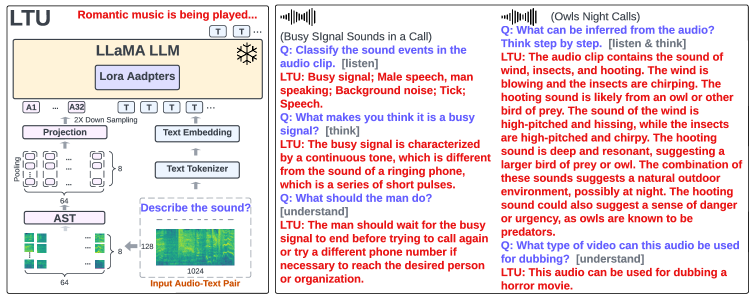
The ability of artificial intelligence (AI) systems to perceive and comprehend audio signals is crucial for many applications. Although significant progress has been made in this area since the development of AudioSet, most existing models are designed to map audio inputs to pre-defined, discrete sound label sets. In contrast, humans possess the ability to not only classify sounds into general categories, but also to listen to the finer details of the sounds, explain the reason for the predictions, think about what the sound infers, and understand the scene and what action needs to be taken, if any. Such capabilities beyond perception are not yet present in existing audio models. On the other hand, modern large language models (LLMs) exhibit emerging reasoning ability but they lack audio perception capabilities. Therefore, we ask the question: can we build a model that has both audio perception and a reasoning ability? In this paper, we propose a new audio foundation model, called LTU (Listen, Think, and Understand). To train LTU, we created a new OpenAQA-5M dataset consisting of 1.9 million closed-ended and 3.7 million open-ended, diverse (audio, question, answer) tuples, and have used an autoregressive training framework with a perception-to-understanding curriculum. LTU demonstrates strong performance and generalization ability on conventional audio tasks such as classification and captioning. More importantly, it exhibits emerging audio reasoning and comprehension abilities that are absent in existing audio models. To the best of our knowledge, LTU is one of the first multimodal large language models that focus on general audio (rather than just speech) understanding.
Motivation & Objective
- Motivate building AI systems that go beyond audio perception to reasoning about sounds and scenes.
- Integrate a high-performance audio perception module with a large language model for unified audio understanding and reasoning.
- Create a large, diverse audio QA dataset (OpenAQA-5M) to train an audio-grounded instruction-following model.
- Show that LTU can perform both traditional audio tasks (classification, captioning) and emergent audio reasoning.
- Provide a training curriculum (perception-to-understanding) to guide learning from perception to reasoning.
Proposed method
- Use Audio Spectrogram Transformer (AST) as the audio encoder, finetuned on AudioSet-2M, projecting to 4096-dim to match LLaMA embeddings.
- Attach LoRA adapters to LLaMA’s self-attention layers to enable efficient fine-tuning with a small parameter budget (4.2M).
- Combine 32 audio embeddings with text embeddings to form LTU input for the LLaMA-based language model.
- Train LTU with a perception-to-understanding curriculum across stages, starting from closed-ended tasks and progressively including open-ended QA.
- Generate OpenAQA-5M via audios relabeled from eight datasets and GPT-assisted Audio Instruction Generation (AIG) to produce diverse audio QA pairs.
- Optimize training with next-token prediction conditioned on past tokens and the reference audio; use generation settings (temperature 0.1, TopK 500, TopP 0.95).
Experimental results
Research questions
- RQ1Can a single model simultaneously perceive general audio events and perform reasoning about audio scenes?
- RQ2Does integrating an audio encoder with an LLM enable open-ended audio question answering with factual correctness and instruction following?
- RQ3What data and curriculum are needed to train an audio-focused multimodal LLM effectively?
- RQ4How does LTU perform on traditional audio tasks versus emergent audio reasoning tasks?
- RQ5Is LTU capable of avoiding hallucinations and refusing unanswerable questions when appropriate?
Key findings
- LTU outperforms conventional audio-text CLAP on 8 classification benchmarks with an average relative improvement of 23.6%.
- LTU is competitive with state-of-the-art captioning models on AudioCaps and Clotho as measured by SPICE, despite training on more diverse data.
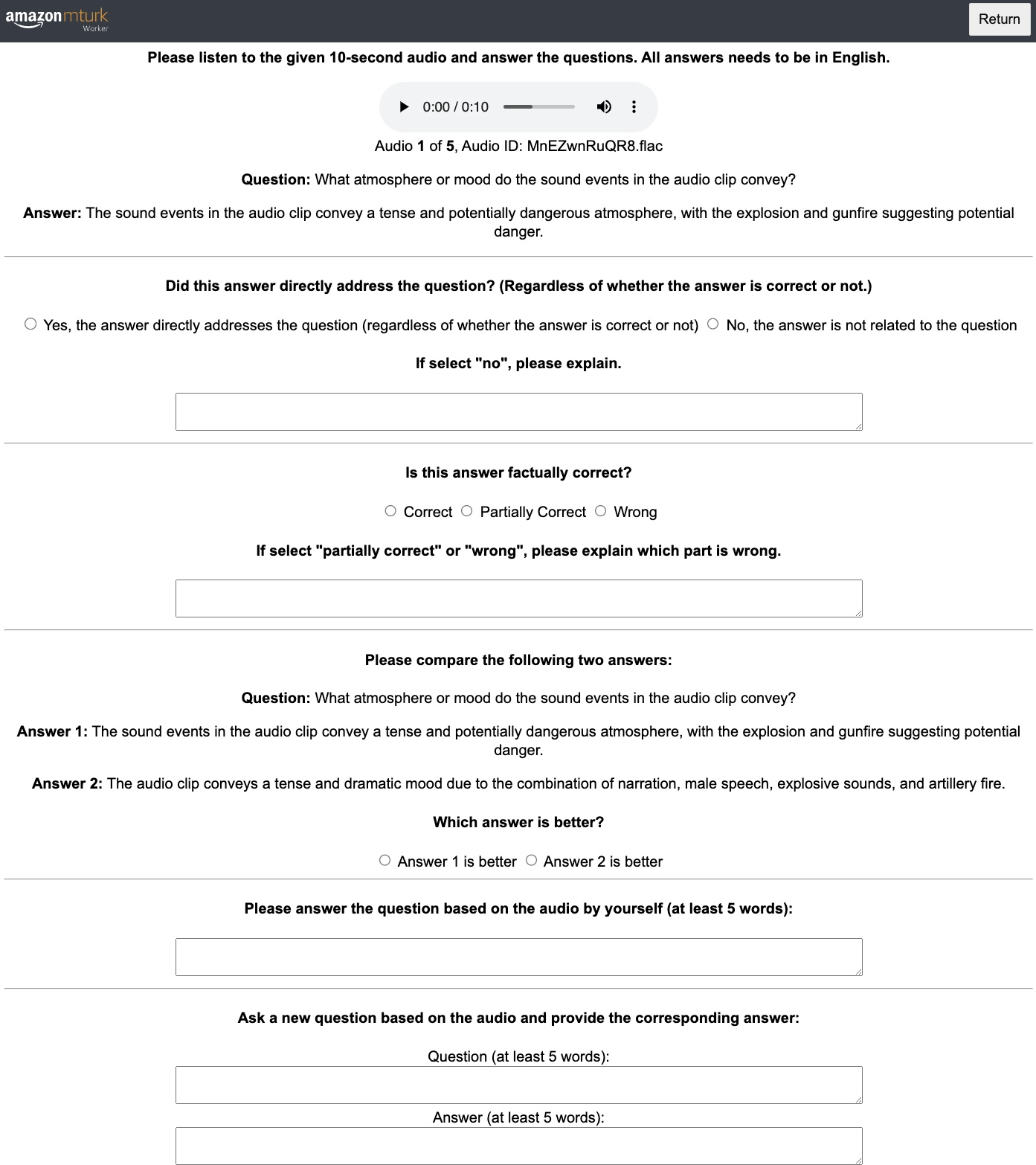
- LTU demonstrates emerging audio reasoning and comprehension abilities, including open-ended question answering with an instruction-following rate around 82.9% factual correctness in human evaluation.
- LTU directly outputs text labels without a predefined label set at inference and shows strong generalization across unseen datasets and tasks.
- A perception-to-understanding curriculum is crucial; removing it significantly degrades performance, and a frozen LLaMA with LoRA adapters enables effective audio grounding without catastrophic forgetting.
Read this paper
Open the full text in the Nubint reader and ask about any passage as you read.
Read this paper on NubintThis review was generated by AI from the original paper. Please check the paper before citing it.