
[Paper Review] LIVABLE: Exploring Long-Tailed Classification of Software Vulnerability Types
LIVABLE is a novel GNN-based approach for long-tailed classification of software vulnerability types, addressing over-smoothing and class imbalance through a differentiated propagation mechanism and adaptive re-weighting loss. It achieves 24.18% higher accuracy than state-of-the-art methods on the Fan et al. dataset and improves tail-class prediction by 7.7%.
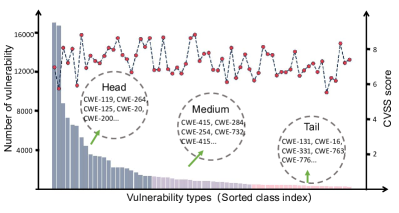
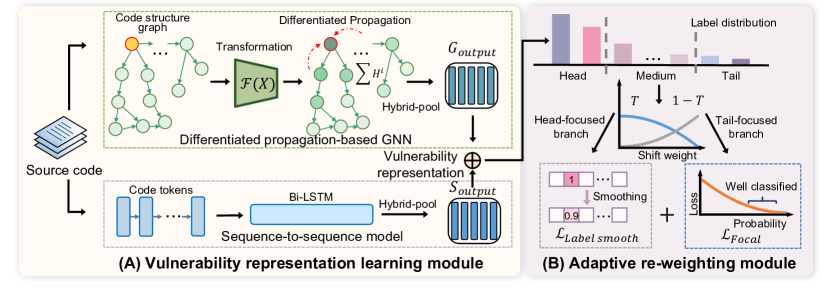
Prior studies generally focus on software vulnerability detection and have demonstrated the effectiveness of Graph Neural Network (GNN)-based approaches for the task. Considering the various types of software vulnerabilities and the associated different degrees of severity, it is also beneficial to determine the type of each vulnerable code for developers. In this paper, we observe that the distribution of vulnerability type is long-tailed in practice, where a small portion of classes have massive samples (i.e., head classes) but the others contain only a few samples (i.e., tail classes). Directly adopting previous vulnerability detection approaches tends to result in poor detection performance, mainly due to two reasons. First, it is difficult to effectively learn the vulnerability representation due to the over-smoothing issue of GNNs. Second, vulnerability types in tails are hard to be predicted due to the extremely few associated samples.To alleviate these issues, we propose a Long-taIled software VulnerABiLity typE classification approach, called LIVABLE. LIVABLE mainly consists of two modules, including (1) vulnerability representation learning module, which improves the propagation steps in GNN to distinguish node representations by a differentiated propagation method. A sequence-to-sequence model is also involved to enhance the vulnerability representations. (2) adaptive re-weighting module, which adjusts the learning weights for different types according to the training epochs and numbers of associated samples by a novel training loss.
Motivation & Objective
- Address the long-tailed distribution of software vulnerability types, where few classes (tails) have minimal samples but high severity.
- Overcome the over-smoothing issue in GNNs that degrades node representation learning in deep architectures.
- Improve classification performance for rare (tail) vulnerability types, which are often overlooked by standard models.
- Develop a unified framework that enhances both vulnerability type classification and detection performance under long-tailed data settings.
- Enable more effective vulnerability triage and remediation by accurately identifying high-severity, low-frequency vulnerability types.
Proposed method
- Propose a differentiated GNN propagation mechanism that adjusts message passing based on node centrality and local structure to reduce over-smoothing.
- Integrate a sequence-to-sequence model to enrich vulnerability representations by capturing sequential patterns in code tokens.
- Design an adaptive re-weighting module that dynamically adjusts loss weights based on class frequency and training epoch to prioritize tail classes.
- Formulate a novel training loss function that combines class frequency and model confidence to reduce bias toward head classes.
- Combine the enhanced GNN representations with the adaptive re-weighting strategy to jointly optimize for both representation learning and long-tailed classification.
- Evaluate the framework on real-world datasets, including the Fan et al. benchmark, using standard metrics like accuracy and F1-score for tail and head classes.
Experimental results
Research questions
- RQ1How does the long-tailed distribution of vulnerability types affect the performance of existing GNN-based vulnerability detection models?
- RQ2Can a differentiated GNN propagation strategy effectively mitigate over-smoothing and improve node representation learning in vulnerability graphs?
- RQ3To what extent can adaptive re-weighting based on class frequency and training progress improve the classification of rare (tail) vulnerability types?
- RQ4Does the proposed LIVABLE framework outperform state-of-the-art methods in both vulnerability type classification and end-to-end vulnerability detection tasks?
- RQ5How does the model perform specifically on high-severity, low-frequency vulnerability types such as CWE-507 and CWE-912?
Key findings
- LIVABLE achieves a 24.18% absolute improvement in overall accuracy over state-of-the-art methods on the Fan et al. dataset for vulnerability type classification.
- The model improves tail-class prediction accuracy by 7.7%, demonstrating significant gains in identifying high-severity, low-frequency vulnerabilities.
- The vulnerability representation learning module enhances baseline models by 4.03% on average in accuracy across three benchmark datasets.
- Ablation studies confirm that both the differentiated GNN propagation and adaptive re-weighting components are essential for performance gains.
- The average CVSS score of tail classes is 7.01, indicating high severity, and LIVABLE effectively identifies these critical vulnerabilities.
- The framework is effective across multiple programming languages and generalizes well to unseen vulnerability types, as shown in cross-dataset evaluations.
Read this paper
Open the full text in the Nubint reader and ask about any passage as you read.
Read this paper on NubintThis review was generated by AI from the original paper. Please check the paper before citing it.