
[Paper Review] LiveCodeBench: Holistic and Contamination Free Evaluation of Large Language Models for Code
LiveCodeBench provides a contamination-free, holistic evaluation of code-focused LLMs across four scenarios (code generation, self-repair, code execution, test output prediction) using problems from LeetCode, AtCoder, and CodeForces, benchmarking 9 base and 20 instruction-tuned models and exposing contamination and overfitting phenomena.
Large Language Models (LLMs) applied to code-related applications have emerged as a prominent field, attracting significant interest from both academia and industry. However, as new and improved LLMs are developed, existing evaluation benchmarks (e.g., HumanEval, MBPP) are no longer sufficient for assessing their capabilities. In this work, we propose LiveCodeBench, a comprehensive and contamination-free evaluation of LLMs for code, which continuously collects new problems over time from contests across three competition platforms, namely LeetCode, AtCoder, and CodeForces. Notably, our benchmark also focuses on a broader range of code related capabilities, such as self-repair, code execution, and test output prediction, beyond just code generation. Currently, LiveCodeBench hosts four hundred high-quality coding problems that were published between May 2023 and May 2024. We have evaluated 18 base LLMs and 34 instruction-tuned LLMs on LiveCodeBench. We present empirical findings on contamination, holistic performance comparisons, potential overfitting in existing benchmarks as well as individual model comparisons. We will release all prompts and model completions for further community analysis, along with a general toolkit for adding new scenarios and model
Motivation & Objective
- Address limitations of existing code benchmarks (contamination, narrow focus on NL-to-code)
- Propose a live-updating, contamination-free evaluation framework
- Evaluate multiple code-centric capabilities beyond generation (self-repair, execution, test output)
- Curate a high-quality, diverse problem set with release dates and difficulty labels
- Provide comprehensive cross-model comparisons to reveal open vs. closed models and overfitting tendencies
Proposed method
- Live, time-stamped problem collection from three platforms to prevent contamination by evaluating models only on problems released after a model's cutoff date
- Holistic evaluation across four scenarios: code generation, self-repair, code execution, and test output prediction with Pass@1 and execution-based metrics
- Data collection via HTML scrapers, extracting problem P, test cases T, and ground truth S, plus contest release date D to enable time-window scrolling
- Scenario-specific prompts and evaluation: zero-shot or few-shot prompts for generation; error feedback for self-repair; few-shot prompts with or without chain-of-thought for code execution; zero-shot prompts for test output prediction
- Balanced benchmark construction with difficulty tagging (Easy/Medium/Hard) and a final dataset of 400 problems from LeetCode, AtCoder, CodeForces
- Platform-specific curation protocols (LeetCode weekly/biweekly contests, AtCoder abc rounds with ≤500 rating, CodeForces Division 3/4) and post-processing to ensure testability and quality
Experimental results
Research questions
- RQ1How does data contamination affect LLM evaluation on code benchmarks?
- RQ2Do holistic, multi-scenario evaluations reveal different model strengths and weaknesses compared to generation-only benchmarks?
- RQ3What are the relative performances of open-access versus closed-access models across diverse code tasks under contamination-free conditions?
- RQ4Is there evidence of overfitting to existing benchmarks like HumanEval when evaluated on LiveCodeBench?
- RQ5How do instruction-tuned models compare to base models across generation, repair, execution, and test-output prediction tasks?
Key findings
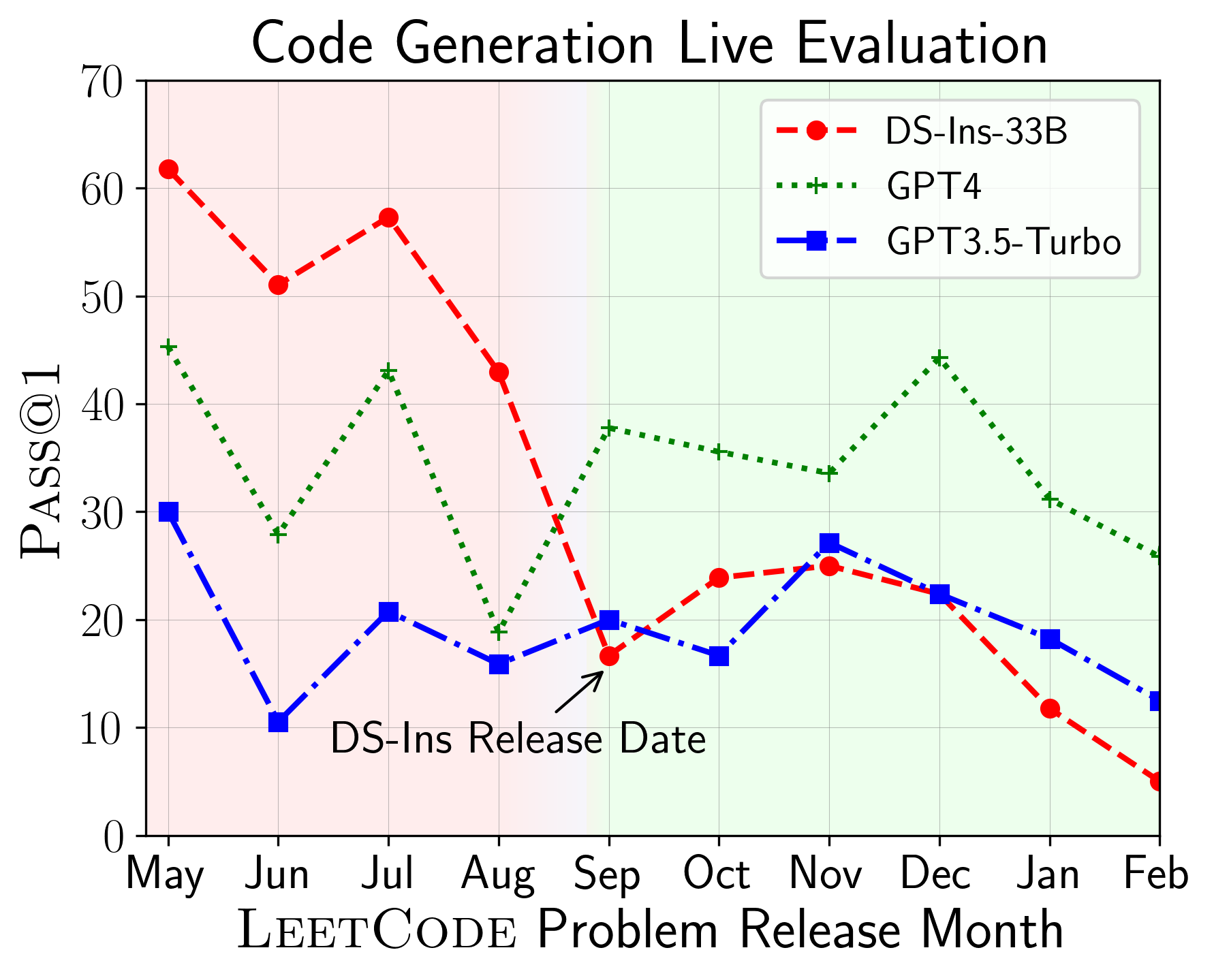
- Contamination is evident: model performance on LeetCode problems released after a cutoff date drops for older models (e.g., DeepSeek/DS-Ins-33B).
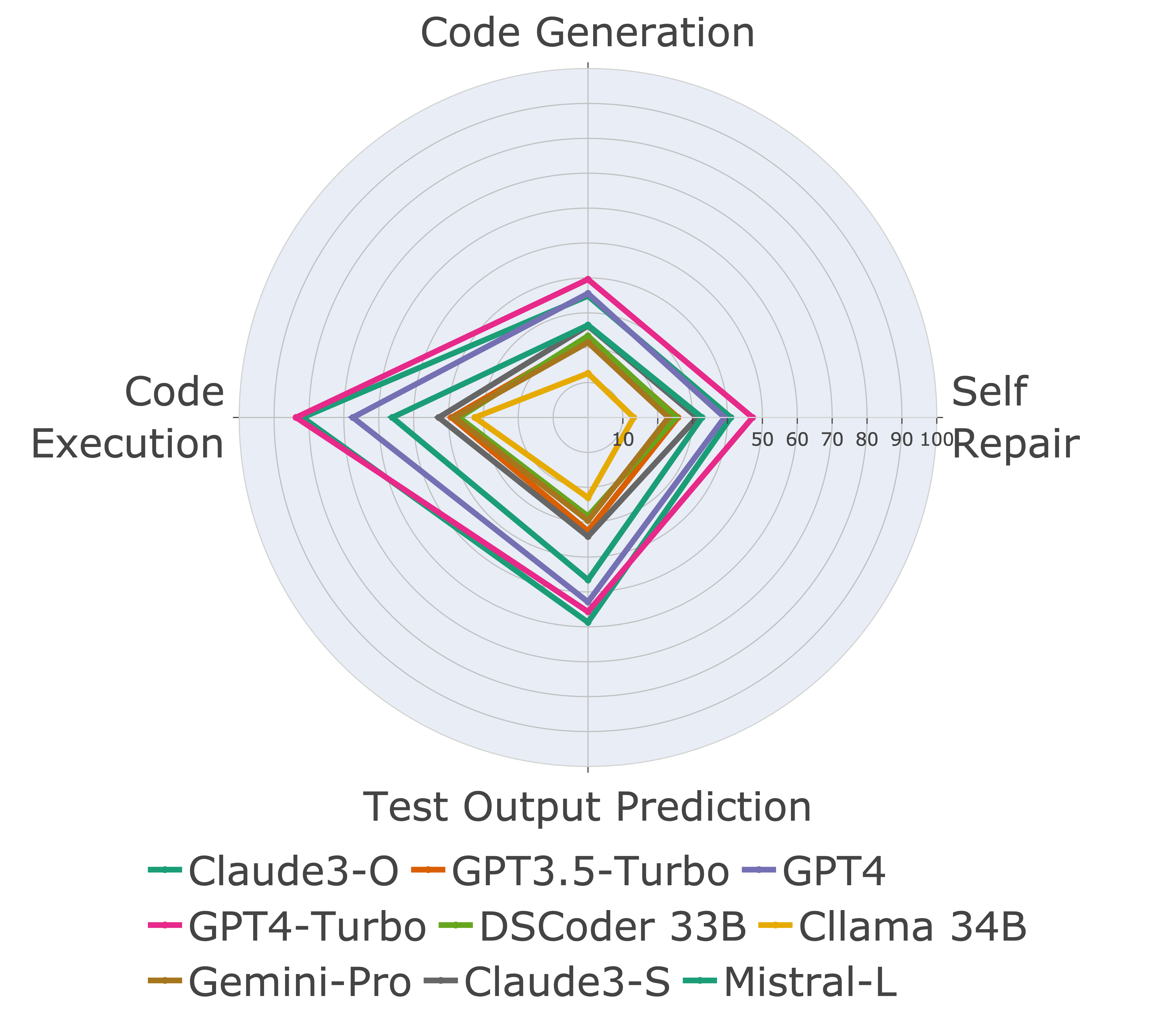
- Holistic evaluation shows model performance correlations across tasks but with varying relative differences; GPT-4-Turbo leads in several tasks and certain models excel in specific scenarios (e.g., Claude-3-Opus and Mistral-L with code execution and test output prediction).
- HumanEval overfitting is suggested by two clusters of models: those performing well on HumanEval+ but not on LiveCodeBench; green cluster (base/closed models) aligns with LiveCodeBench, red cluster (fine-tuned open models) does not.
- Open vs closed models: closed API models generally outperform open models; only strong instruction-tuned open models (e.g., DS-Ins-33B, Phind-34B) close the gap.
- GPT-4 and GPT-4-Turbo achieve strong performance across scenarios, with larger margins over other models; base DeepSeek, CodeLLaMa, and StarCoder2 show varied strengths, with DS-Base-6.7B outperforming some larger open models.
- Instruction tuning yields consistent gains on both HumanEval+ and LiveCodeBench (e.g., DS-Ins-33B, Phind-34B) compared to their base variants.
Read this paper
Open the full text in the Nubint reader and ask about any passage as you read.
Read this paper on NubintThis review was generated by AI from the original paper. Please check the paper before citing it.