
[Paper Review] LLaVA-Interactive: An All-in-One Demo for Image Chat, Segmentation, Generation and Editing
LLaVA-Interactive is an open-source, cost-efficient multimodal AI system that enables rich human-AI interaction through visual prompting, combining pre-trained models for image chat, segmentation, and image generation/editing without additional training. It supports multi-turn dialogues with natural language and visual inputs like strokes, drag-and-drop, and bounding boxes, significantly improving intent understanding and interaction engagement compared to text-only models.
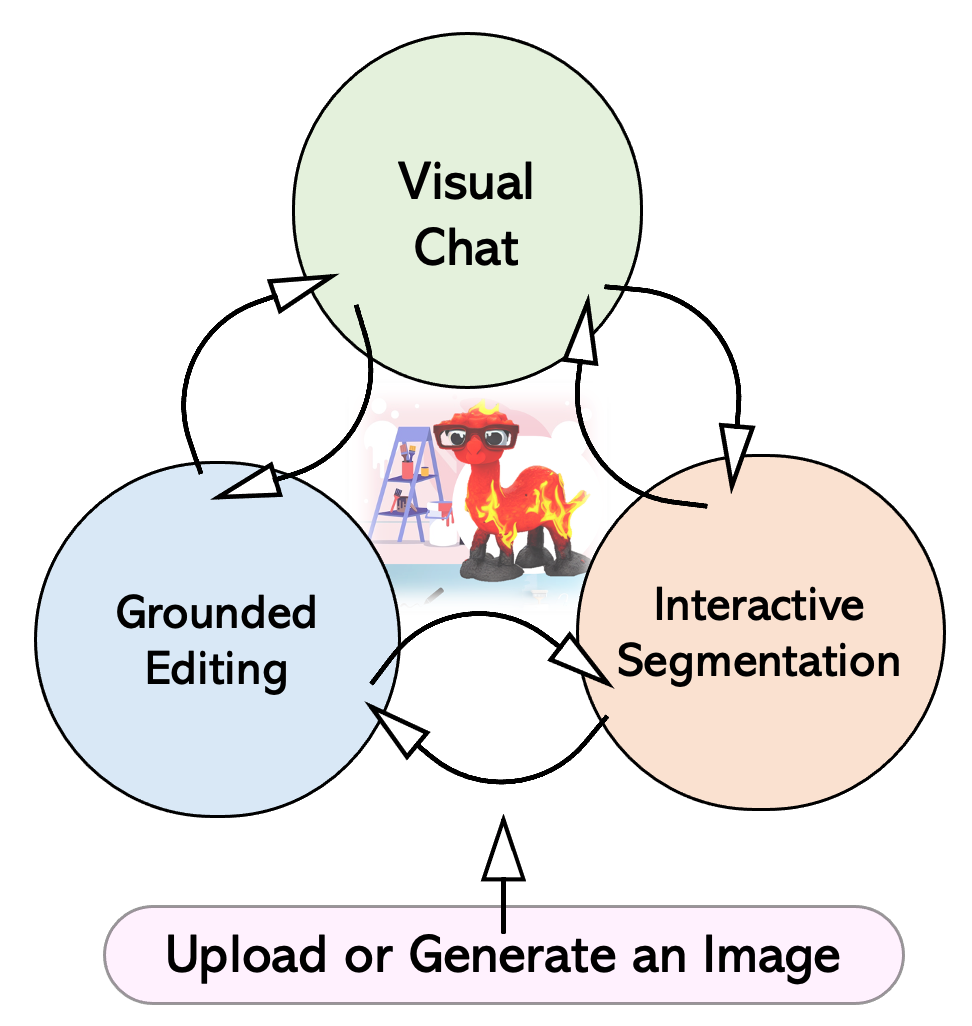
LLaVA-Interactive is a research prototype for multimodal human-AI interaction. The system can have multi-turn dialogues with human users by taking multimodal user inputs and generating multimodal responses. Importantly, LLaVA-Interactive goes beyond language prompt, where visual prompt is enabled to align human intents in the interaction. The development of LLaVA-Interactive is extremely cost-efficient as the system combines three multimodal skills of pre-built AI models without additional model training: visual chat of LLaVA, image segmentation from SEEM, as well as image generation and editing from GLIGEN. A diverse set of application scenarios is presented to demonstrate the promises of LLaVA-Interactive and to inspire future research in multimodal interactive systems.
Motivation & Objective
- To develop a low-cost, open-source multimodal AI system that supports rich, interactive human-AI dialogue beyond text-only inputs.
- To enable visual prompting (e.g., drawing, dragging, bounding boxes) to express complex user intents in image editing, segmentation, and generation tasks.
- To integrate three pre-trained multimodal models—LLaVA for visual chat, SEEM for segmentation, and GLIGEN for image generation/editing—without additional training.
- To demonstrate the feasibility of a unified, interactive multimodal agent that bridges vision and language tasks in real-world scenarios.
- To inspire future research in general-purpose multimodal AI agents through a flexible, extensible, and publicly available framework.
Proposed method
- The system combines inference from three pre-trained models: LLaVA for multimodal understanding and dialogue, SEEM for instance segmentation, and GLIGEN for image generation and editing.
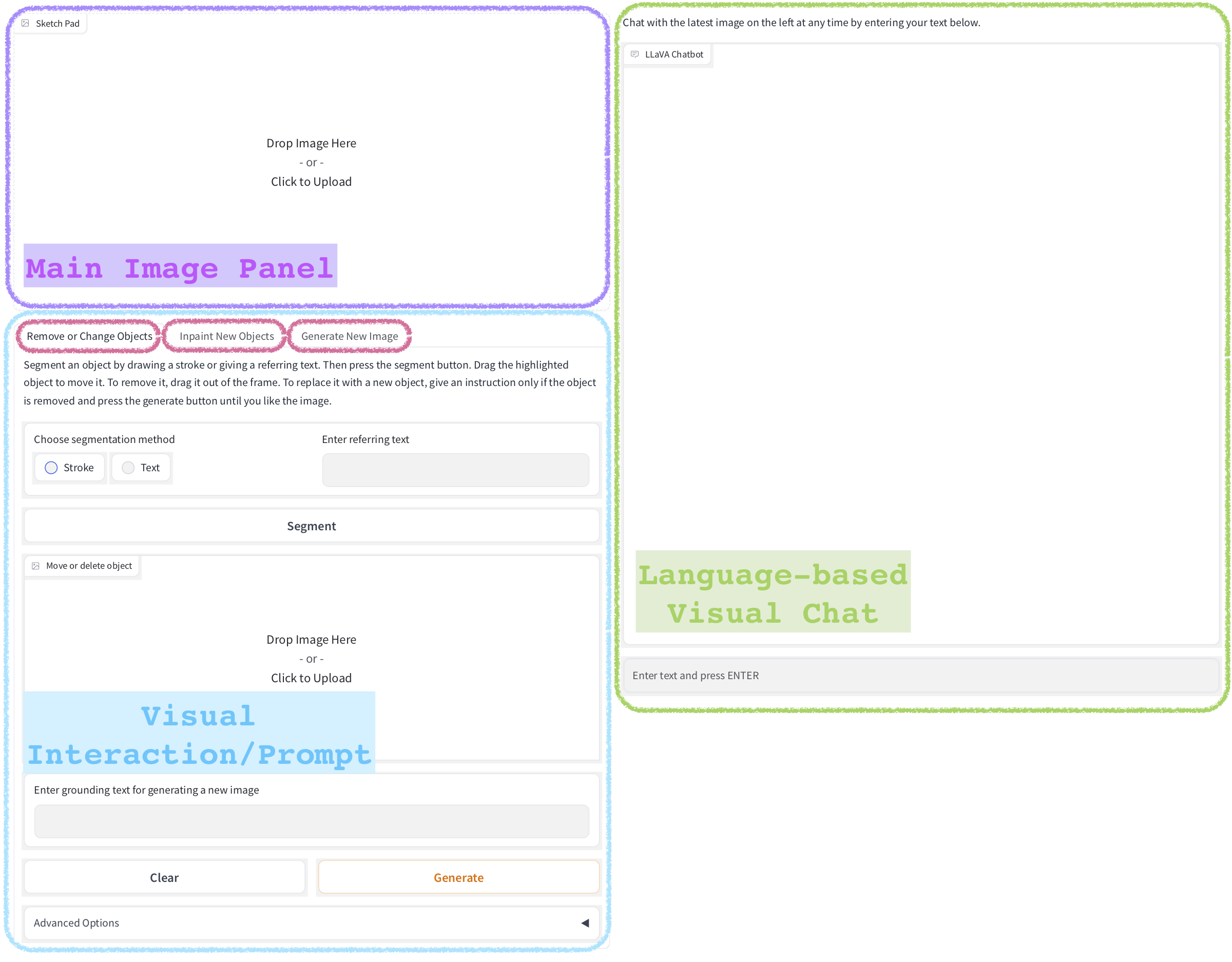
- Visual prompts such as strokes, drag-and-drop, and bounding boxes are used to specify user intent directly on the image, enabling precise control over segmentation and editing tasks.
- The interface is structured into three panels: a visual interaction panel for drawing and selecting objects, a chat panel for natural language interaction, and a result panel for displaying outputs.
- User actions are interpreted through grounding instructions and visual cues, which are mapped to the corresponding model APIs in real time.
- The system processes user inputs in a multi-turn dialogue flow, maintaining context across interactions and updating outputs dynamically.
- No model fine-tuning or prompt engineering is required; all functionality is achieved through orchestration of existing, pre-trained models.
Experimental results
Research questions
- RQ1Can a multimodal AI system effectively interpret and act on visual prompts such as strokes and bounding boxes to support complex image editing tasks?
- RQ2How does visual prompting improve user intent understanding and interaction engagement compared to text-only prompting in multimodal dialogue systems?
- RQ3To what extent can a system combining pre-trained models achieve rich, interactive capabilities without additional training?
- RQ4What are the practical application scenarios where visual prompting enhances the usability of multimodal AI agents?
- RQ5Can such a system serve as a viable, open-source alternative to proprietary models like GPT-4V for building interactive, multimodal agents?
Key findings
- LLaVA-Interactive successfully enables multi-turn, multimodal dialogues using both natural language and visual inputs, demonstrating enhanced user intent understanding.
- Visual prompting (e.g., drawing on objects, dragging segments) significantly improves precision and expressiveness in segmentation and editing tasks compared to text-only commands.
- The system achieves full functionality—image chat, segmentation, generation, and editing—by orchestrating three pre-trained models without any fine-tuning or additional training.
- Case studies in interior design and unusual object detection show that the system can interpret complex user requests and generate contextually appropriate, visually accurate outputs.
- The system demonstrates strong potential as a flexible, extensible framework for building future multimodal AI agents, particularly in creative and interactive domains.
- The open-source release of the codebase and demo enables community-driven innovation and further development of interactive multimodal systems.
Read this paper
Open the full text in the Nubint reader and ask about any passage as you read.
Read this paper on NubintThis review was generated by AI from the original paper. Please check the paper before citing it.